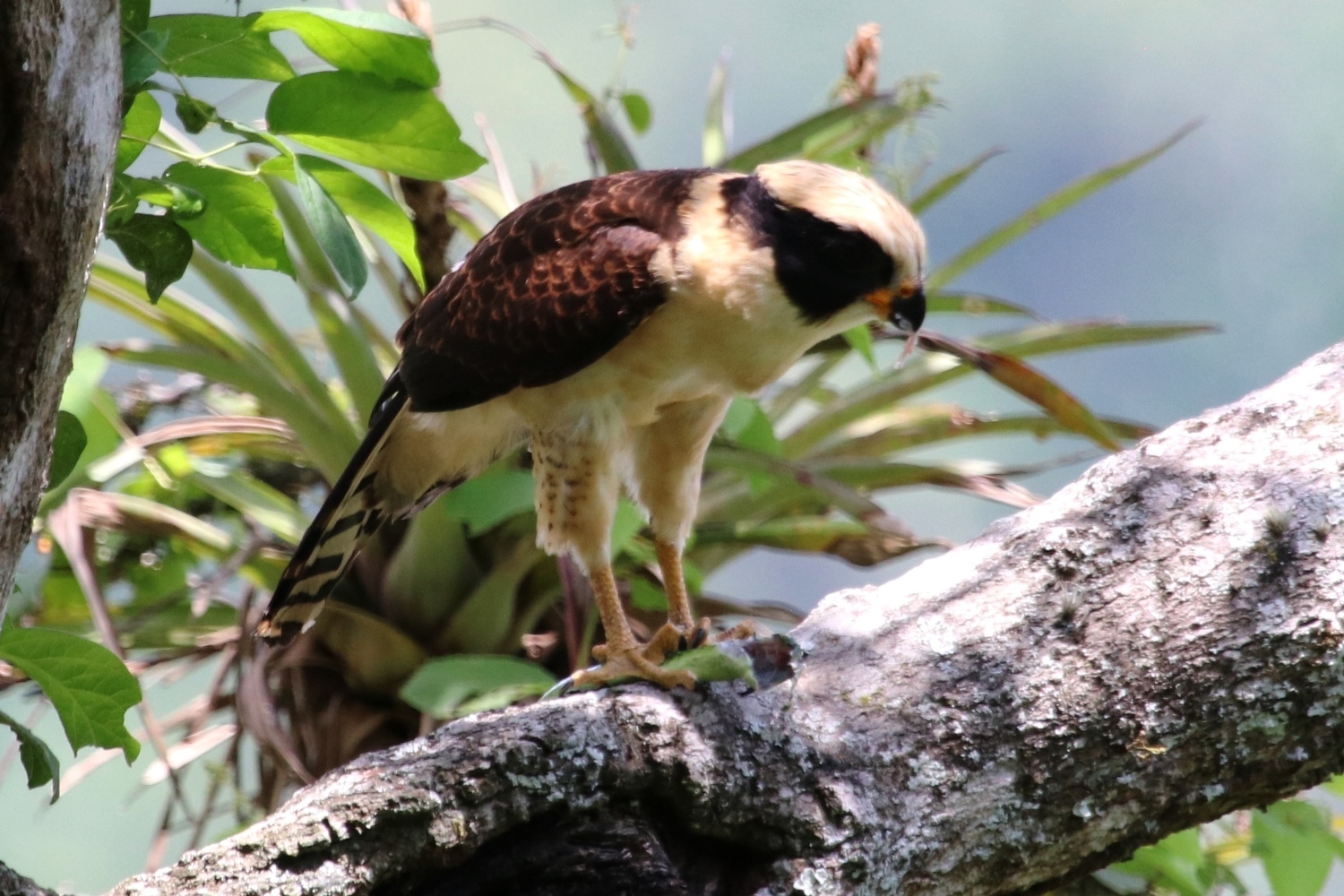
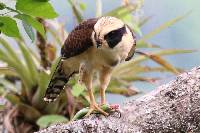
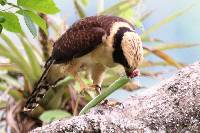
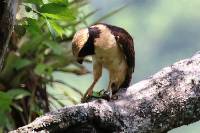
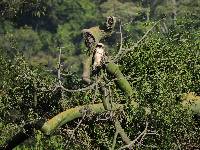
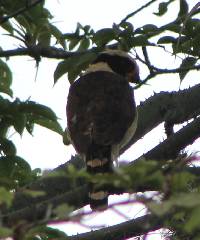
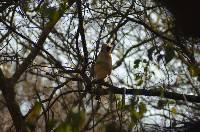
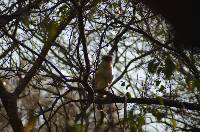
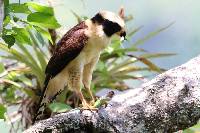
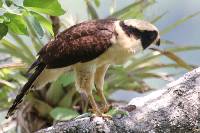
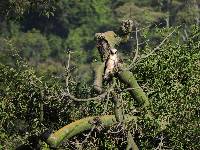
The laughing falcon (Herpetotheres cachinnans) is a medium-sized bird of prey in subfamily Herpetotherinae of family Falconidae, the falcons and caracaras. It is found from Mexico south through Central America and in every mainland South American country except Chile and Uruguay.
Taxonomy and systematics
The laughing falcon was formally described in 1758 by the Swedish naturalist Carl Linnaeus in the tenth edition of his Systema Naturae. He placed it with the falcons and eagles in the genus Falco and coined the binomial name Falco cachinnans. Linnaeus based his account on information from one of his students, Daniel Rolander, who had visited the Dutch colony of Surinam in South America. The laughing falcon is now the only species placed in the genus Herpetotheres that was introduced in 1817 by the French ornithologist Louis Vieillot. A 2015 molecular phylogenetic study by Jérôme Fuchs and collaborators found that the laughing falcon was sister to the forest falcons in the genus Micrastur.
Major taxonomic systems place the laughing falcon in the subfamily Herpetotherinae with the forest falcons. Earlier it had been placed in the subfamily Falconinae with the "true" falcons. Though up to six subspecies have been proposed, only two have widespread acceptance: the nominate H. c. cachinnans (Linnaeus, 1758) and H. c. fulvescens (Chapman, 1915).
The laughing falcon's generic name Herpetotheres refers to its preferred food; it is Latinized Ancient Greek, derived from erpeton (ἑρπετόν, "reptile") + therizein (θερίζειν, "to mow down"). Its English name comes from its loud voice, as does the specific epithet cachinnans, Latin for "laughing aloud" or "laughing immoderately".
Painting by Andrew Jackson Grayson
Description
The laughing falcon is 45 to 56 cm (18 to 22 in) long and has a wingspan of 79 to 94 cm (31 to 37 in). Females are slightly larger than males and significantly heavier. Males of the nominate subspecies weigh 408 to 686 g (0.9 to...