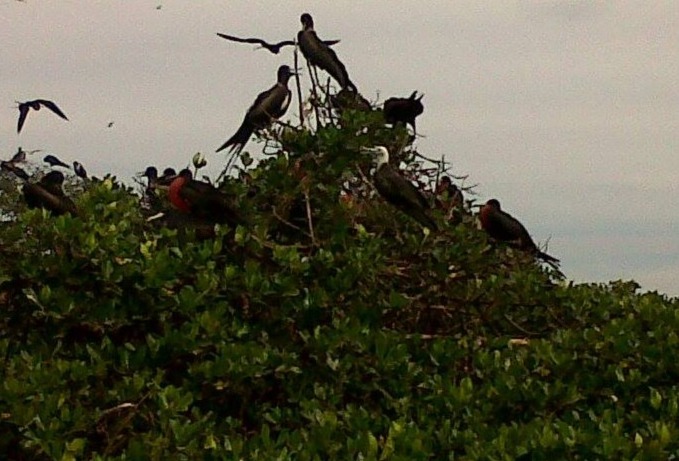
The magnificent frigatebird (Fregata magnificens), frigate petrel or man o' war is a seabird of the frigatebird family Fregatidae. With a length of 89–114 centimetres (2 ft 11 in – 3 ft 9 in) and wingspan of 2.17–2.44 m (7 ft 1 in – 8 ft 0 in), it is the largest species of frigatebird. It occurs over tropical and subtropical waters off America, between northern Mexico and Peru on the Pacific coast and between Florida and southern Brazil along the Atlantic coast. There are also populations on the Galápagos Islands in the Pacific and the Cape Verde islands in the Atlantic. It is one of the fastest birds in the world, flying at speeds of up to 153 kilometres (95 mi) per hour.
The magnificent frigatebird is a large, lightly built seabird with brownish-black plumage, long narrow wings and a deeply forked tail. The male has a striking red gular sac which he inflates to attract a mate. The female is slightly larger than the male and has a white breast and belly. Frigatebirds feed on fish taken in flight from the ocean's surface (often flying fish), and sometimes indulge in kleptoparasitism, harassing other birds to force them to regurgitate their food.
Taxonomy
The magnificent frigatebird was originally considered to belong to the species Fregata aquila but in 1914 the Australian ornithologist Gregory Mathews proposed that the magnificent frigatebird should be considered as a separate species with the binomial name Fregata magnificens. Of the four other species within the genus Fregata, genetic analysis has shown that the magnificent frigatebird is most closely related to the Ascension frigatebird (Fregata aquila).
There are two subspecies:
F. m. magnificens - breeds on the Galápagos Islands
F. m. rothschildi - breeds on islands off the Pacific coast of Mexico and Central America, the tropical Atlantic from Florida south to Brazil, and on the Cape Verde islands (where almost extirpated)
Prior to 2022, both these subspecies were considered synonymous...