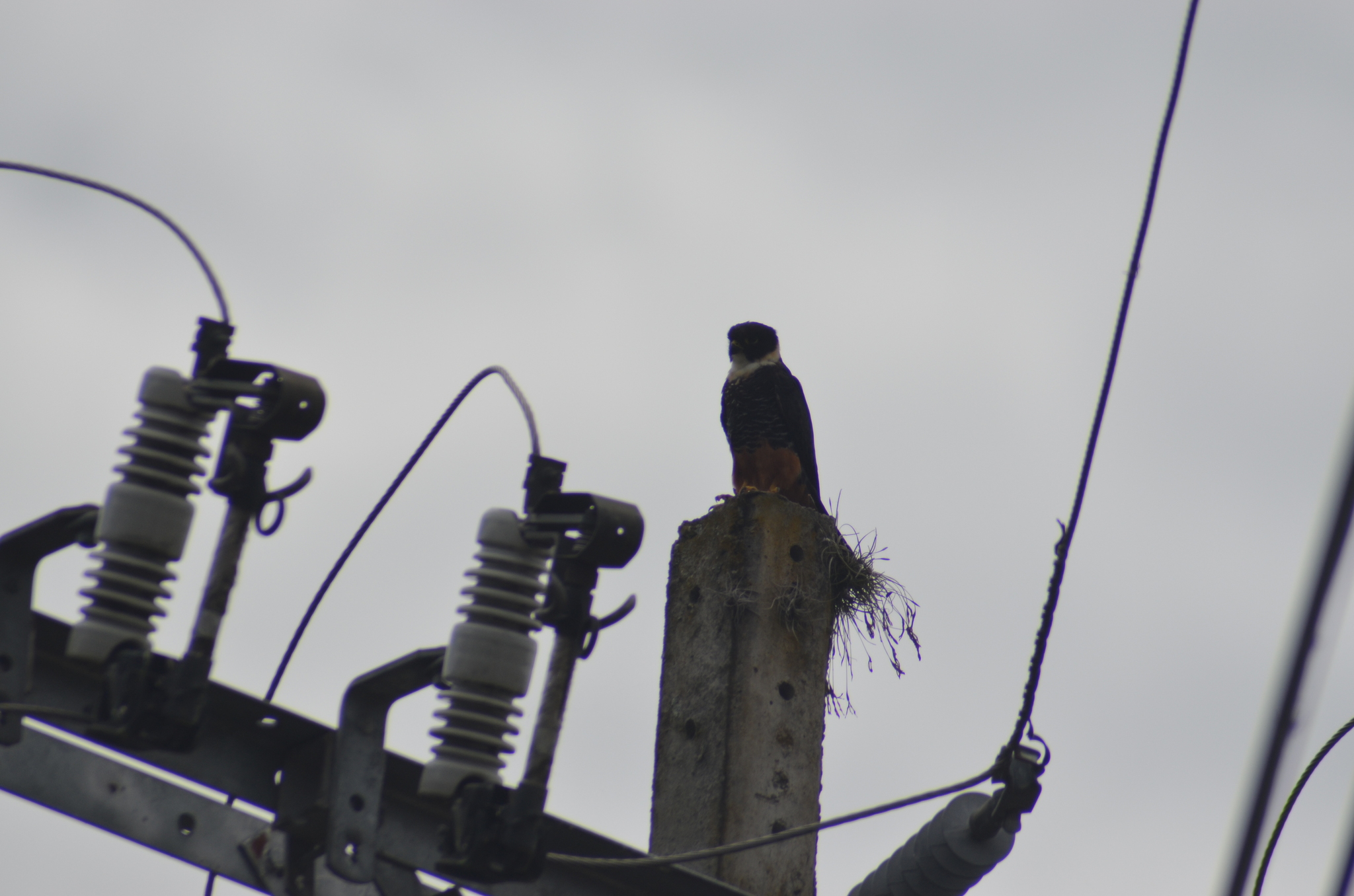
The bat falcon (Falco rufigularis) is a bird of prey in the family Falconidae, the falcons and caracaras. It is found in Mexico, Central America, Trinidad, and every mainland South American country except Chile and Uruguay.
Taxonomy and systematics
The bat falcon was long known as Falco albigularis; the names Falco fusco-coerulescens or Falco fuscocaerulescens, long used for the aplomado falcon (F. femoralis), are now believed to refer to the present species.
The bat falcon has these three subspecies:
F. r. petoensis Chubb, 1918
F. r. rufigularis Daudin, 1800
F. r. ophryophanes (Salvadori, 1895)
Some authors maintain that F. r. petoensis and F. r. ophryophanes are not subspecies but clinal variations in plumage. Others add a fourth subspecies F. r. petrophilus that is usually included in petoensis. Yet others assign only two subspecies, the nominate F. r. rufigularis and F. r. petrophilus.
The bat falcon is closely related to and looks like a small version of the orange-breasted falcon (F. deiroleucus), with which it has often been misidentified. They share plumage and vocal characteristics and are sister species. These two had been thought to be closely related to the aplomado falcon (F. femoralis), but more recent genetic evidence shows they are more closely related to the Old World hobbies than to any other New World falcon.
Description
The bat falcon is 23 to 30 cm (9.1 to 12 in) long. Males weigh 108 to 150 g (3.8 to 5.3 oz) and have a wingspan of 51 to 58 cm (20 to 23 in). Females weigh 177 to 242 g (6.2 to 8.5 oz) and have a wingspan of 65 to 67 cm (26 to 26 in). They have long wings and a longish tail with a square tip. The sexes have similar plumage. Adults have blue-black head and upperparts with grayish edges on the feathers from the upper back to the uppertail coverts. Their throat, upper breast, and sides of the neck are white to buff, sometimes with some cinnamon; the rest of their breast is black with fine...