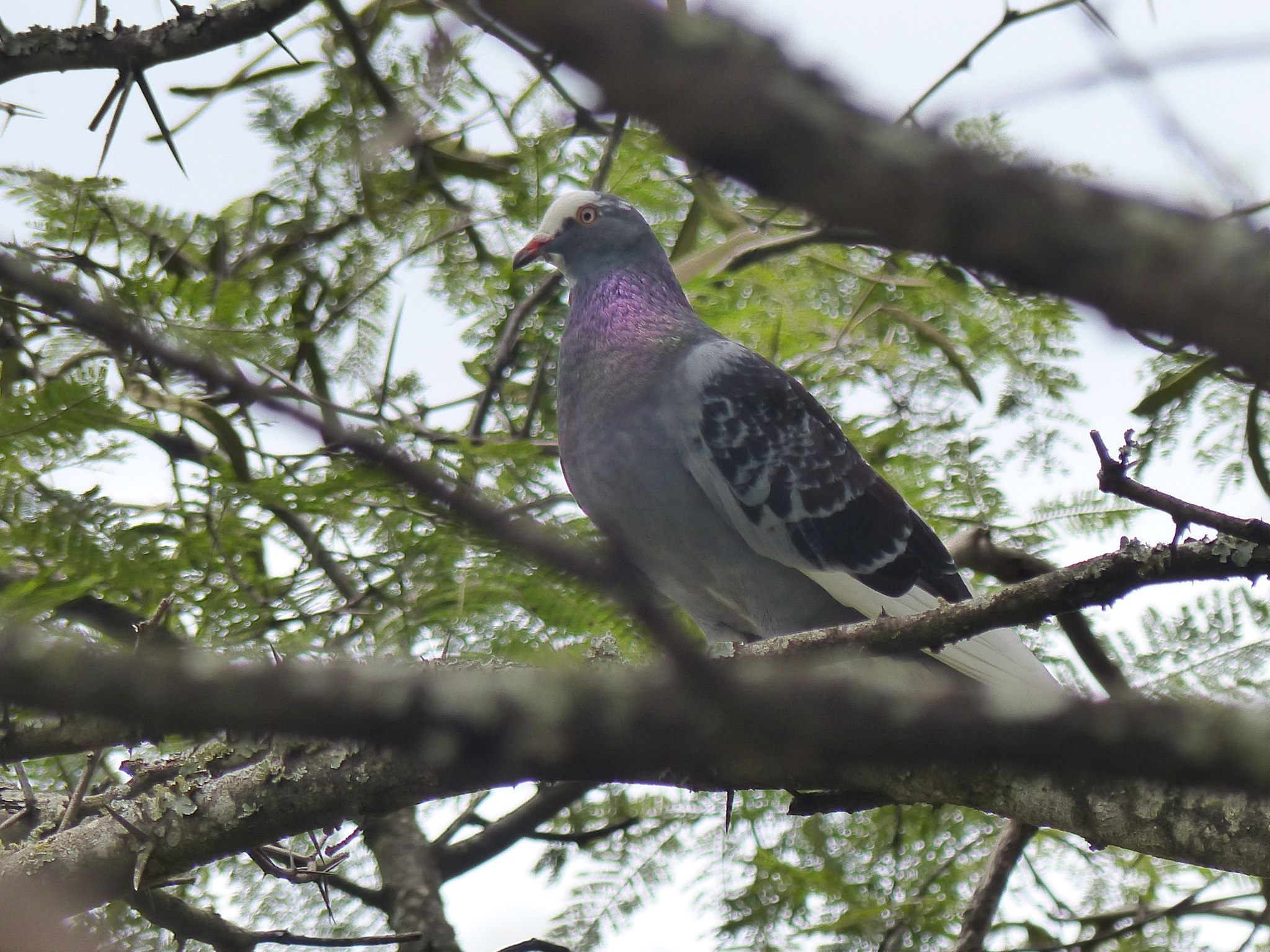
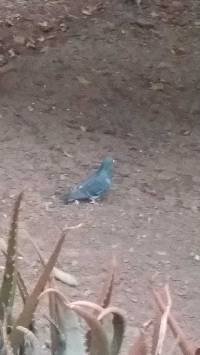
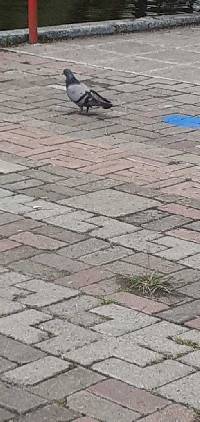
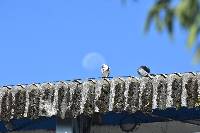
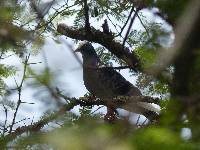
The rock dove (Columba livia), also known as the common pigeon or rock pigeon (but see also Petrophassa), is a member of the bird family Columbidae (doves and pigeons). In common usage, it is often simply referred to as the "pigeon", although the rock dove is the wild form of the bird; the pigeons familiar to most people are the domesticated forms of the wild rock dove.
Wild rock doves are uniformly pale grey with two black bars on each wing, with few differences being seen between males and females; i.e. they are not strongly sexually dimorphic. The domestic pigeon, often called "Columba livia domestica", which includes about 1,000 different breeds, is descended from this species. Escaped domestic pigeons are the origin of feral pigeons around the world. Both forms can vary widely in the colour and pattern of their plumage unlike their wild ancestor, being red, brown, checkered, uniformly coloured, or pied.
Habitats include various open and semi-open environments where they are able to forage on the ground. Cliffs and rock ledges are used for roosting and breeding in the wild. Originating in Southern Europe, North Africa, and Western Asia, when including their domestic and feral descendants, they are an example of a least-concern species per IUCN among birds, being abundant with an estimated population of 17 to 28 million wild and feral birds in Europe alone and up to 120 million worldwide.
Taxonomy and systematics
C. l. neglecta, Raikot, Gilgit-Baltistan, Pakistan
The official standard English name is rock dove, as given by the International Ornithological Congress.
The rock dove was formally described in 1789 by the German naturalist Johann Friedrich Gmelin in his revised and expanded edition of Systema Naturae written by Carl Linnaeus. He placed it with all the other doves and pigeons in the genus Columba and coined the binomial name Columba livia. The genus name Columba is the Latin word meaning "pigeon, dove", whose older etymology comes from the Ancient Greek...