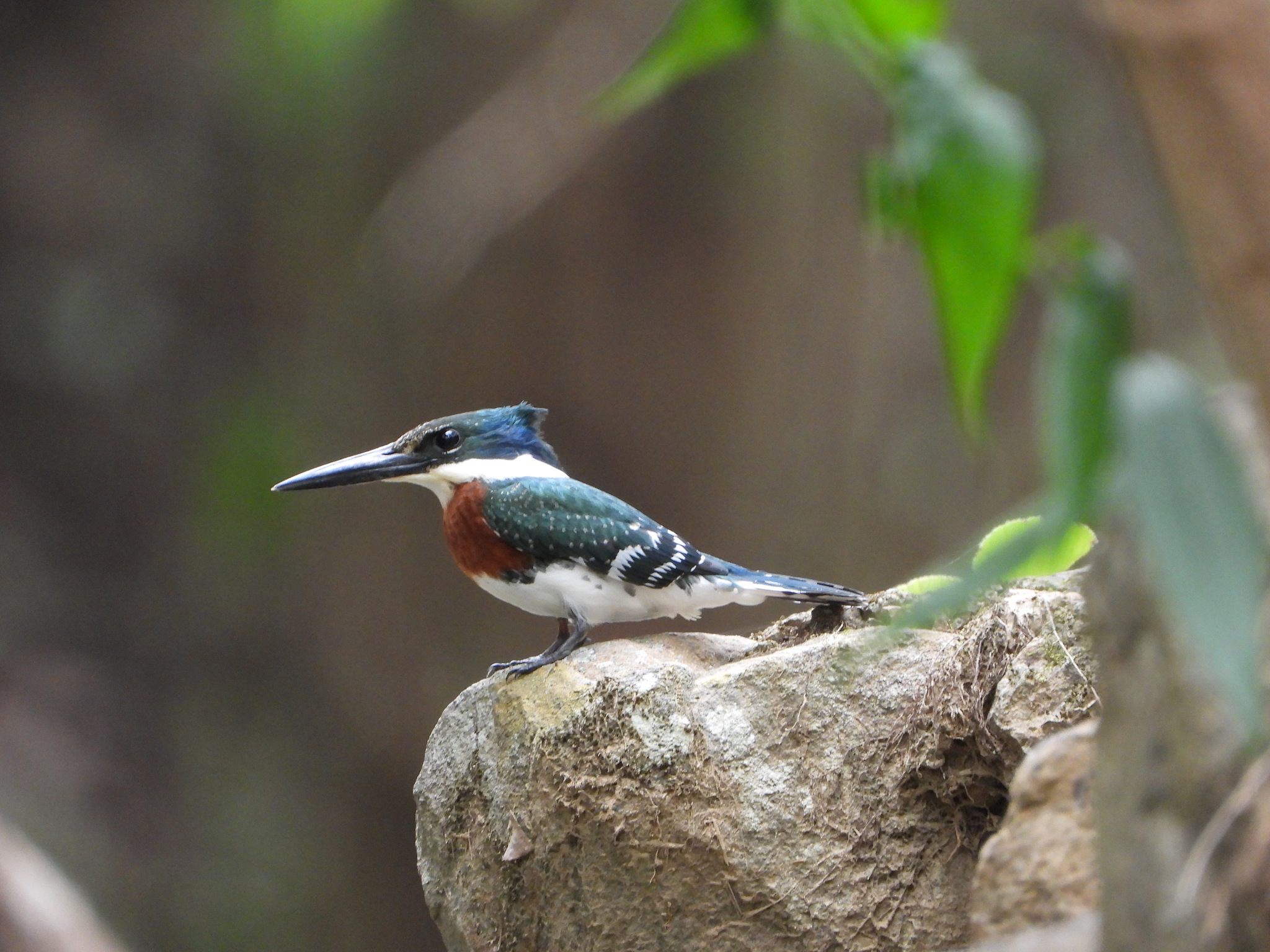
The American green kingfishers are the kingfisher genus Chloroceryle, which are native to tropical Central and South America, with one species extending north to south Texas.
Taxonomy and species
The genus Chloroceryle was introduced in 1848 by the German naturalist Johann Jakob Kaup. Kaup did not specify a type species but Richard Bowdler Sharpe designated the American pygmy kingfisher in 1871. The genus name combines the Ancient Greek khlōros meaning "green" with the genus Ceryle that was introduced by Friedrich Boie in 1828.
Phylogeny
body.skin-vector-2022
Chloroceryle
Amazon kingfisher
American pygmy kingfisher
Green-and-rufous kingfisher
Green kingfisher
Cladogram based on Andersen et al. (2017)
The genus contains four species:
Genus Chloroceryle – Kaup, 1848 – four species
Common name
Scientific name and subspecies
Range
Size and ecology
IUCN status and estimated population
American pygmy kingfisher Male
Female
Chloroceryle aenea (Pallas, 1764)
Two subspecies
C. a. aenea (Pallas, 1764)
C. a. stictoptera (Ridgway, 1884)
southern Mexico south through Central America to western Ecuador, and then around the northern Andes cordillera in the east to central Bolivia and central Brazil.
Size:
Habitat:
Diet:
LC
Green-and-rufous kingfisher Male
Female
Chloroceryle inda (Linnaeus, 1766)
Two subspecies
C. i. inda (Linnaeus, 1766)
C. i. chocoensis Todd, 1943
Nicaragua to northern Bolivia, southeastern Brazil, western Colombia, northwestern Ecuador
Size: