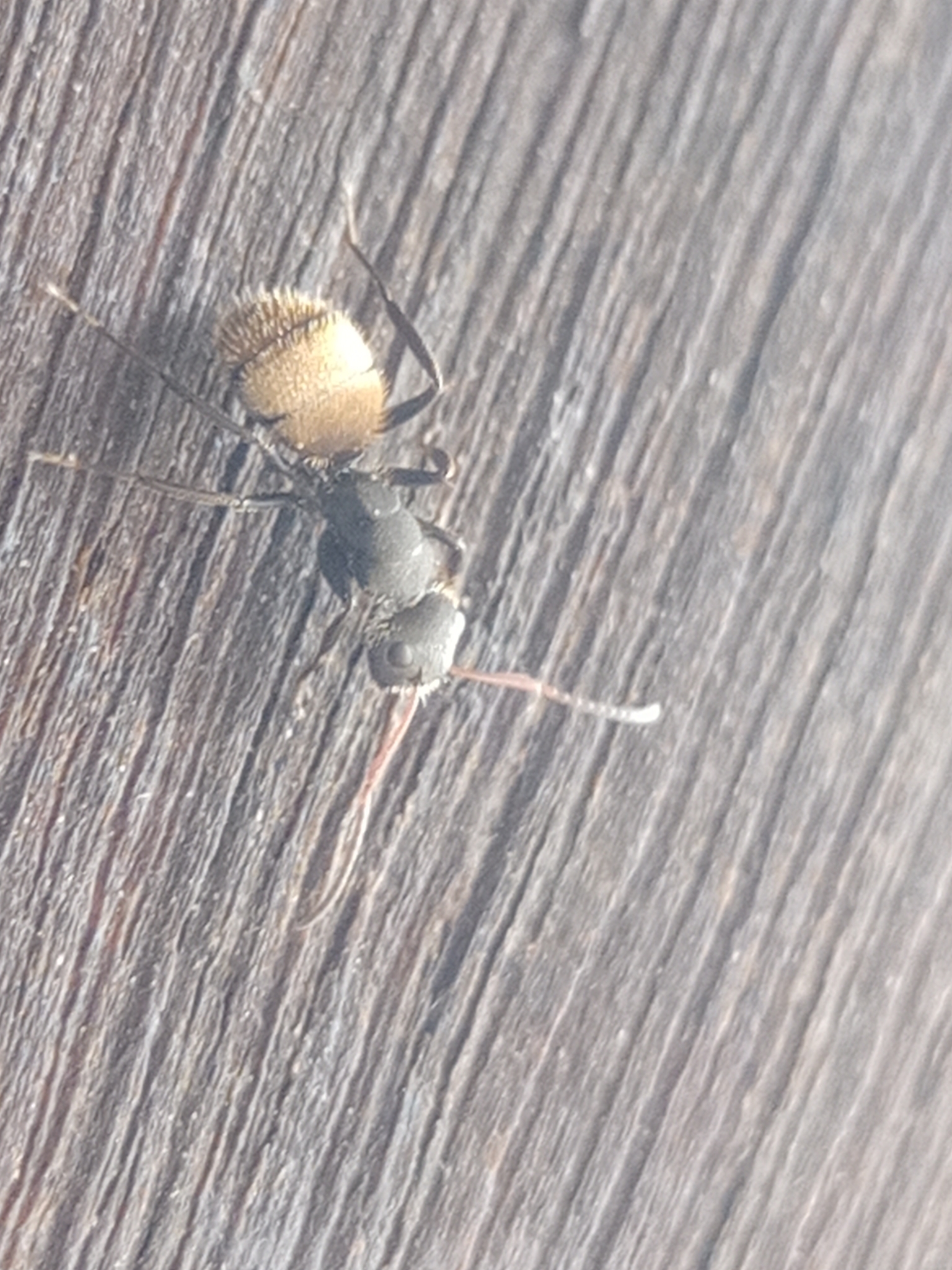
Camponotus, the carpenter ants, are a genus of ants in the subfamily Formicinae found nearly worldwide except in Antarctica and a few islands. This genus is the most species-rich genus of ants in terms of described species, comprising over 1,500 described species as of 2025. Although they are commonly referred to as carpenter ants, only a few members, mostly in the subgenera Camponotus and Myrmentoma, nest in wood.
True carpenter ants build nests inside wood, consisting of galleries chewed out with their mandibles or jaws, preferably in dead, damp wood. However, unlike termites, they do not consume wood, but instead discard a material that resembles sawdust outside their nest. Sometimes, carpenter ants hollow out sections of trees. They also commonly infest wooden buildings and structures, causing a widespread problem: they are a major cause of structural damage. Nevertheless, their ability to excavate wood helps in forest decomposition. The genus includes over 1,000 species. They also farm aphids. In their farming, the ants protect the aphids from predators (usually other insects) while they excrete a sugary fluid called honeydew, which the ants get by stroking the aphids with their antennae.
Description
Carpenter ants are generally large ants: workers are usually 4–7 mm long in small species and 7–13 mm in large species, queens are 9–20 mm long and males are 5–13 mm long. The bases of the antennae are separated from the clypeal border by a distance of at least the antennal scape's maximum diameter. The mesosoma in profile usually forms a continuous curve from the pronotum through to the propodeum.
Phylogeny
For a period, Colobopsis (including the "exploding ants" in the Colobopsis cylindrica group) was considered a subgenus of Camponotus. A 2015 phylogenomic study found it to be the sister group to all the remaining Camponotini. Consequently, since 2016, Colobopsis has been treated as a separate genus again.