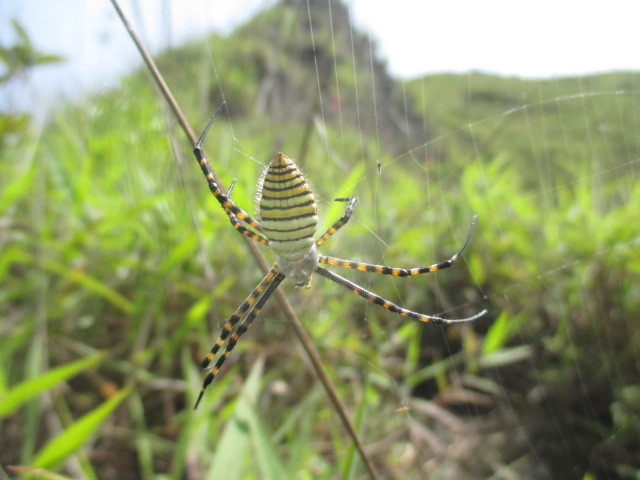
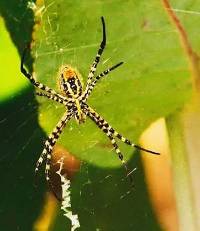
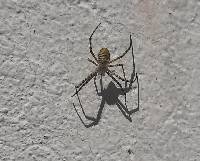
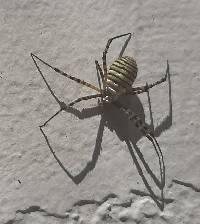
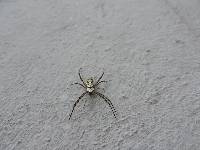
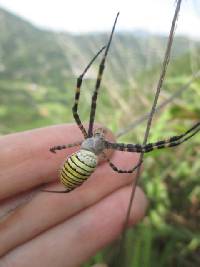
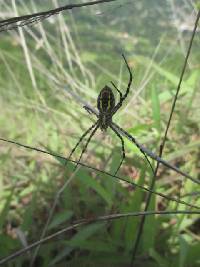
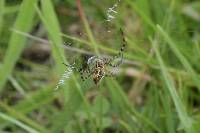
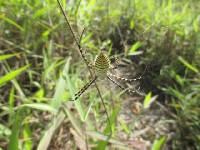
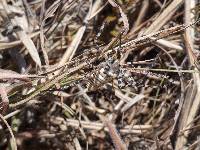
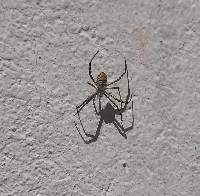
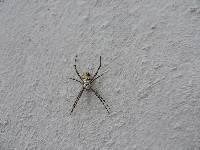
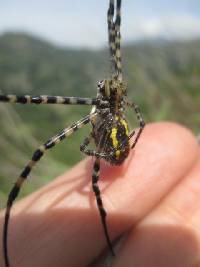
Argiope trifasciata (the banded garden spider or banded orb weaving spider) is a species of spider native to North and South America, but now found around the world.
They typically begin to appear during autumn from early September to late October as temperatures start dropping. In Egypt, the type locality of this spider, females were found surviving the relatively warm winter months.
Their webs can reach a diameter of about 60 cm. The length of the web depends on the size of the spider. Webs are capable of reaching a total length of two meters.
Distribution
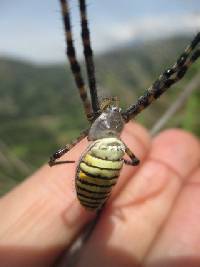
Ventral view of a female from Portugal
Originally from the Americas, Argiope trifasciata was introduced worldwide.
In Europe, it can be found on the Iberian Peninsula, the Canary Islands, and Madeira. The similar looking Argiope bruennichi is common in the Azores.
In Africa, the species is recorded from three countries. In South Africa, the species is known from eight of the nine provinces at elevations ranging from 3 to 1,557 m above sea level.
Habitat and ecology
The species constructs orb webs in wetlands, open grassland areas and gardens. The webs are usually placed low in shrubby vegetation sturdy enough to bear their weight. The spider hangs at the hub head-down throughout the day.
In South Africa, the species inhabits all floral biomes except the Nama Karoo and Succulent Karoo biomes, and has also been collected from crops such as cotton, kenaf, lucerne and tomatoes.
Behavior
The banded orb weaver wraps up a large milkweed bug and subsequently cuts it from its web
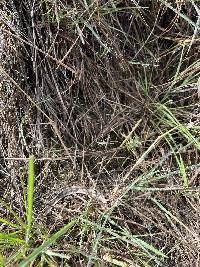
Egg sac, photographed in northern Texas
Egg Sacs (Cairo, Egypt)
In Illinois, Argiope trifasciata hatches in early summer but does not become readily notable until mid-August, when they have grown large enough to make their distinctive webs, which can be up to 60 cm (24 in) in diameter, among stems and bushes. The female rests at the centre of the web facing downwards, with her legs often arranged in pairs,...