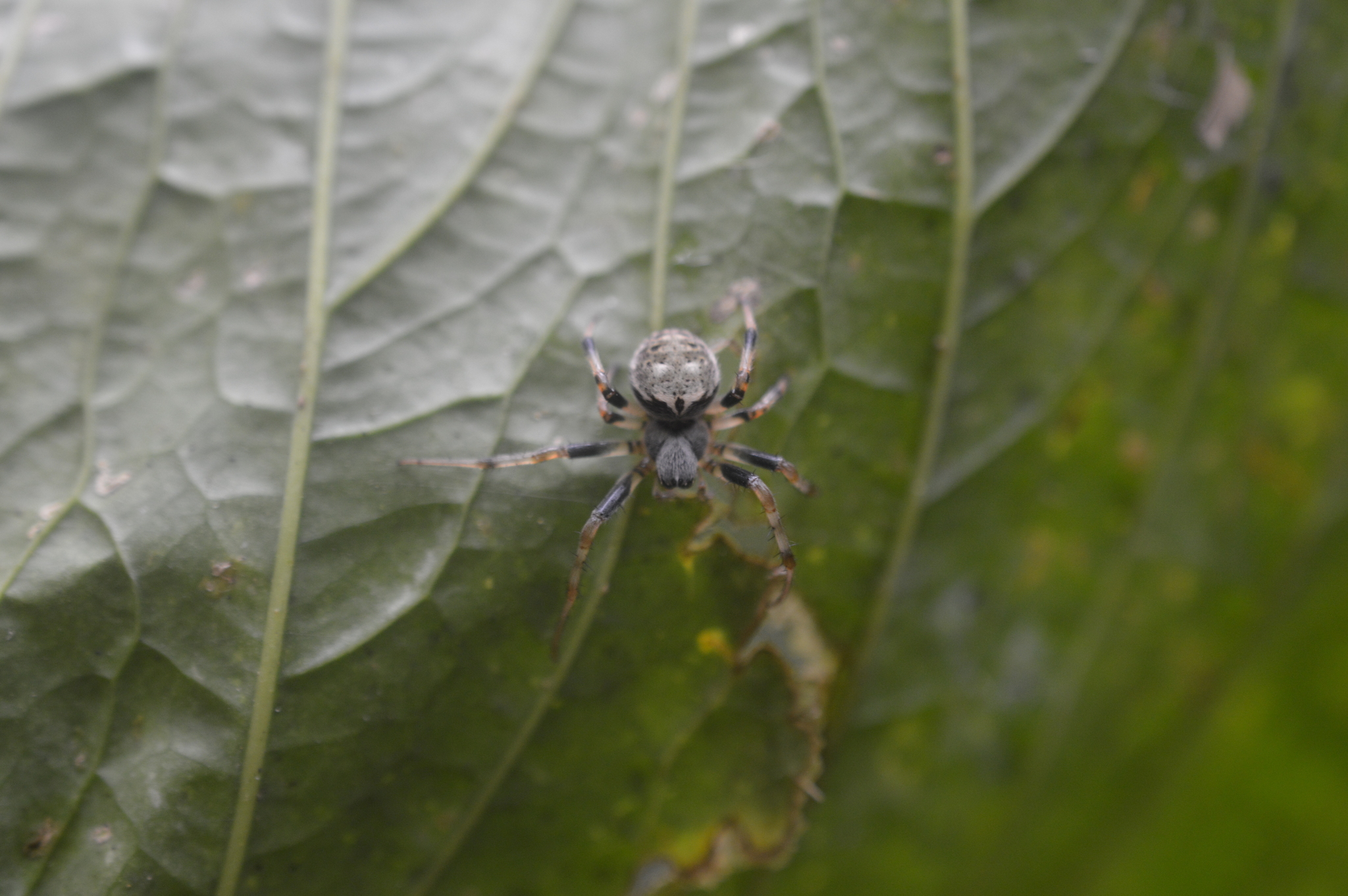
Araneus is a genus of common orb-weaving spiders with more than 500 species, among which are the European garden spider and the barn spider. The genus was erected by Carl Alexander Clerck in 1757.
Spiders of this genus present perhaps the most obvious case of sexual dimorphism among all of the orb-weaver family, with males being normally
In females, the epigyne has a long scape (a tongue-like appendage). Male pedipalps have a hook-like terminal apophysis. Abdominal tubercles are present anterolaterally.
Taxonomic history
Marbled orb-weaver (Araneus marmoreus)
Araneus was, for much of its history, called Epeira. The latter name is now considered a junior synonym of Araneus, as the latter was published almost 50 years earlier.
Epeira was first coined by Charles Athanase Walckenaer in 1805, for a range of spiders now considered Araneidae (orb-weavers). Over time, a rather diverse set of spiders was grouped under this genus name, including species from the modern families Araneidae, Mimetidae (Mimetus syllepsicus described by Nicholas Marcellus Hentz in 1832), Tetragnathidae, Theridiidae, Theridiosomatidae (Theridiosoma gemmosum, described by Ludwig Carl Christian Koch in 1877 as Theridion gemmosum), Titanoecidae (Nurscia albomaculata, described by Hippolyte Lucas in 1846 as Epeira albo-maculata) and Uloboridae (Uloborus glomosus, described by Walckenaer in 1842 as Epeira glomosus). Epeira cylindrica O. P.-Cambridge, 1889 was at a time placed in the Linyphiidae and is considered incertae sedis, as is "Araneus" cylindriformis (Roewer, 1942).
Epeira was synonymized with the genus Aranea by William Elford Leach in 1815, and with Araneus by Eugène Simon in 1904, though this synonymy was not universally recognized.
Throughout the 19th century, Epeira was used as a catch-all genus, similar to the once ubiquitous salticid genus Attus. However, from 1911, to its last mention in 1957, only very few...