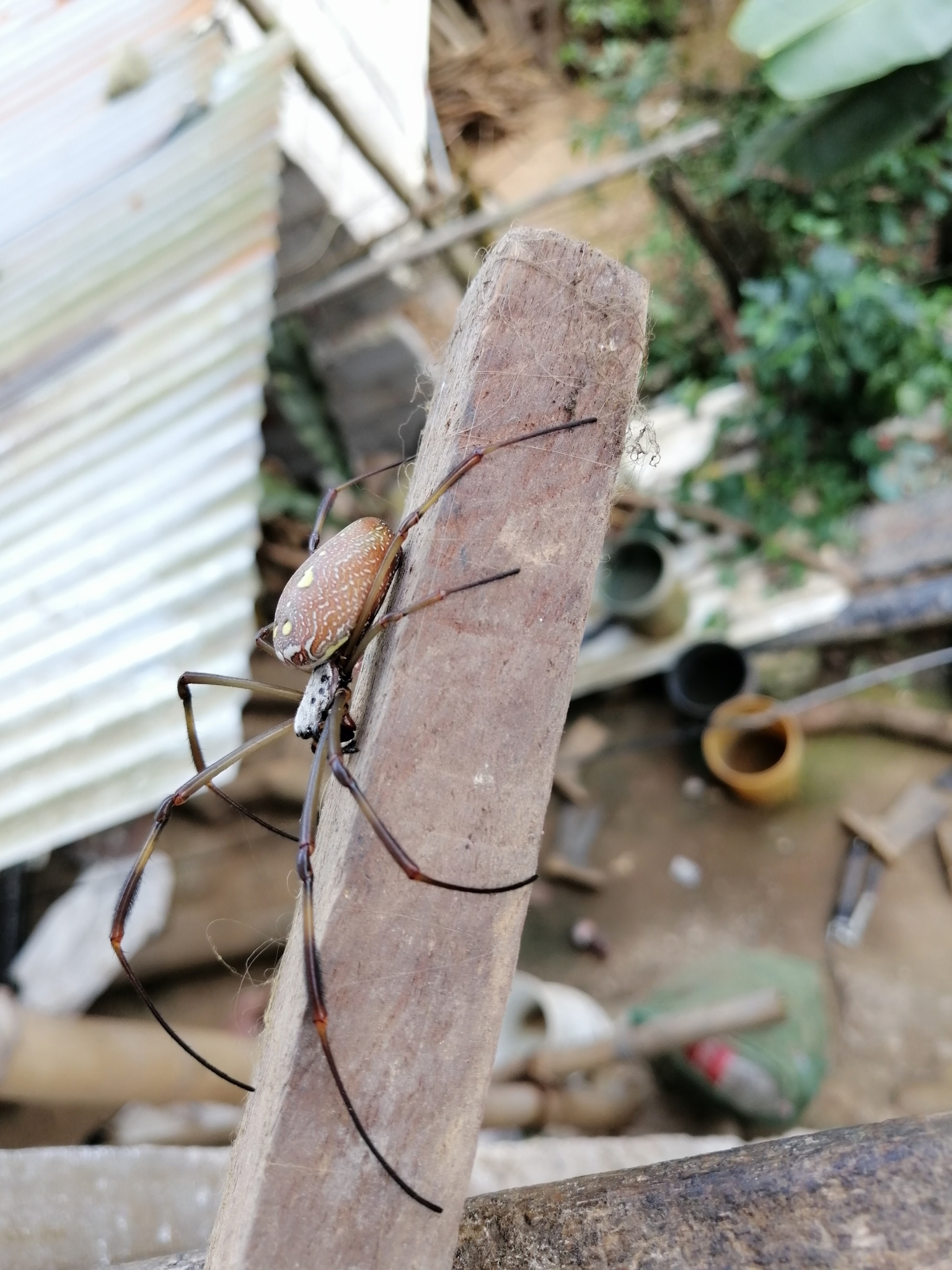
Orb-weaver spiders are members of the spider family Araneidae. They are the most common group of builders of spiral wheel-shaped webs often found in gardens, fields, and forests. The English word "orb" can mean "circular", hence the English name of the group. Araneids have eight similar eyes, hairy or spiny legs, and no stridulating organs.
The family has a cosmopolitan distribution, including many well-known large or brightly colored garden spiders. With almost 5,000 described species in about 200 genera worldwide, the Araneidae comprise one of the largest family of spiders (with the Salticidae and Linyphiidae). Araneid webs are constructed in a stereotypical fashion, where a framework of nonsticky silk is built up before the spider adds a final spiral of silk covered in sticky droplets.
Orb webs are also produced by members of other spider families. The long-jawed orb weavers (Tetragnathidae) were formerly included in the Araneidae; they are closely related, being part of the superfamily Araneoidea. The family Arkyidae has been split off from the Araneidae. The cribellate or hackled orb-weavers (Uloboridae) belong to a different group of spiders. Their webs are strikingly similar, but use a different kind of silk.
Description
Spiderlings in the web near where they hatched
Araneidae web
Generally, orb-weaving spiders are three-clawed builders of flat webs with sticky spiral capture silk. The building of a web is an engineering feat, begun when the spider floats a line on the wind to another surface. The spider secures the line and then drops another line from the center, making a "Y". The rest of the scaffolding follows with many radii of nonsticky silk being constructed before a final spiral of sticky capture silk.
The third claw is used to walk on the nonsticky part of the web. Characteristically, the prey insect that blunders into the sticky lines is stunned by a quick bite, and then wrapped in silk. If the prey is a venomous insect, such as a wasp, wrapping may...