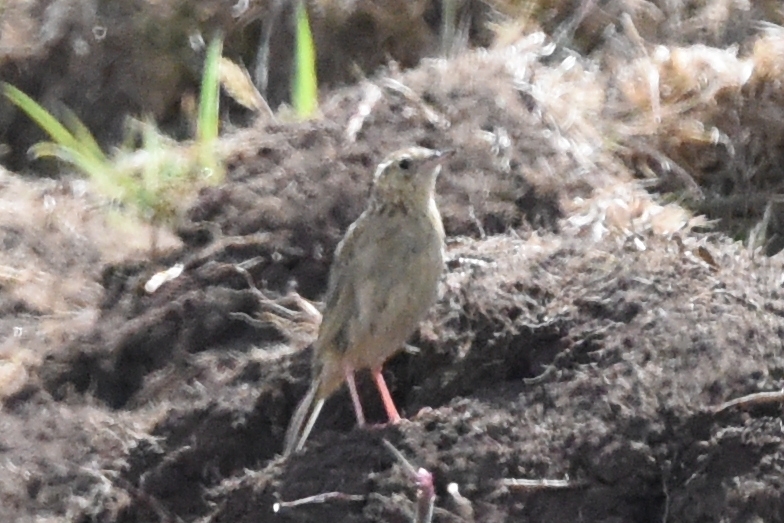
The pipits are a cosmopolitan genus, Anthus, of small passerine birds with medium to long tails. Along with the wagtails and longclaws, the pipits make up the family Motacillidae. The genus is widespread, occurring across most of the world, except the driest deserts, rainforest and the mainland of Antarctica.
They are slender, often drab, ground-feeding insectivores of open country. Like their relatives in the family, the pipits are monogamous and territorial. Pipits are ground nesters, laying up to six speckled eggs.
Taxonomy and systematics
A New Zealand pipit Anthus novaeseelandiae. This species was formerly considered conspecific with the Australian pipit Anthus australis under the name Australasian pipit.
The genus Anthus was introduced in 1805 by German naturalist Johann Matthäus Bechstein. The type species was later designated as the meadow pipit.
The generic name Anthus is the Latin word for a small bird of grasslands mentioned by Pliny the Elder.
Molecular studies of the pipits suggested that the genus arose in East Asia around seven million years ago (Mya), during the Miocene, and that the genus had spread to the Americas, Africa, and Europe between 5 and 6 Mya. Speciation rates were high during the Pliocene (5.3 to 2.6 Mya), but slowed down during the Pleistocene. Repeated dispersal between continents seems to have been important in generating new species in Eurasia, Africa, and North America, rather than species arising by radiation once a continent was reached. In South America, however, vicariance appears to have played an important role in speciation.
The genus has more than 40 species, making it the largest genus in terms of numbers in its family. The exact species limits of the genus are still a matter of some debate, with some checklists recognising only 34 species. For example, the New Zealand pipit A. novaeseelandiae, which is currently treated as four subspecies found in New Zealand, formerly also included Australian pipit A. australis of...