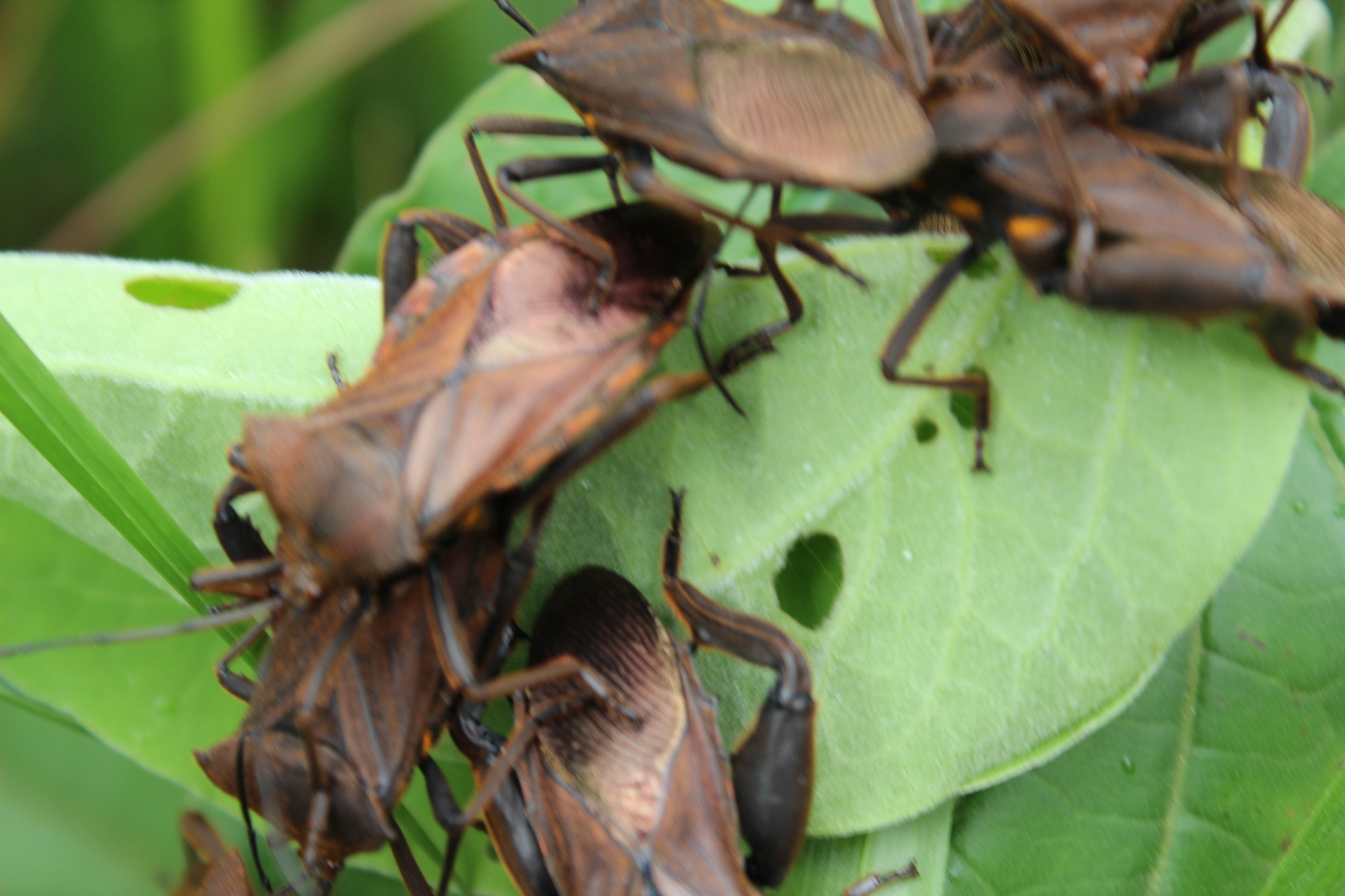
Coreidae is a large family of predominantly sap-sucking insects in the Hemipteran suborder Heteroptera. The name "Coreidae" derives from the genus Coreus, which derives from the Ancient Greek κόρις (kóris) meaning bug.
As a family, the Coreidae are cosmopolitan, but most of the species are tropical or subtropical.
Common names and significance
The common names of the Coreidae vary regionally. Leaf-footed bug refers to leaf-like expansions on the legs of some species, generally on the hind tibiae. In North America, the pest status of species such as Anasa tristis on squash plants and other cucurbits gave rise to the name squash bugs. The Coreidae are called twig-wilters or tip-wilters in parts of Africa and Australia because many species feed on young twigs, injecting enzymes that macerate the tissues of the growing tips and cause them to wilt abruptly.
Morphology and appearance
The Coreidae commonly are oval-shaped, with antennae composed of four segments, numerous veins in the membrane of the fore wings, and externally visible repugnatorial stink glands. They vary in size from 7 to 45 mm long, which implies that the family includes some of the biggest species of Heteroptera. The body shape is quite variable; some species are broadly oval, others are elongated with parallel sides, and a few are slender. Many species with the "leaf-footed" tibiae are very slender with conspicuous expansions of the hind tibiae, but some robust species also have decided expansions. Some species are covered with spines and tubercles. As an example of these, the tribe Phyllomorphini Mulsant & Rey, 1870, are strikingly aberrant, with thin legs, spiny bristles, and laciniate outlines and adornments.
Many of the more robust species have grossly enlarged, thickened, and bowed hind femora armed with spikes on the inner edge, and with hind tibiae to match, though the enlargement of the tibiae is less exaggerated.
In the nymphs, the openings of the two repugnatorial stink glands of the Coreidae are visible...