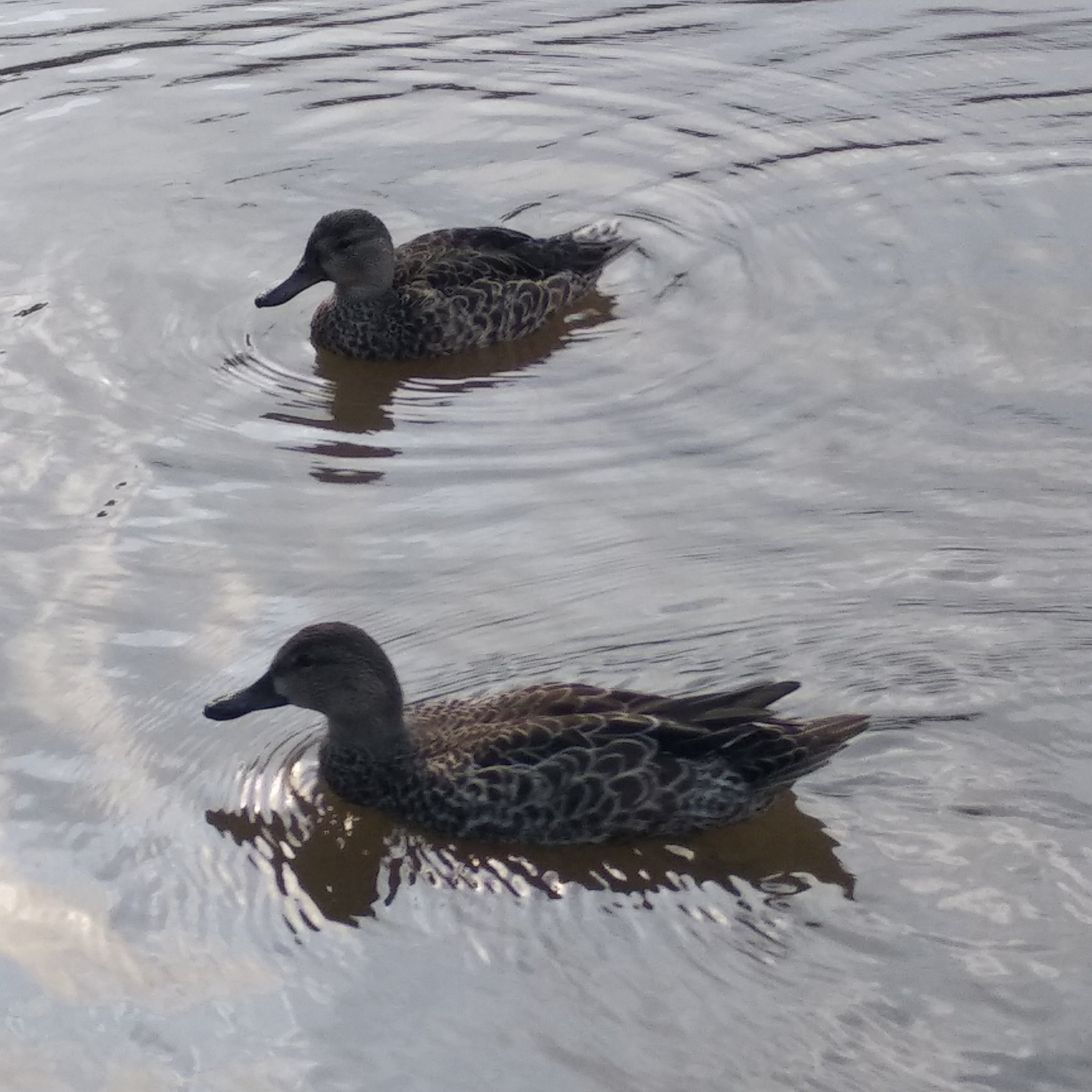
The blue-winged teal (Spatula discors) is a species of bird in the duck, goose, and swan family Anatidae. One of the smaller members of the dabbling duck group, it occurs in North America, where it breeds from southern Alaska to Nova Scotia, and south to northern Texas. It winters along the Pacific and Atlantic coasts and south into the Caribbean islands and Central America.
Taxonomy
The first formal description of the blue-winged teal was by the Swedish naturalist Carl Linnaeus in 1766 in the twelfth edition of his Systema Naturae. He coined the binomial name Anas discors. A molecular phylogentic study comparing mitochondrial DNA sequences published in 2009 found that the genus Anas, as then defined, was non-monophyletic. The genus was subsequently split into four monophyletic genera with ten species including the blue-winged teal moved into the resurrected genus Spatula. This genus had been originally proposed by the German zoologist Friedrich Boie in 1822. The name Spatula is the Latin for a "spoon" or "spatula". The specific epithet discors is the Latin for "different" or "at variance".
Description
Call
Blue-winged teal drake in flight at Sacramento National Wildlife Refuge
The blue-winged teal is 40 cm (16 in) long, with a wingspan of 58 cm (23 in), and a weight of 370 g (13 oz). The adult male has a greyish blue head with a white facial crescent, a light brown body with a white patch near the rear and a black tail. The adult female is mottled brown, and has a whitish area at base of bill. Both sexes have sky-blue wing coverts, a green speculum, and yellow legs. They have two molts per year and a third molt in their first year. The call of the male is a short whistle; the female's call is a soft quack.
Distribution
The range is all of North America except western and northern Alaska, northern Yukon Territory, northern Northwest Territories and the northeastern area of Canada. Blue-winged teal are rare in the desert southwest, and the west coast....