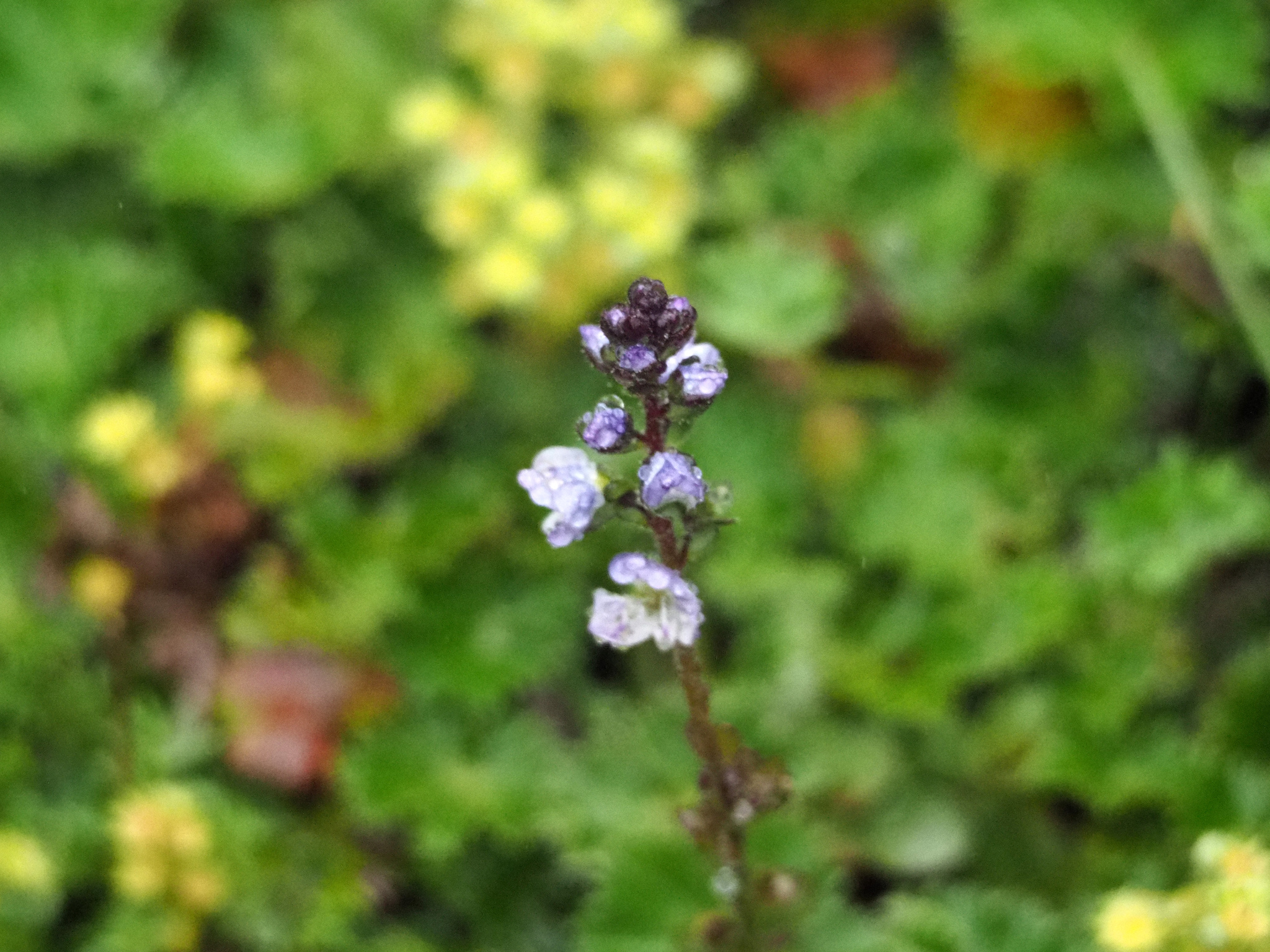
Veronica serpyllifolia, the thyme-leaved speedwell or thymeleaf speedwell, is a perennial flowering plant in the plantain family. The species as a whole is native mostly to Eurasia & North America, and has three variants with their individual ranges; var. serpyllifolia has particularly spread beyond its native range.
Description
Veronica serpyllifolia L. initially grows low to the ground then will start to grow upright. The leaves are borne on creeping stems. Roots grow from leaf axils. This plant can be hard to spot as it is relatively small and grows in patches which can be covered by grass. They are more noticeable when they bloom. The prostrate stems bear erect flowering branches up to 20 cm (7.9 in) high.
The first leaves of the seedling have no petiole, are hairless, and have a smooth margin. The leaves are oval, and the lower leaves have smooth margins. The upper leaves are smaller than the lower. The leaves are opposite, with the lower leaves having relatively short stalks, while the higher or upper leaves are stalkless (lack petioles).
The flowers are small, white, and have dark purple marks on their petals. They have four petals, and a corolla 6 mm (0.24 in) wide. They grow in racemes from the leaf axils. Their stems grow from nodes on the rhizomes, allowing them to grow in thick mats close to the ground.
Veronica serpyllifolia reproduces either by dropping its seeds or by rooting stems. Their root systems are both fibrous and rhizomatous. The fruits are obcordate (heart shaped) capsules, mostly flattened, and have a pubescent outer layer with a notched tip. They are approximately 2.5–3.5 mm (0.098–0.138 in) long. The fruit is lined with hairs and the seeds on the inside of the capsule are also flattened. Once the capsules are mature, they open to release many small seeds.
V. serpyllifolia can grow in low mats.
V. serpyllifolia seed capsules
Distribution
Veronica serpyllifolia L. var. serpyllifolia, commonly known...