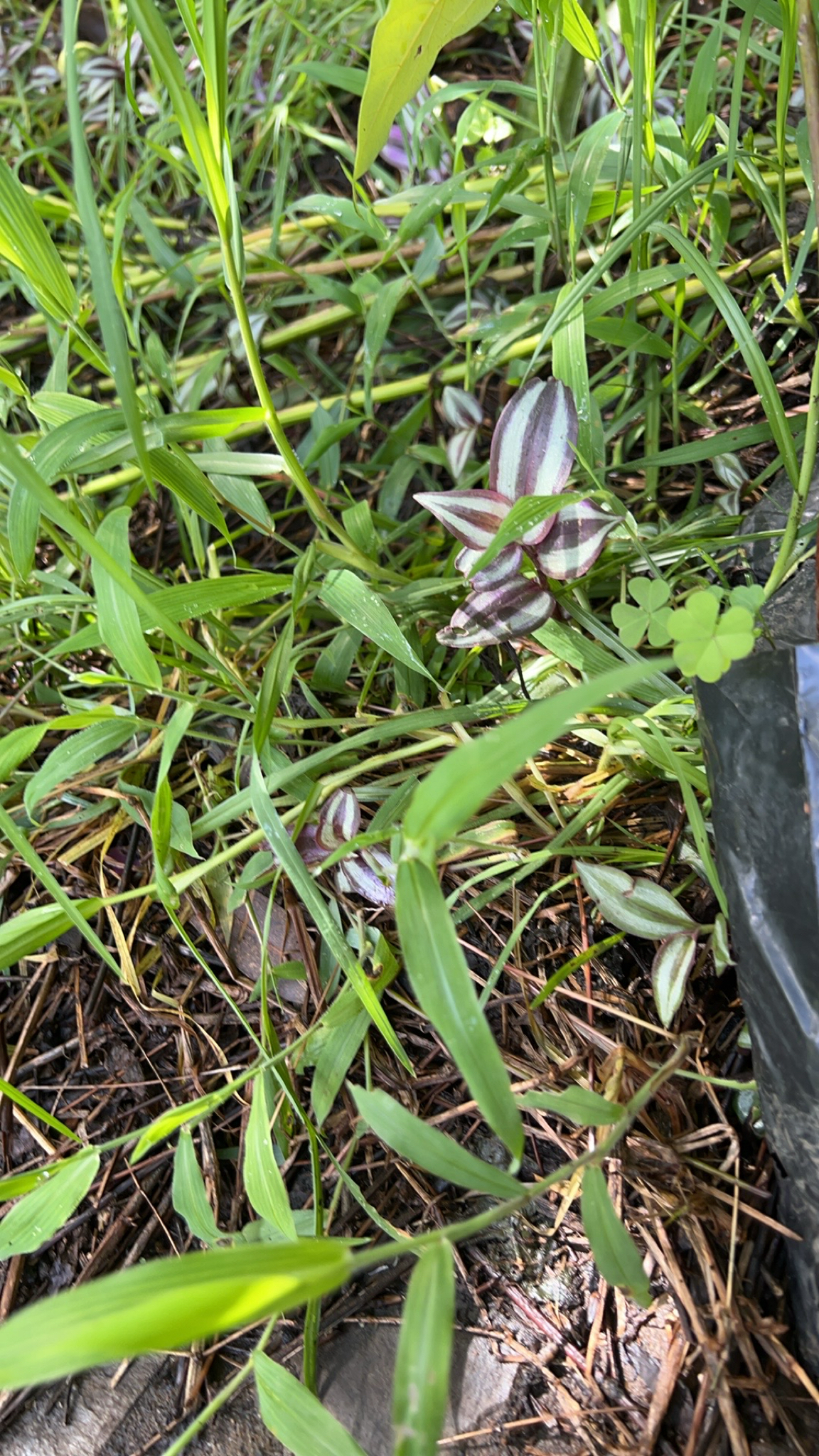
Tradescantia zebrina, formerly known as Zebrina pendula, is a species of creeping plant in the Tradescantia genus. Common names include silver inch plant and wandering Jew. The latter name is controversial, and some now use the alternative wandering dude. The plant is popular in cultivation due to its fast growth and attractive foliage. It is used as a groundcover in warm winter climates, and as a houseplant elsewhere.
Description
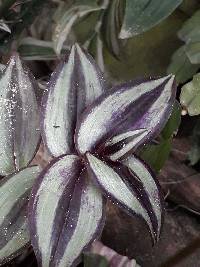
Tradescantia zebrina has attractive zebra-patterned leaves, the upper surface showing purple new growth and green older growth parallel to the central axis, as well as two broad silver-colored stripes on the outer edges, with the lower leaf surface presenting a deep uniform magenta. The leaves are bluish green and usually have two longitudinal stripes that are silvery on the surface and purple on the underside. When chronically exposed to long periods of intense sunlight, the variegation fades and the leaf becomes purple throughout.
The leaf sheaths are thin and translucent, 8 to 12 mm long and 5 to 8 mm wide, at the mouth they are long, otherwise glabrous or slightly hairy.
Tradescantia zebrina leaves
The low-lying, slightly succulent, perennial, herbaceous plant often forms dense mats or colonies. This is done primarily by natural formation of taproots. On the nodules of the shoot are root approaches, from which roots develop in permanent contact with water or a sufficiently moist substrate under favorable conditions within a day. The shoots are glabrous or hairy. The stalked, parallel-veined leaves are mostly ovate, 4 to 10 cm long and 1.5 to 3 cm wide, pointed towards the tip, rounded to the base. The upper surface is glabrous to mildly hairy, the underside hairless to averagely hairy, ciliate towards the leaf base. The structure of the flower—usually from the three pink petals and the white sexual organs—is similar to that of the other Tradescantia, but unlike what happens in those, the plant branches...