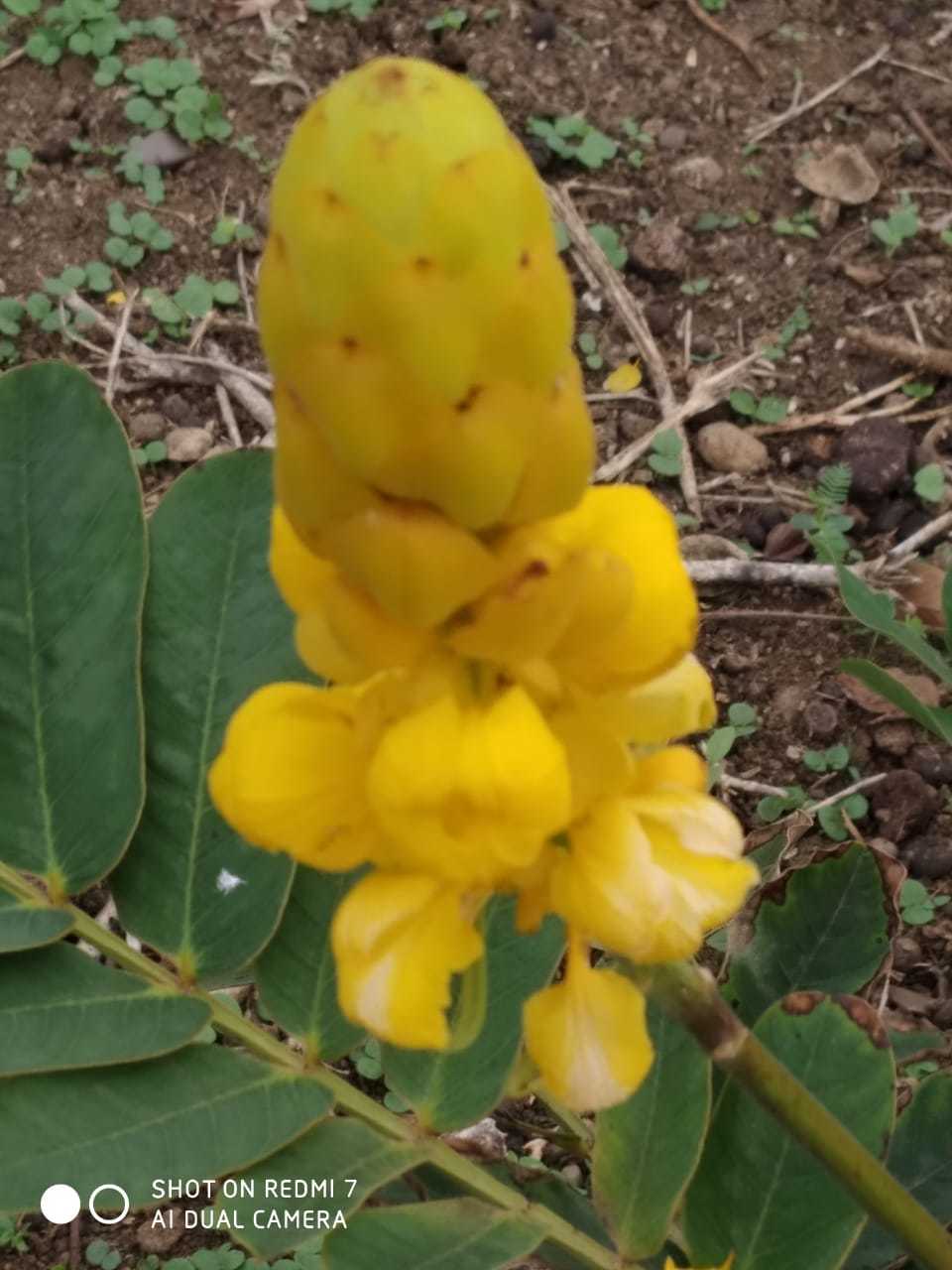
Senna alata is an important Neotropical medicinal tree, as well as an ornamental flowering plant in the subfamily Caesalpinioideae. It also known as emperor's candlesticks, candle bush, candelabra bush, Christmas candles, empress candle plant, ringworm shrub, Roman candle, or candletree. A remarkable species of Senna, it was sometimes separated in its own genus, Herpetica.
Geographic range
Senna alata is native to most of the Neotropics (from Mexico and the West Indies to Paraguay), and can be found in diverse habitats. In the tropics, it grows up to an altitude of 1,200 metres (3,900 ft). It is brought over to Malesia of the Old World by the Spanish galleon trade in Manila 16th century; however they have been adapted in communities of the southeast Asian, North Australian and African ranges with greater ornamental and medicinal values.
It is so naturalized in the Malay Peninsula (known in Malay: gelenggang) that its blooming from mid November-December there has become incorporated in the Kedahan traditional rice planting cycle (piama) as a marker of its beginning dry season.
Description
The shrub stands 3–4 metres (9.8–13.1 ft) tall, with leaves 50–80 centimetres (20–31 in) long.
The leaves close in the dark.
The inflorescence looks like a yellow candle.
The fruit, shaped like a straight pod, is up to 25 cm long. Its seeds are distributed by water or animals.
The seed pods (fruits) are nearly straight, dark brown or nearly black, about 15 centimetres (5.9 in) long, and 15 millimetres (0.59 in) wide. On both sides of the pods is a wing that runs the length of the pod. A pod contains 50 to 60 flattened, triangular seeds.
Cultivation
This species is easy to grow from the seed. They may either be sown directly or started in a nursery.
Medicinal uses
Senna alata (also known as Cassia alata) is often called the ringworm bush because of its very effective fungicidal properties, for treating ringworm and other fungal infections of...