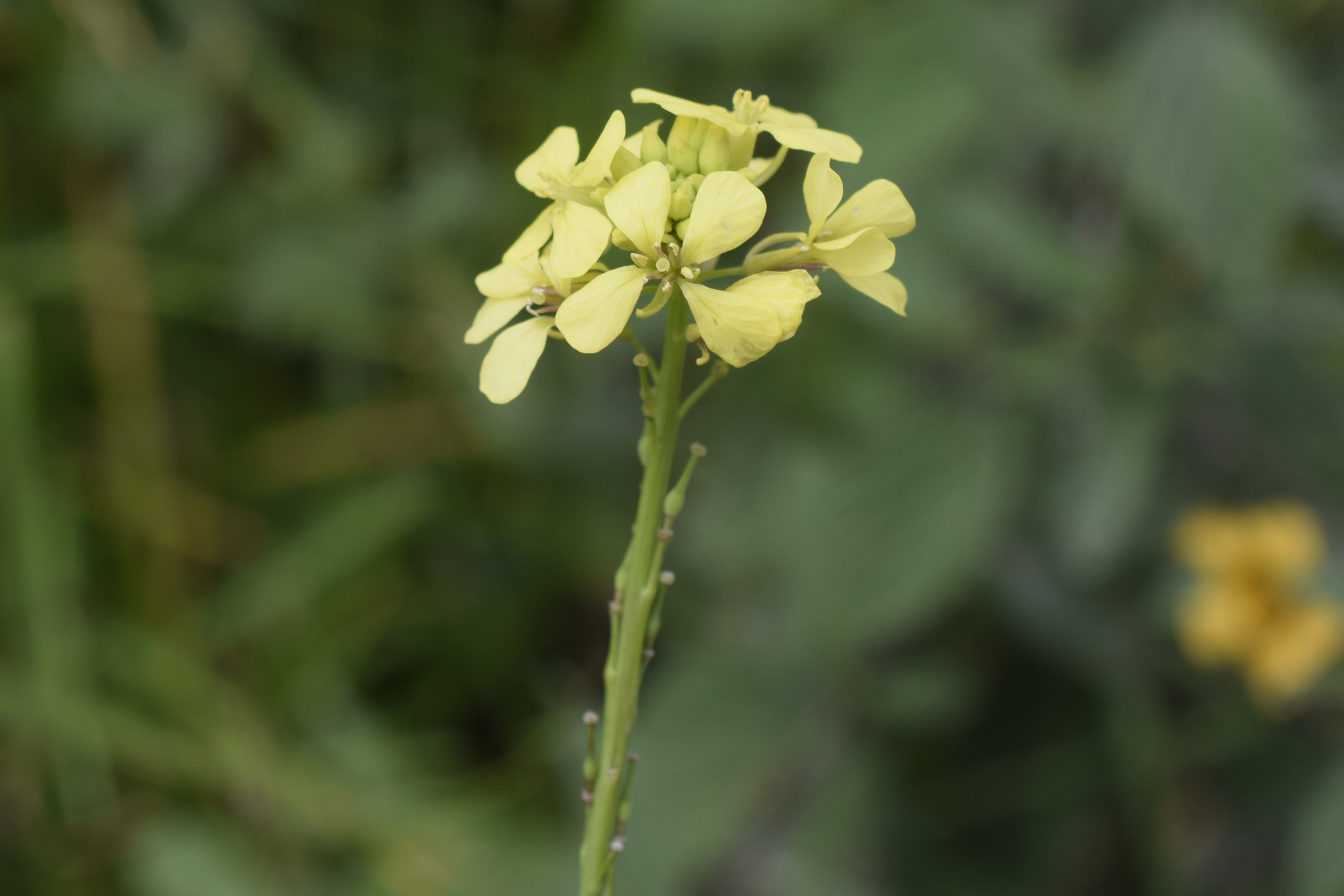
Rapistrum, the bastard cabbages, is a genus of the family Brassicaceae with a distinctive cross like arrangement of its petals. It is also known as wild-turnip or turnipweed. Species of Rapistrum are annual to perennials (Lifespan from 1 to 2 or more years). The yellow petals are accompanied by sepals that stand vertically at near right angles (erecto-patent). Leaf shape and arrangement varies from rough toothed (dentate) to a configuration of opposingly lobed pairs along the plant stalk, pinnately lobed.
Etymology
The word "Rapistrum" is formed from the Latin rapa ("turnip") and -astrum, ("incomplete resemblance").
Fruit
The genus Rapistrum has a characteristic fruit comprising two segments, one distal and one proximal:
The distal (upper division) is the part of the fruit farthest away from the point of attachment. The distal is endowed with a ribbed spheroid base (globose) that tapers to form a narrowed projection. It holds a single seed.
The proximal (lower division) is the part of the fruit nearest to the point of attachment. Possesses a more uniform narrower shape compared to the distal above, giving the fruit a waist. It holds a maximum of three seeds, more commonly none or one.
The fruit varies between species in the genus. The distal of R. rugosum is strongly ribbed and narrows to form a beak whereas R. perenne is comparatively less wrinkled and ends with a style that stubbornly resists detachment, 'a persistent style'.
When ripe the distal breaks away in an across-wise fashion, breaking transversely.
Bibliography
Streeter, D. (1983), The wild flowers of the British Isles, London: Midsummer Books Ltd., ISBN 1-900732-03-3.
Wikidata: Q162891
Wikispecies: Rapistrum
APDB: 194299
APNI: 114792
BioLib: 39240
CoL: C89T7
eFloraSA: Rapistrum
EoL: 61528
EPPO: 1RASG
FloraBase: 21484
FNA: 127997
FoAO2: Rapistrum
FoC: 127997
GBIF (old): 3040850
GRIN: 10259
iNaturalist: 72330
IPNI: 331896-2
ITIS: 23291
NBN: NHMSYS0000462286
NCBI: 71361
NZOR:...