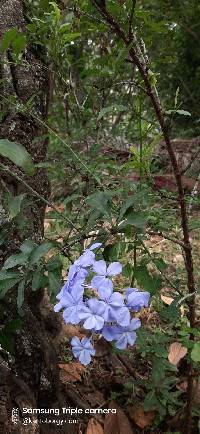
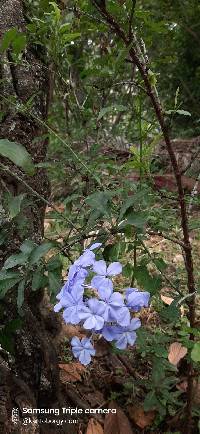
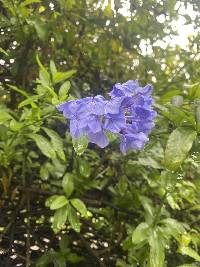
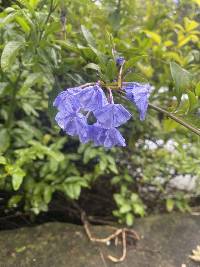
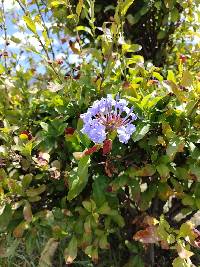
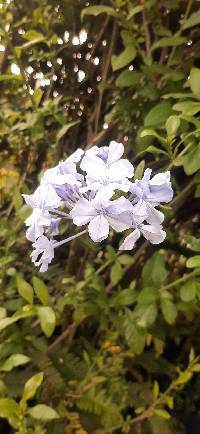
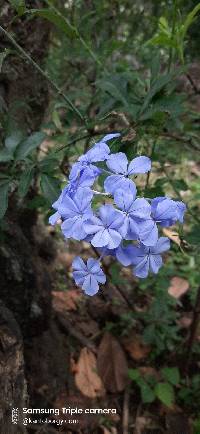
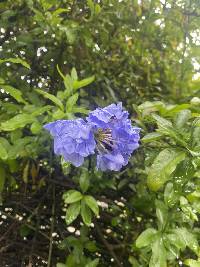
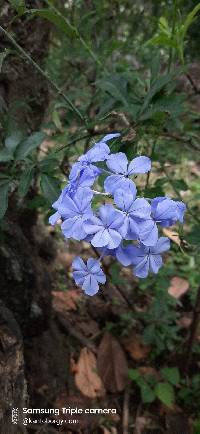
Plumbago auriculata, the Cape leadwort, blue plumbago or Cape plumbago, is a species of flowering plant in the family Plumbaginaceae, native to South Africa and Mozambique.
The specific epithet auriculata means "with ears", referring to the shape of the leaves., leaf venation - reticulate.
Description
Plumbago auriculata is an evergreen shrub, often grown as a climber, ascending rapidly to 6 m (20 ft) tall by 3 m (10 ft) wide in nature, though much smaller when cultivated as a houseplant. The leaves are a glossy green and grow to 5 cm (2 in) long. The stems are long, thin, and climbing. The leaves alternate and are 2–5 cm.
The corolla with five petal-like lobes is about 2 cm wide and can be pale blue, blue or violet in color. There also variations with white (P. auriculata var. alba) or deep blue (P. auriculata 'Royal Cape') flowers. The flowers are complete and bisexual, and are arranged in corymb-like racemes.
The sepals and petals are connate while the pistil is adnate. The ovary of the flower is superior and the flower has regular symmetry. It has basal placentation, with 1 locule and 5 carpels. It flowers mostly in the summer, but in the right conditions it can bloom year-round.
↑
↑ Cite error: The named reference Botanica 691 was invoked but never defined (see the help page).
↑ Cite error: The named reference Vermeulen 216 was invoked but never defined (see the help page).
↑ "Plant Database".
↑ Plumbago auriculata by The North Carolina Extension Gardener Plant Toolbox
Inflorescences
The corolla with five petal-like lobes is about 2 cm wide and can be pale blue, blue or violet in color. There also variations with white (P. auriculata var. alba) or deep blue (P. auriculata 'Royal Cape') flowers. The flowers are complete and bisexual, and are arranged in corymb-like racemes.
The sepals and petals are connate while the pistil is adnate. The ovary of the flower is superior and the...