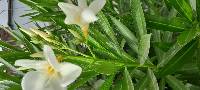
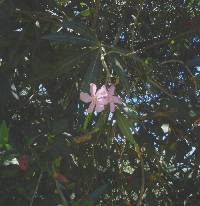
Nerium oleander, the oleander, is a shrub or small tree native to the Mediterranean region east to southern Asia, from Morocco and Portugal east to India and Myanmar; the Flora of China also cites it as native in Yunnan in China. It is the only species currently classified in the genus Nerium, belonging to subfamily Apocynoideae of the dogbane family Apocynaceae. It is also cultivated widely in temperate and subtropical areas as an introduced ornamental and landscaping plant.
It is tolerant to both drought and inundation, but not to prolonged frost. It is a highly poisonous plant but its bitterness renders it unpalatable to humans and most animals, so poisoning cases are rare and the general risk for human mortality is low. Ingestion of larger amounts may cause nausea, vomiting, excess salivation, abdominal pain, bloody diarrhoea and irregular heart rhythm. Prolonged contact with sap may cause skin irritation, eye inflammation and dermatitis.
Description
Wild Nerium oleander in a wadi east of Ouarzazate in Morocco
Oleander grows to 2–6 metres (7–20 feet) tall, with erect stems that splay outward as they mature; first-year stems have a glaucous bloom, while mature stems have a greyish bark. It is most commonly grown in its natural shrub form, but can be trained into a small tree with a single trunk. The leaves are in pairs or whorls of three, thick and leathery, dark-green, narrow lanceolate, 5–21 centimetres (2–8 inches) long and
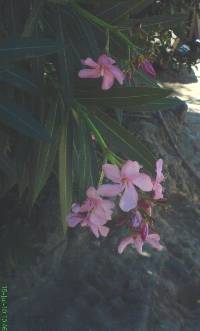
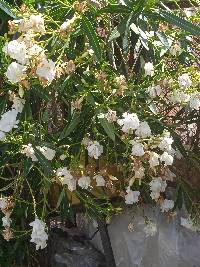
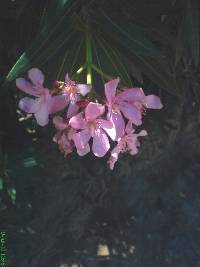
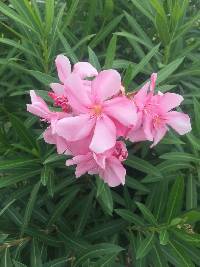
The flowers grow in clusters at the end of each branch; they are 2.5–3 cm (1–1 in) diameter, pink, with a deeply 5-lobed fringed corolla round the central corolla tube in natural wild plants. White to dark red, larger (to 5 cm diameter), and double-flowered, cultivars are also common in cultivation. They are often, but not always, sweet-scented. The fruit is a long narrow pair of follicles 5–23 cm (2–9 in) long, which splits open at maturity to release numerous downy seeds.