Euphorbia ophthalmica, the Florida hammock sandmat, is a species of plant in the family Euphorbiaceae.
Description
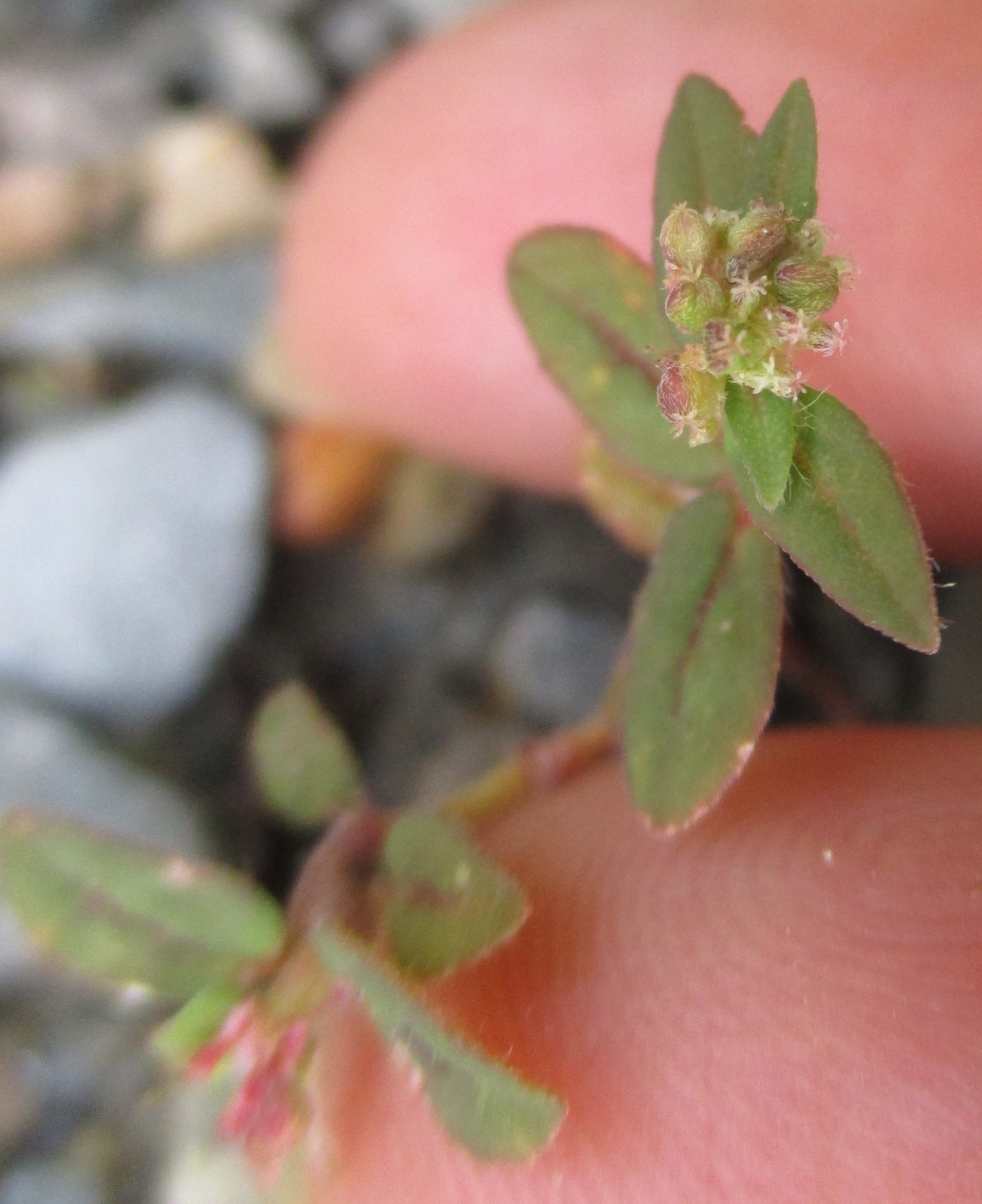
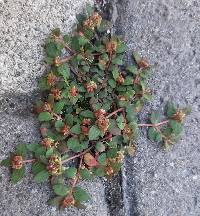
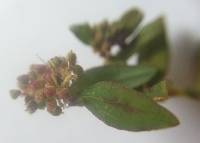
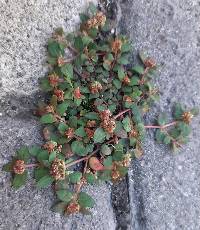
Euphorbia ophthalmica is an annual or short-lived perennial plant with a slender to slightly thickened taproot. Growing on or close to its substrate and forming mats, often it's considered a weed. Its body is covered with varying degrees of hairiness, often with somewhat stiff hairs bending close to the plant's surface. Leaves with asymmetric bases arise opposite one another on petioles up to 1.2mm long (
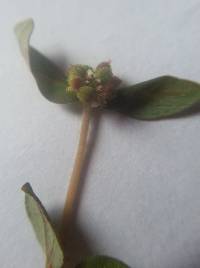
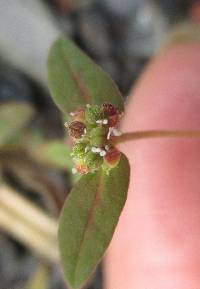
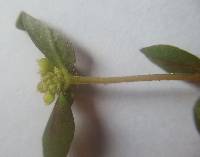
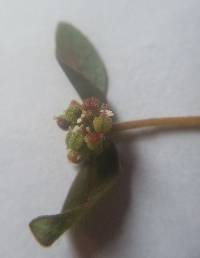
At stem tips, cyathium-type "false flowers," or pseudanthia, are distinctively densely packed in somewhat flat-topped inflorescences. Cub-like cyathia bear 4 yellow-green to pink glands which sometimes bear thin, white to pink rims. Male flowers in each cyathium number 2-8, while the single female flowers have hairy ovaries with styles divided into two from half to nearly their whole lengths. Capsule-type fruits are ovoid, hairy, and up to 1.3mm high (1⁄20 inch). Seeds are orange-brown to pinkish, narrowly ovoid, and almost smooth.
Frequently Euphorbia ophthalmica has been misidentified as Euphorbia hirta, which is larger and more "delicate" than Euphorbia ophthalmica. Also, inflorescences of Euphorbia hirta both terminate the stems and issue from short, leafless branches along the stem where leaf petioles attach, while Euphorbia ophthalmica inflorescences appear strictly at the tips of leafy stems.
Habitat
Flowering and fruiting year-round, Euphorbia ophthalmica inhabits different kinds of disturbed sites, including lawns and roadsides. In the US, it occurs in hammock forests. In the Bahamas it also is found in burned-over piney woods.
Human uses
As a traditional medicine in Mexico, the white latex and stems of Euphorbia ophthalmica have been used both cooked and raw for pimples, boils, sores and "mesquinos," understood to be warts or larger areas of rough, grainy-looking skin caused by Human papillomavirus infection.