Eryngium foetidum is a tropical perennial herb in the family Apiaceae. Common names include culantro (Costa Rica and Panama) ( or ), cimarrón, recao (Puerto Rico), chardon béni (Martinique), Mexican coriander, samat, ban dhaniya, long coriander, wide coriander, Burmese coriander, sawtooth coriander, Shadow Beni (Trinidad and Tobago), and ngò gai (Vietnam). It is native to Mexico, the Caribbean, and Central and South America, but is cultivated worldwide, mostly in the tropics as a perennial, but sometimes in temperate climates as an annual. In India it is called "Mandhonia", specifically in the Northeast.
In the United States, the common name culantro sometimes causes confusion with cilantro, a common name for the leaves of Coriandrum sativum (also in Apiaceae but in a different genus), of which culantro is said to taste like a stronger version.
Uses
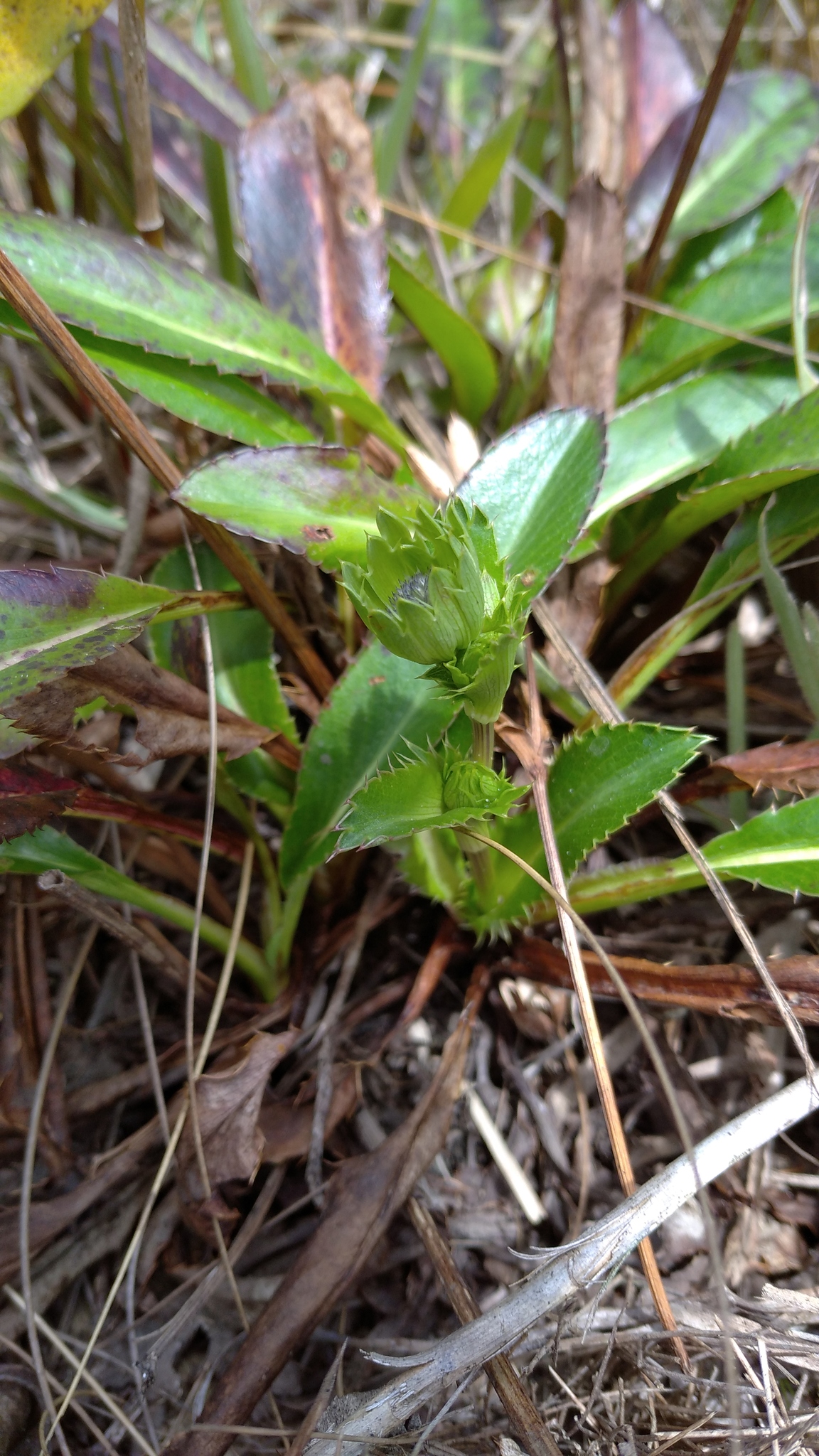
Eryngium foetidum plant with leaves and young inflorescence
Wikibooks Cookbook has a recipe/module on
Culantro
Eryngium foetidum is widely used in seasoning, marinating and garnishing in the Caribbean (particularly in Cuba, the Dominican Republic, Haiti, Puerto Rico, and Trinidad and Tobago), as well as Guatemala, El Salvador, Honduras, Nicaragua, Panama, Costa Rica, Ecuador, Colombia and in Brazil's and Peru's Amazon regions. It is also used extensively as a culinary herb in the North-Eastern States of India (Tripura, Mizoram, Meghalaya, Assam, Nagaland, Manipur, Arunachal Pradesh and Sikkim), Cambodia , Thailand, India, Nepal, Vietnam, Laos, Myanmar, Bangladesh, southwestern China and other parts of tropical Asia. It is sometimes used as a substitute for coriander leaves, but has a stronger, tangier taste. Unlike coriander, Eryngium foetidum dries well, retaining good color and flavor, which makes it valuable in the dried herb industry.
In the United States, E. foetidum grows naturally in Florida, Georgia, Hawaii, Puerto Rico, and the Virgin Islands.