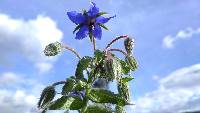
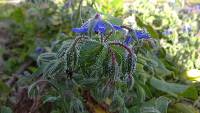
Borage ( or ; Borago officinalis), also known as starflower, is an annual herb in the flowering plant family Boraginaceae native to the Mediterranean region. Although the plant contains small amounts of pyrrolizidine alkaloids, some parts are edible and its seeds provide oil.
Description
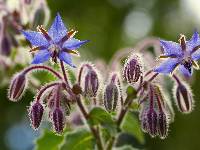
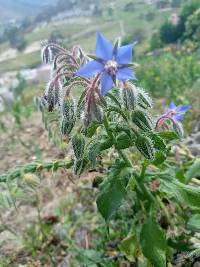
B. officinalis flower
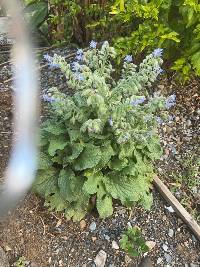
B. officinalis grows to a height of 60 centimetres (2 feet), and is bristly or hairy all over the stems and leaves; the leaves are alternate, simple, and 5–15 cm (2–6 inches) long.
The flowers are complete, perfect with five narrow, triangular-pointed petals. Flowers are most often blue, although pink flowers are sometimes observed. White-flowered types are also cultivated. The blue flower is genetically dominant over the white flower.
The flowers arise along scorpioid cymes to form large floral displays with multiple flowers blooming simultaneously, suggesting that borage has a high degree of geitonogamy (intraplant pollination).
It has an indeterminate growth habit. In temperate climates such as in the UK, its flowering season is relatively long, from June to September. In milder climates, borage blooms continuously for most of the year. It can be invasive.
The seeds consist of 26–38% borage seed oil, of which 17–28% is gamma-linolenic acid (GLA, an omega-6 fatty acid), making borage seed oil the richest known source of GLA. The oil also contains the fatty acids palmitic acid (10–11%), stearic acid (3.5–4.5%), oleic acid (16–20%), linoleic acid (35–38%), eicosenoic acid (3.5–5.5%), erucic acid (1.5–3.5%), and nervonic acid (1.5%). Healthy adults typically produce ample GLA from dietary linoleic acid, but borage seed oil is often marketed as a GLA supplement, under the names "starflower oil" or "borage oil".
The leaves contain small amounts (2–10 ppm in the dried herb) of the liver-toxic pyrrolizidine alkaloids (PA) intermedine, lycopsamine, amabiline, and supinine and the nontoxic saturated PA...