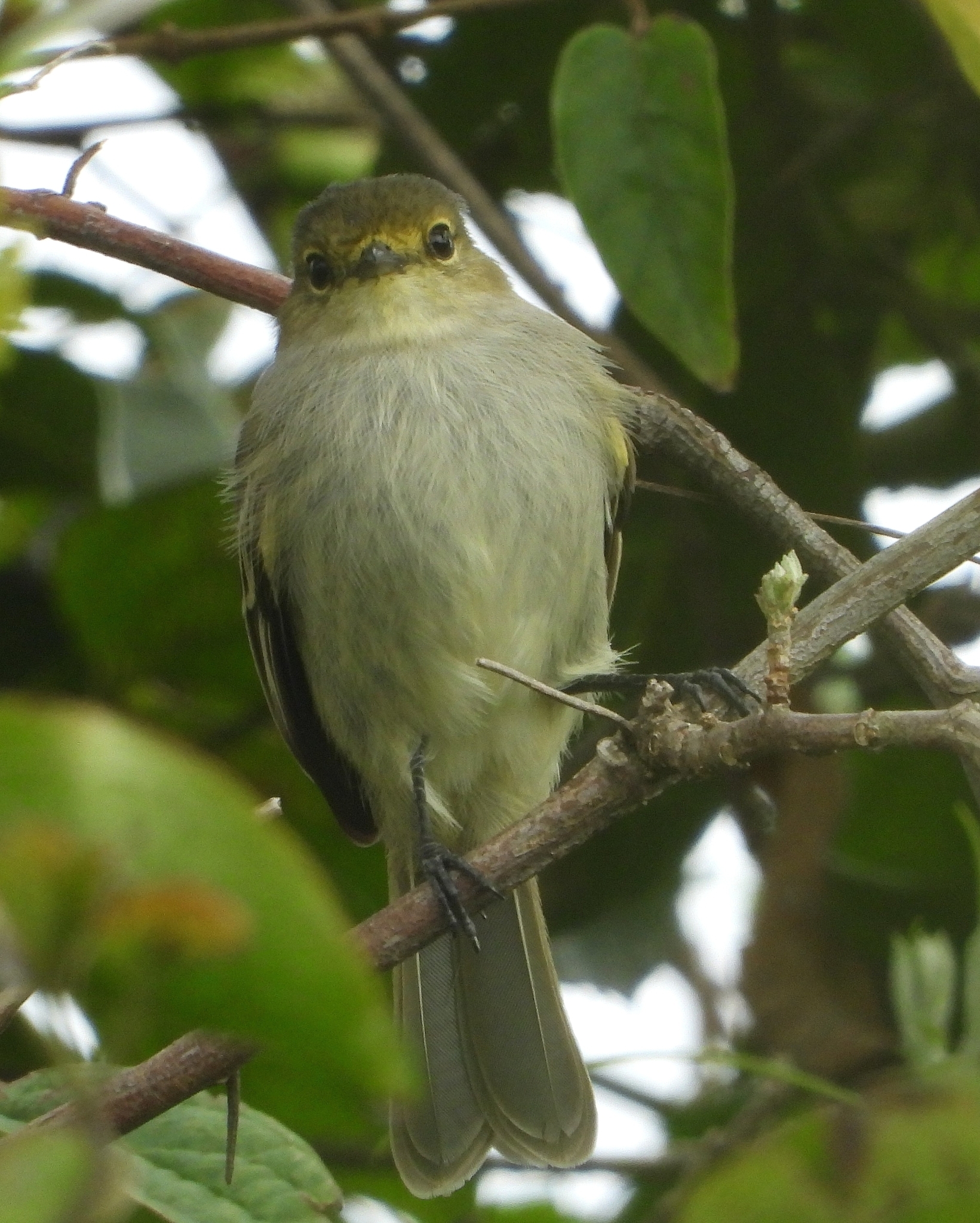
The Peruvian tyrannulet (Zimmerius viridiflavus) is a species of bird in the family Tyrannidae, the tyrant flycatchers. It is found in southwestern Ecuador and Peru.
Taxonomy
The Peruvian tyrannulet was formally described in 1844 as Elaenia viridiflava by the Swiss naturalist Johann Jakob von Tschudi. The specific epithet combines the Latin viridis meaning "green" with flavus meaning "yellow". Tschudi gave the locality as Peru, but this has been restricted to the Río Tulumayo in the Department of Junín. The Peruvian tyrannulet is now one of 13 species placed in the genus Zimmerius that was introduced in 1977 by the American ornithologist Melvin Alvah Traylor Jr..
Two subspecies are recognised:
Z. v. flavidifrons (Sclater, PL, 1860) – southwestern Ecuador (southeastern Guayas to western Loja Province and El Oro) to far northern Peru
Z. v. viridiflavus (Tschudi, JJ, 1844) – east slope of Andes of Peru (Huánuco to Junín)
The subspecies Z. v. flavidifrons was formerly considered as a subspecies of the golden-faced tyrannulet (Zimmerius chrysops), but based on analyses of genetic, morphological and vocal differences by Frank Rheindt and collaborators, flavidifrons was moved to be a subspecies of the Peruvian tyrannulet. The subspecies Z. v. flavidifrons has also been treated as a separate species, the Loja tyrannulet.
Description
The Peruvian tyrannulet is about 11 to 12 cm (4.3 to 4.7 in) long and weighs 9 to 10 g (0.32 to 0.35 oz). The sexes have the same plumage. Adults have pale yellow lores and eye-ring and a dark stripe through the eye on an otherwise buff-washed bright olive face. Their crown is darkish olive to grayish olive and their back and rump are bright olive. Their wings are dark dusky with bright yellow-green edges on the coverts and flight feathers. Their tail is dusky olive. Their throat is pale yellow, their breast and flanks olive-yellow with some olive markings, and their belly bright yellow. They have a gray to medium...