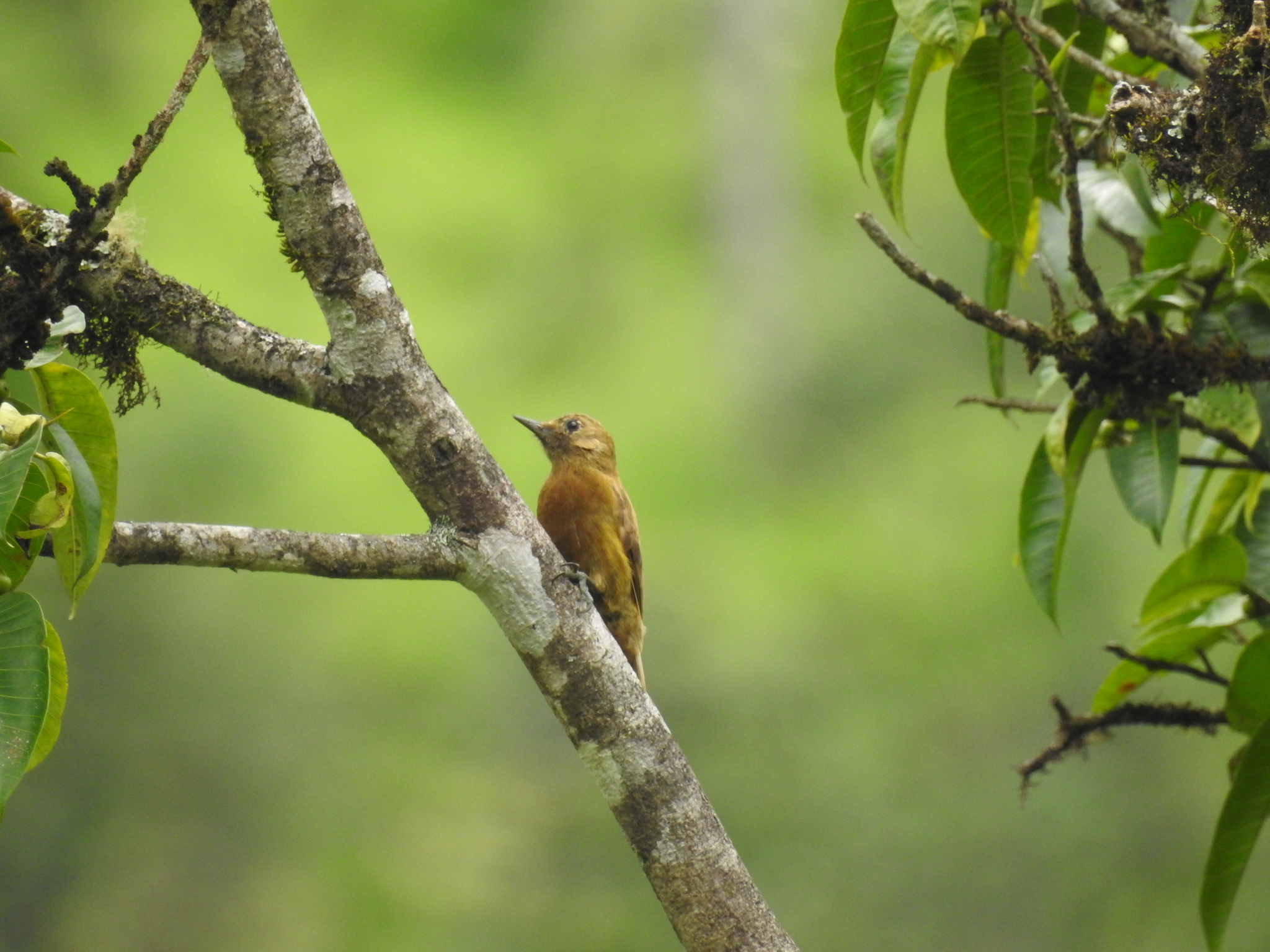
The smoky-brown woodpecker (Leuconotopicus fumigatus) is a species of bird in subfamily Picinae of the woodpecker family Picidae. It is found in Argentina, Belize, Bolivia, Colombia, Costa Rica, Ecuador, El Salvador, Guatemala, Honduras, Mexico, Nicaragua, Panama, Peru, and Venezuela.
Taxonomy and systematics
The species was first described by the French naturalist Alcide d'Orbigny as Picus fumigatus, based on individuals observed in the Province of Corrientes in Argentina, and later in Santa Cruz de la Sierra in Bolivia.
Since its original description it has successively been placed in genus Leuconotopicus and Picoides and then returned to Leuconopticus. The International Ornithological Committee and BirdLife International's Handbook of the Birds of the World retain it in that genus. However, starting in 2018, the American Ornithological Society and the Clements taxonomy moved all species of genus Leuconotopicus into genus Dryobates.
The genus name Leuconotopicus derives from the Ancient Greek leukos (white), noton (back) and pikos (woodpecker). The specific epithet fumigatus is Latin for smoked.
The taxonomic systems recognize these five subspecies:
L. f. oleagineus (Reichenbach, 1854)
L. f. sanguinolentus (Sclater, P.L., 1859)
L. f. reichenbachi (Cabanis & Heine, 1863)
L. f. fumigatus (D'Orbigny, 1840)
L. f. obscuratus (Chapman, 1927)
Male in Colombia
Description
The smoky-brown woodpecker is about 18 cm (7.1 in) long and weighs 31 to 50 g (1.1 to 1.8 oz). Males and females have the same plumage except on their heads. Males are red from forehead to nape with dark feather bases showing through. The female's forehead to nape is dark brown with an olive tinge and occasionally some white speckles. Adults of both sexes of the nominate subspecies fumigatus have a mostly olive-brown face with whitish lores, a thin white supercilium, and a black "moustache" with a thin white line above it. Their upperparts are mostly brown to olive-brown with a red...