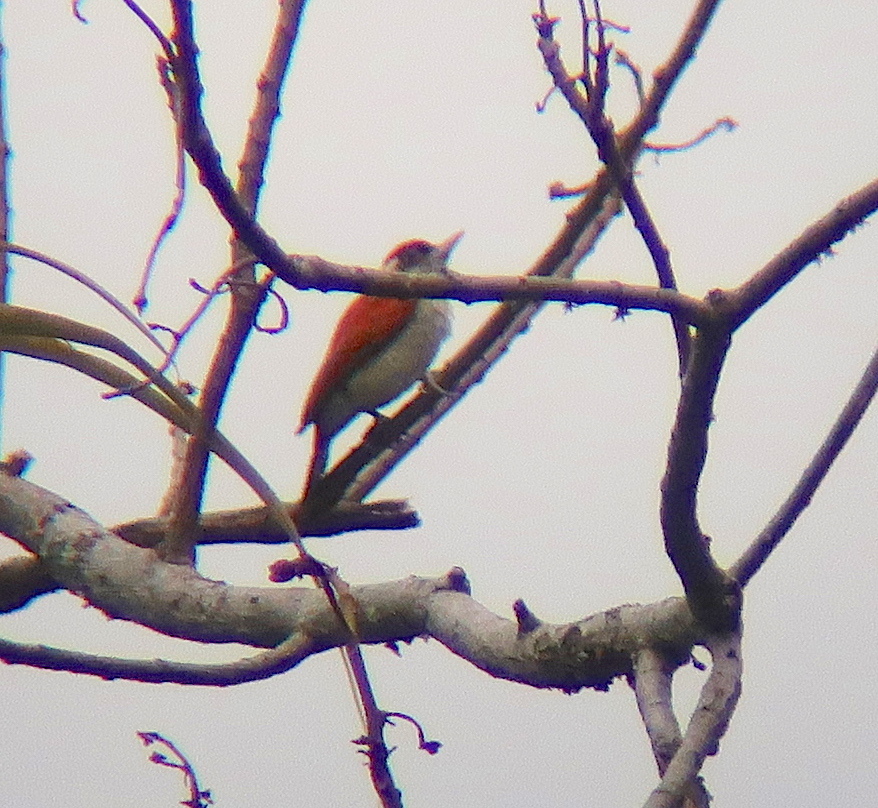
Veniliornis is a genus of birds in the woodpecker family Picidae. They are native to the Neotropics.
Taxonomy
The genus was introduced by the French ornithologist Charles Lucien Bonaparte in 1854. The word Veniliornis combines the name of the Roman deity Venilia with the Greek word ornis meaning "bird". The type species was designated as the blood-colored woodpecker (Veniliornis sanguineus) by the English zoologist George Robert Gray in 1855.
The genus contains the following 14 species:
Image
Common name
Scientific name
Distribution
Scarlet-backed woodpecker
Veniliornis callonotus
Colombia, Ecuador and northern Peru
Yellow-vented woodpecker
Veniliornis dignus
Colombia, Ecuador, Peru, and Venezuela
Bar-bellied woodpecker
Veniliornis nigriceps
Bolivia, Colombia, Ecuador, and Peru.
Little woodpecker
Veniliornis passerinus
South America east of the Andes
Dot-fronted woodpecker
Veniliornis frontalis
Argentina and Bolivia.
White-spotted woodpecker
Veniliornis spilogaster
Brazil, Uruguay, eastern Paraguay and northeastern Argentina.
Blood-colored woodpecker
Veniliornis sanguineus
Guyana, Suriname, and French Guiana
Red-rumped woodpecker
Veniliornis kirkii
Costa Rica south and east to Ecuador, Venezuela, Trinidad and Tobago
Red-stained woodpecker
Veniliornis affinis
eastern Brazil and the Amazon Basin.
Chocó woodpecker
Veniliornis chocoensis
Colombia and Ecuador.
Golden-collared woodpecker
Veniliornis cassini
northern Brazil, the Guianas, Venezuela and far eastern Colombia.
Yellow-eared woodpecker
Veniliornis maculifrons
eastern Brazil.
Striped woodpecker
Veniliornis lignarius – formerly in Picoides
southwestern South America.
Checkered woodpecker
Veniliornis mixtus – formerly in Picoides
eastern South America.