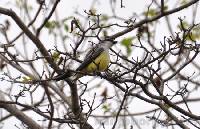
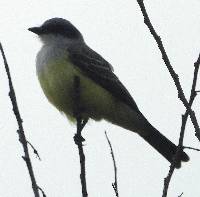
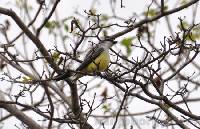
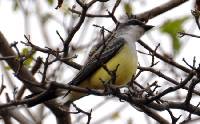
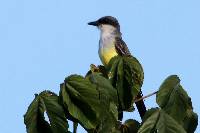
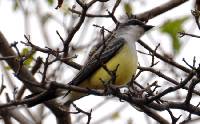
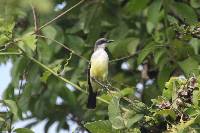
The snowy-throated kingbird (Tyrannus niveigularis) is a species of bird in the family Tyrannidae, the tyrant flycatchers. It is found in Colombia, Ecuador, and Peru.
Taxonomy and systematics
The snowy-throated kingbird is monotypic.
South of Guayaquil, Ecuador
Description
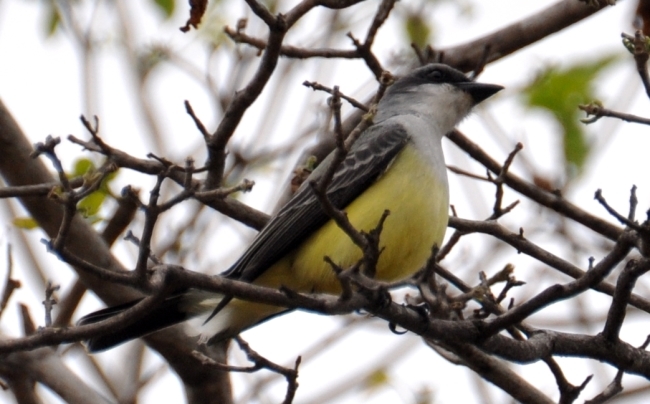
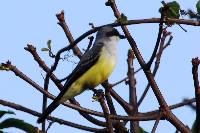
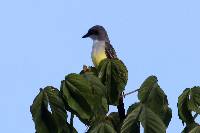
The snowy-throated kingbird is 18.5 to 19 cm (7.3 to 7.5 in) long; one male weighed 34.4 g (1.2 oz). The sexes have the same plumage. Adults have a gray crown and nape with a partially hidden yellow patch in the center of the crown. They have a thin black band on the forecrown and lores that widens into a mask to the ear coverts. Their upperparts are mostly pale gray with more olive on the lower back and rump. Their wings are dusky with whitish edges on the coverts and secondaries. Their tail is blackish with a square tip. Their cheeks and throat are white that darkens to pale gray on the breast. Their belly and undertail coverts are pale yellow. They have a dark iris, a black bill, and black legs and feet.
Distribution and habitat
The snowy-throated kingbird is found west of the Andes from far southwestern Colombia's Nariño Department south through Ecuador into Peru as far as northern La Libertad and southwestern San Martín departments. During the breeding season it inhabits gallery forest, deciduous forest, arid scrublands, secondary forest, and agricultural areas that retain some woodlands. In northern Ecuador and probably Colombia in the non-breeding season it occurs in more humid landscapes. In elevation it is found below 1,500 m (4,900 ft) in Colombia, mostly below 500 m (1,600 ft) in Ecuador, and below 700 m (2,300 ft) in Peru.
Behavior
The snowy-throated kingbird is a partial migrant. It usually leaves Peru entirely between July and November "but may stay longer in strong El Niño years". It is a year-round resident in Ecuador from about the Peruvian border north to central Manabí Province though part of that population moves into the rest of northwestern Ecuador for June to November...