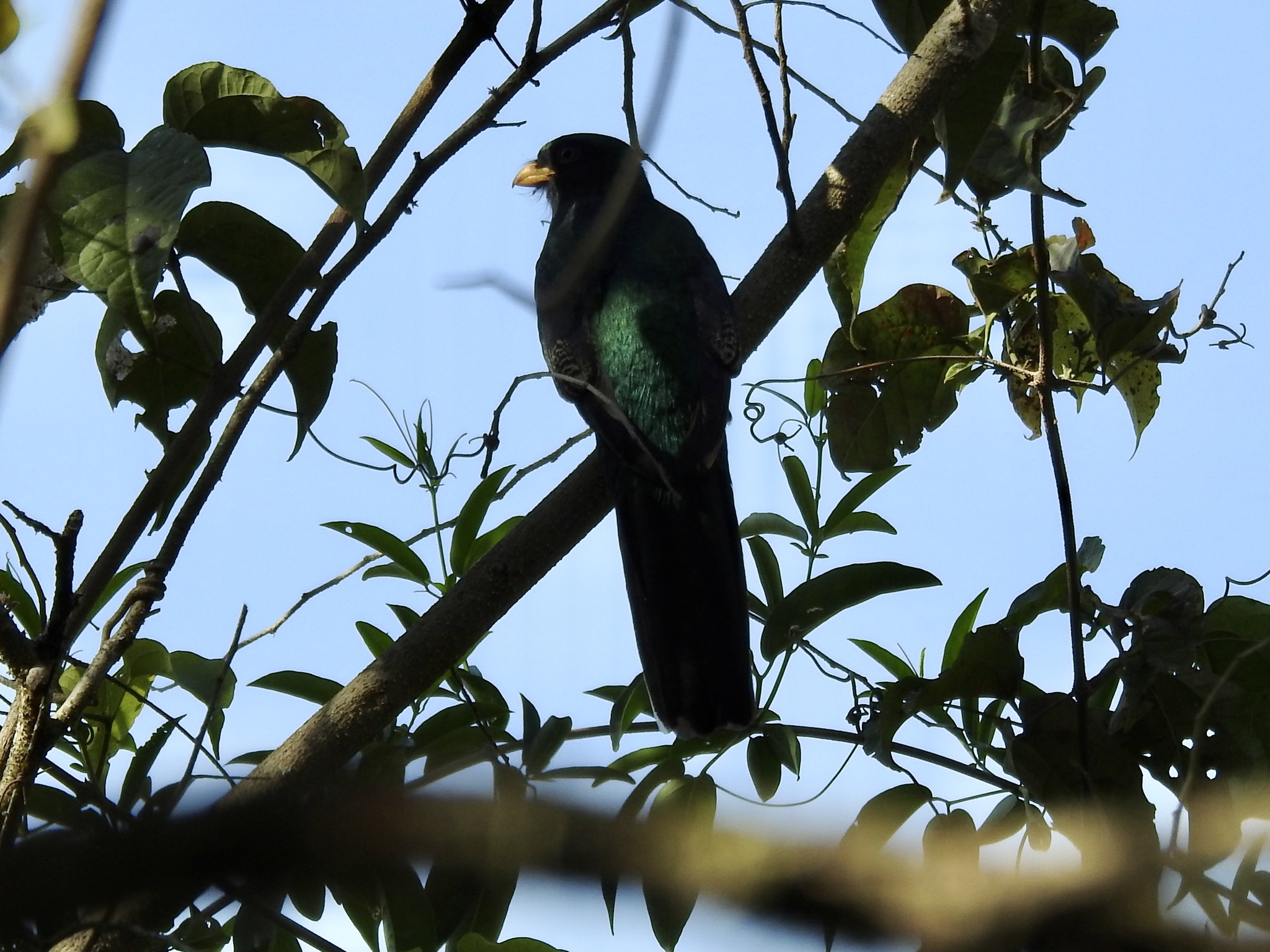
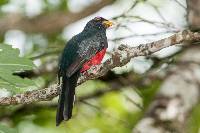
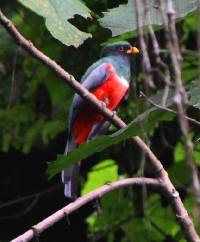
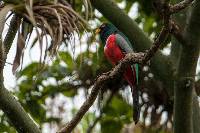
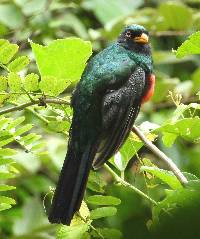
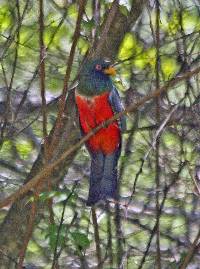
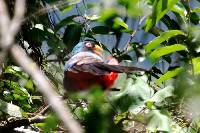
The black-tailed trogon (Trogon melanurus) is a species of bird in the family Trogonidae, the quetzals and trogons. It is found Panama and northern South America.
Taxonomy and systematics
The black-tailed trogon has three subspecies according to the International Ornithological Committee (IOC): the nominate T. m. melanurus, T. m. macroura, and T. m. eumorphus. The Clements taxonomy adds a fourth subspecies, T. m. occidentalis. What is now the Ecuadorian trogon (T. mesurus) was until the early 2000s considered another subspecies. A subspecies of slaty-tailed trogon (T. massena australis) is sometimes treated as a subspecies of black-tailed trogon, and T. m. macroura has been suggested as a separate species.
Female Black-tailed Trogon
San Francisco Reserve, Darien - Panama
Description
The black-tailed trogon is 28 to 30 cm (11 to 12 in) long and weighs 52 to 122 g (1.8 to 4.3 oz). The male of the nominate subspecies has a yellow bill and a blackish face and throat with an orange-red ring around the eye. The crown, nape, upperparts, and breast are green. A white band separates the breast from the red belly and vent. The upperside of the tail is deep blue and the underside is slaty gray. The folded wing has fine vermiculation that looks gray at a distance. The female's maxilla is slaty. She is gray where the male is green, and the gray of the breast extends further into the upper belly. Instead of the orange-red ring around the eye there are white arcs before and after it. The male T. m. macroura's wing has coarser vermiculation than the nominate and the upper tail is more turquoise. Its wings and tail are longer. The male T. m. eumorphus is similar to the nominate, but its wings are darker, the tail bluer, and the white breast band narrower. T. m. occidentalis is indistinguishable from eumorphus.
Distribution and habitat
The range of T. m. macroura is separate from that of the other subspecies. It is found in Panama east of the Canal Zone through northern Colombia into extreme...