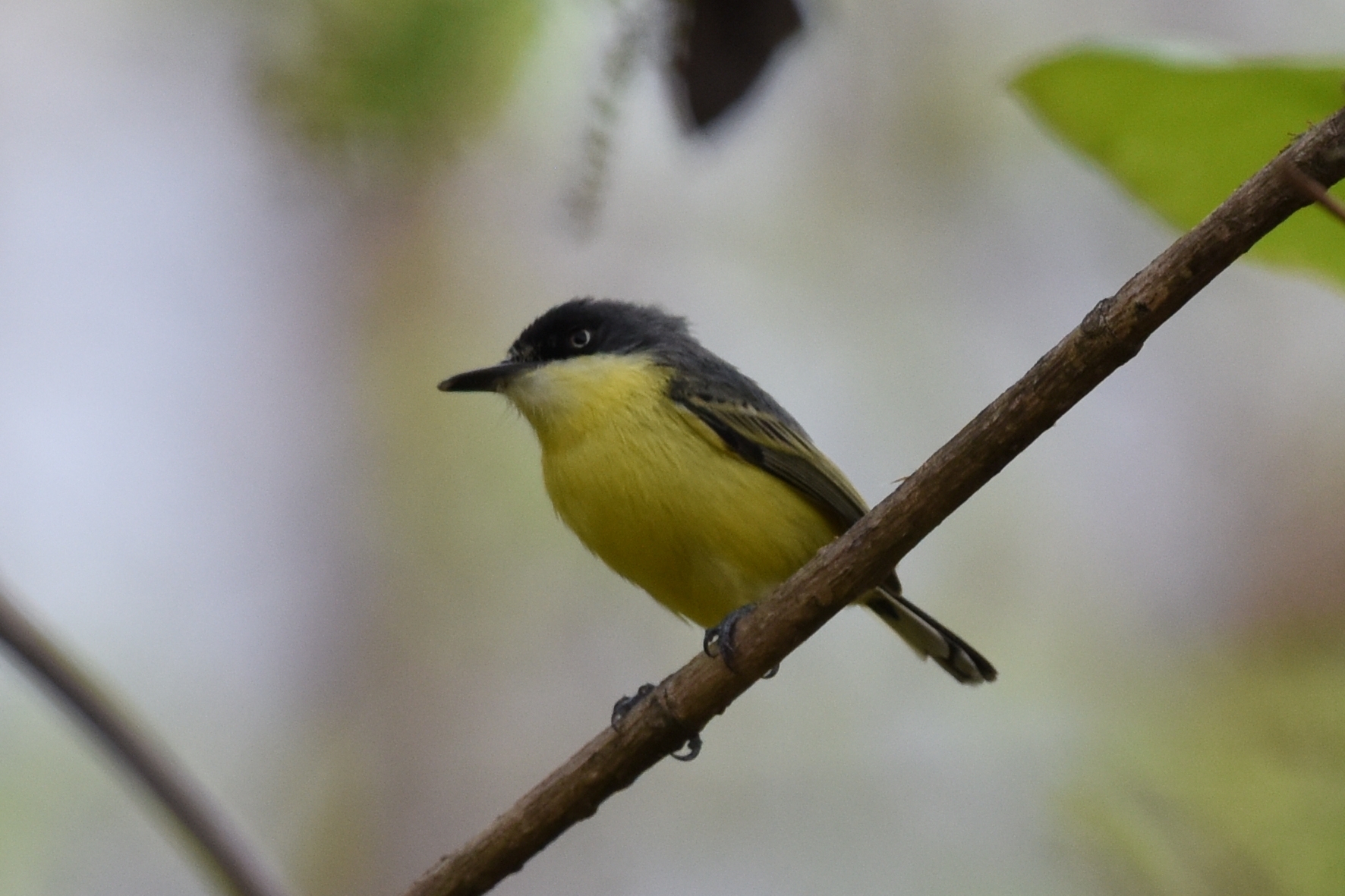
The common tody-flycatcher (Todirostrum cinereum) is a small passerine bird in the family Tyrannidae, the tyrant flycatchers. It is found in Mexico, in every Central American country, and in every mainland South American country except Chile and Uruguay.
Taxonomy and systematics
The common tody-flycatcher was formally described by the Swedish naturalist Carl Linnaeus in 1766 in the twelfth edition of his Systema Naturae under the binomial name Todus cinereus. Linnaeus based his description on the "Grey and Yellow Fly-catcher" that had been described and illustrated in 1760 by George Edwards from a specimen collected in Suriname. The specific epithet cinereum is from Latin cinereus meaning "ash-grey". The common tody-flycatcher is now the type species of the genus Todirostrum that was introduced by René Lesson in 1831.
Eight subspecies are recognized:
T. c. virididorsale Parkes, 1976
T. c. finitimum Bangs, 1904
T. c. wetmorei Parkes, 1976
T. c. sclateri (Cabanis & Heine, 1860)
T. c. cinereum (Linnaeus, 1766)
T. c. peruanum Zimmer, JT, 1930
T. c. coloreum Ridgway, 1906
T. c. cearae Cory, 1916
The Clements taxonomy partially separates T. c. sclateri as "common tody-flycatcher (sclateri) within the species; the other seven subspecies are the "common tody-flycatcher (cinereum group)".
Description
The common tody-flycatcher is a tiny, big-headed bird, 8.8 to 10.2 cm (3.5 to 4.0 in) long, weighing 4 to 8 g (0.14 to 0.28 oz), and with a long, flattened, straight bill. Adult males of the nominate subspecies T. c. cinereum have a glossy black forecrown and a slate-gray hindcrown and nape. Their lores and the area around their eyes are glossy black. Their upper back is slate-gray that becomes dark olive all the way to the uppertail coverts. Their wings are black with yellow edges on the flight feathers and yellow edges and tips on the coverts; the last show as two wing bars. Their tail is black with white tips on the outer feathers. Their entire underparts are...