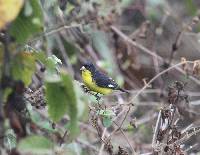
The lesser goldfinch (Spinus psaltria) is a small finch in the genus Spinus native to the Americas.
As is the case for most species in the genus Spinus, lesser goldfinch males have a black forehead, which females lack. Males in this species vary strikingly in the color of their back across their range, from green in western North America to black in the eastern Rocky Mountains and Texas south to northern South America; this variation has resulted in five subspecies being recognized.
Taxonomy
S. p. hesperophilus
Together with its relatives the American goldfinch and Lawrence's goldfinch, it forms a clade, termed the 'New World goldfinch' clade, in the genus Spinus. Some authors have suggested treating this clade as a separate genus Astragalinus, but this has not been followed by either the IOC or BirdLife International.
The lesser goldfinch was formally described by the American zoologist Thomas Say in 1822 under the binomial name Fringilla psaltria. The specific epithet psaltria is Ancient Greek for a female harpist. The type locality is Colorado Springs, Colorado. The lesser goldfinch is now placed in the genus Spinus that was introduced in 1816 by the German naturalist Carl Ludwig Koch.
Five subspecies are currently recognized, though their validity has been questioned:
S. p. hesperophilus (Oberholser, 1903) – west USA and northwest Mexico
S. p. witti Grant, PR, 1964 – Tres Marias Islands (off west Mexico)
S. p. psaltria (Say, 1822) – west-central USA to south-central Mexico
S. p. jouyi (Ridgway, 1898) – southeast Mexico and northwest Belize
S. p. colombianus (Lafresnaye, 1843) – south Mexico to Peru and Venezuela