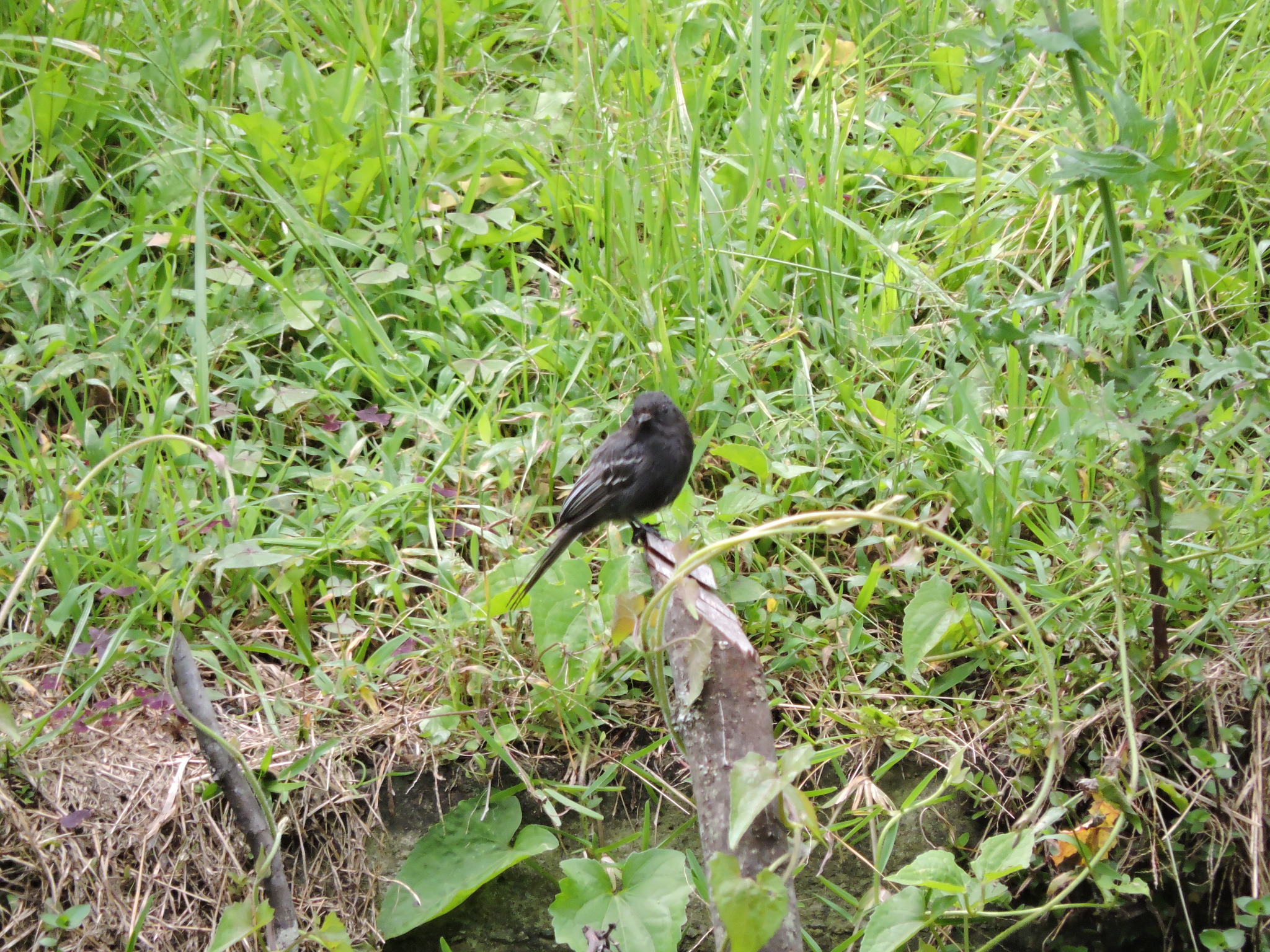
The genus Sayornis is a small group of medium-sized insect-eating birds, known as phoebes, in the tyrant flycatcher family Tyrannidae.
Taxonomy
The genus Sayornis that was introduced by the French naturalist Charles Lucien Bonaparte in 1854 with black phoebe (Sayornis nigricans) as the type species. The genus name is constructed from the specific part of Bonaparte's name for Say's phoebe, Muscicapa saya, and Ancient Greek ornis meaning "bird". The English Phoebe is a name for the Roman moon-goddess Diana. A large molecular phylogenetic study of the tyrant flycatcher family published in 2020 found that Sayornis was sister to the genus Empidonax.
Description and ecology
They are native to North and South America.
They prefer semi-open or open areas near water. These birds wait on a perch and then catch insects, usually in pairs. Their nest is an open cup sometimes placed on man-made structures. They aren't fond of dense forests, and prefer low perches.
They often slowly lower and raise their tails while perched.
The genus contains three species:
Image
Scientific name
Common name
Distribution
Sayornis phoebe
Eastern phoebe
Eastern North America
Sayornis nigricans
Black phoebe
United States, Mexico and Central America, and parts of South America
Sayornis saya
Say's phoebe
United States and Canada
Species
The genus contains three species:
Image
Scientific name
Common name
Distribution
Sayornis phoebe
Eastern phoebe
Eastern North America
Sayornis nigricans
Black phoebe
United States, Mexico and Central America, and parts of South America
Sayornis saya
Say's phoebe
United States and Canada