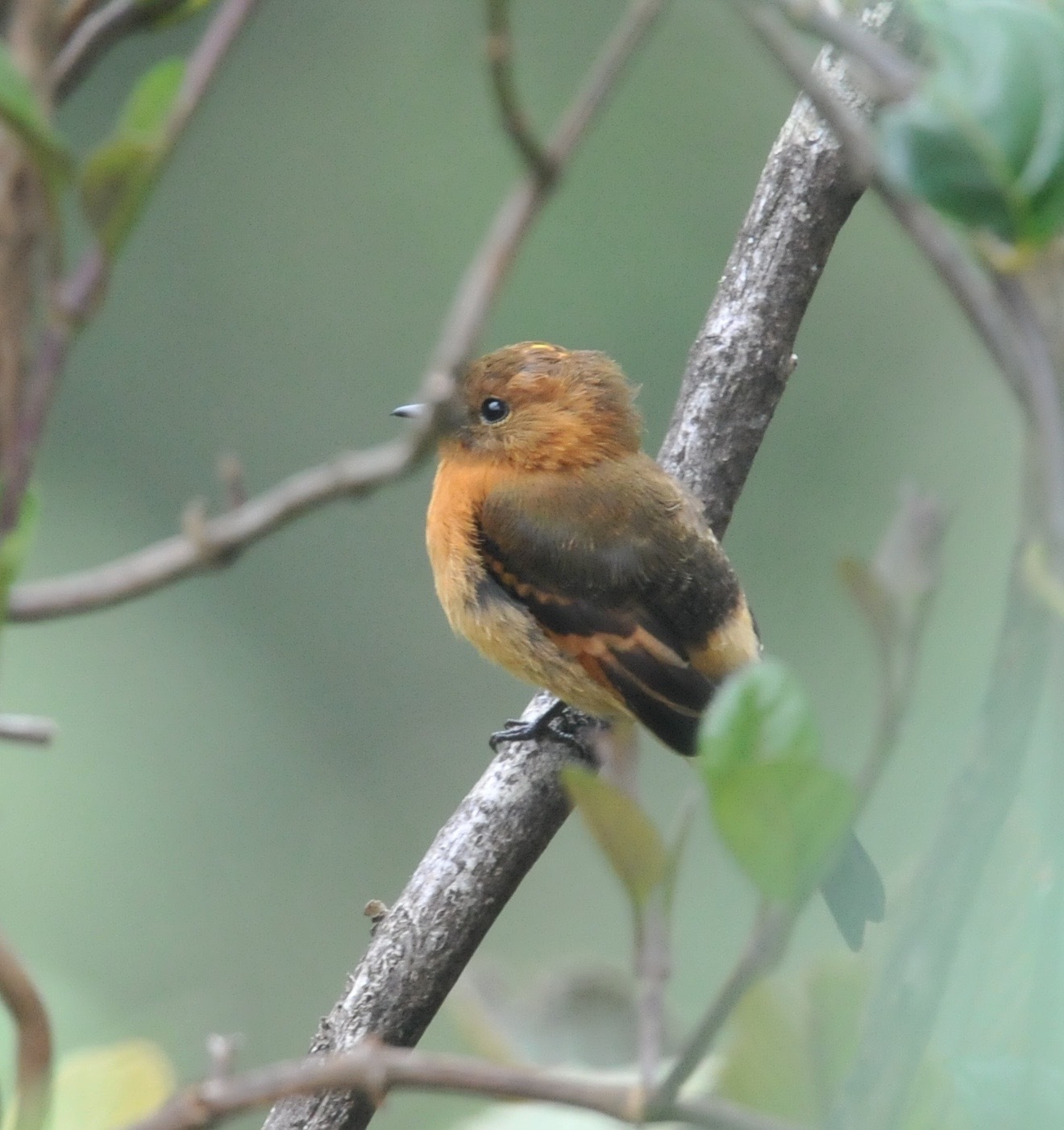
The cinnamon flycatcher (Pyrrhomyias cinnamomeus) is a species of bird in the family Tyrannidae, the tyrant flycatchers. It is native to the cloud forests of the Andes and other South American mountain ranges, and is found in Argentina, Bolivia, Colombia, Ecuador, Peru, and Venezuela.
Taxonomy and systematics
The cinnamon flycatcher was originally described as Muscicapa cinnamomea, a member of the Old World flycatcher family Muscicapidae. In the mid-nineteenth century it was recognized as a tyrant flycatcher and moved to its current genus, where it is the only member.
The cinnamon flycatcher has these six subspecies:
P. c. assimilis (Allen, JA, 1900)
P. c. vieillotioides (Lafresnaye, 1848)
P. c. spadix Wetmore, 1939
P. c. pariae Phelps, WH & Phelps, WH Jr, 1949
P. c. pyrrhopterus (Hartlaub, 1843)
P. c. cinnamomeus (D'Orbigny & Lafresnaye, 1837)
The Clements taxonomy further sorts the subspecies into the Santa Marta group (assimilis), the Venezuelan group (vieillotioides, spadix, and pariae), and the Andean group (pyrrhopterus and cinnamomeus). Several of the subspecies were originally described as full species, and P. c. assimilis may warrant reconsideration as one.
Description
The cinnamon flycatcher is 11 to 13 cm (4.3 to 5.1 in) long and weighs about 11 g (0.39 oz). The sexes have the same plumage. Adults of the nominate subspecies P. c. cinnamomeus have a dark brownish crown with a partially hidden yellow patch in the center. They have a faint buffy eye-ring and patch above the lores, olive-brown cheeks and nape, and cinnamon-rufous sides of the neck. Their upperparts are olive-brown with a thin, often hidden, cinnamon-orange band on the rump. Their wings are black with wide rufous edges on the flight feathers and wide rufous tips on the coverts that show as two wing bars. Their tail is blackish. Their throat and underparts are cinnamon-rufous; the belly is lighter than the rest. They have a dark iris, a wide black bill, and blackish legs and...