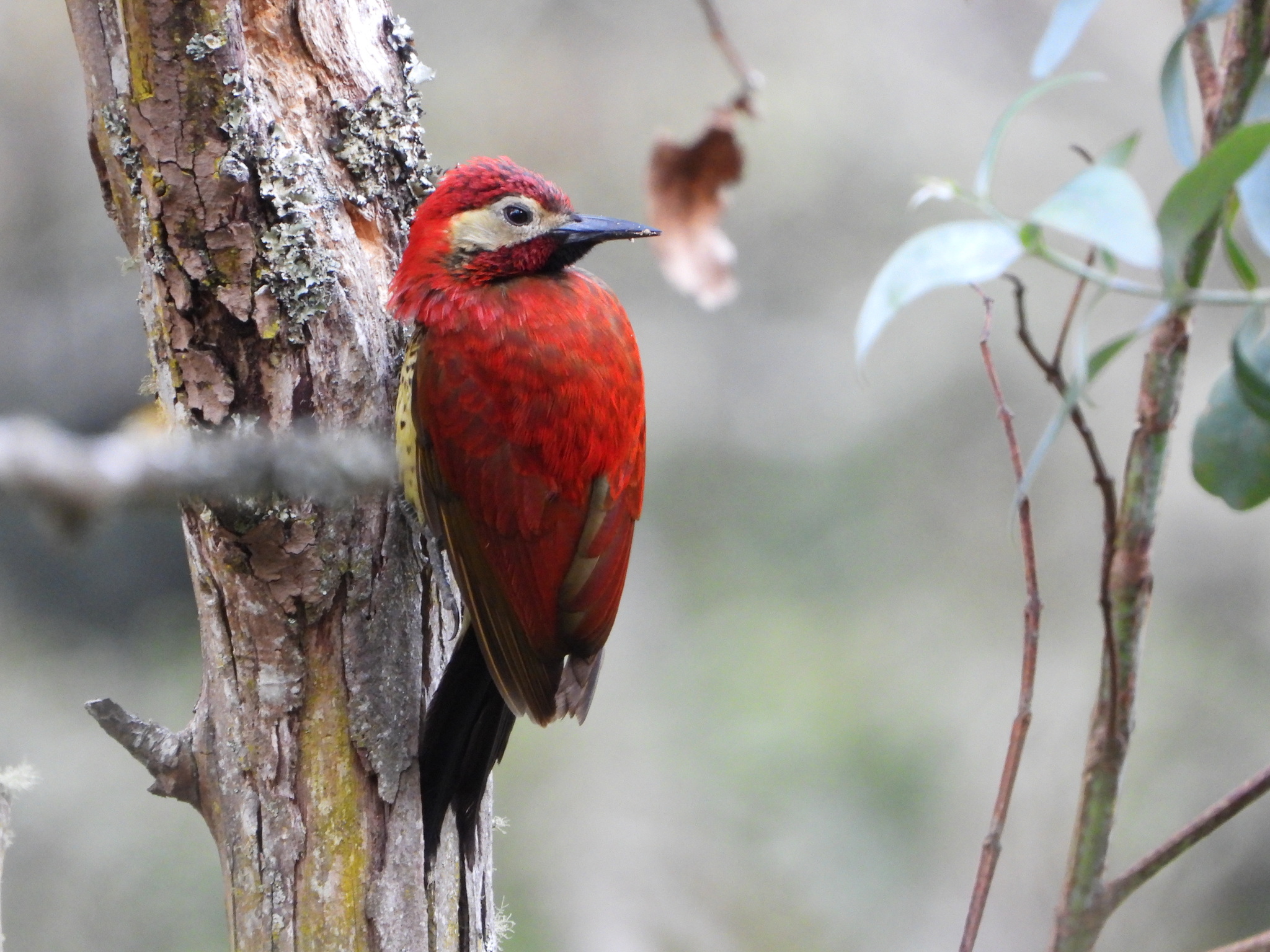
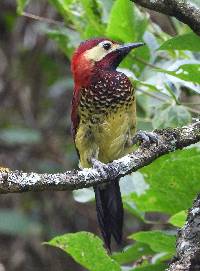
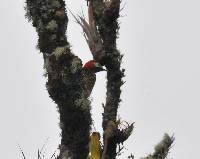
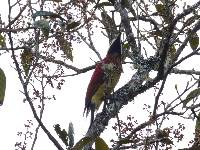
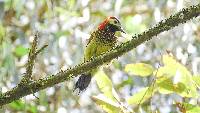
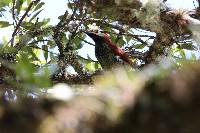
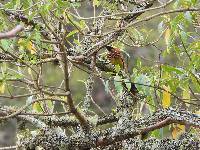
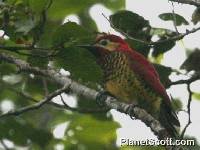
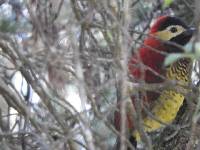
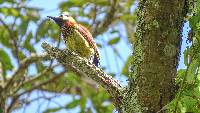
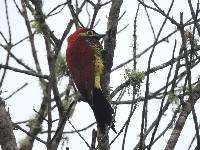
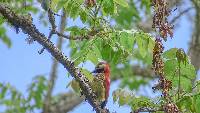
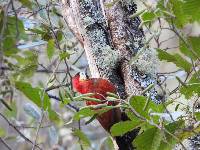
The crimson-mantled woodpecker (Colaptes rivolii) is a species of bird in subfamily Picinae of the woodpecker family Picidae. It is found in Bolivia, Colombia, Ecuador, Peru, and Venezuela.
Taxonomy and systematics
The crimson-mantled woodpecker was originally described as Picus Rivolii. It was later placed in genus Hypoxanthus that was still later merged into Piculus; since about 2007 it has been moved into Colaptes by taxonomic systems.
The American Ornithological Society, the International Ornithological Committee, and the Clements taxonomy recognize these six subspecies of crimson-mantled woodpecker:
C. r. quindiuna (Chapman, 1923)
C. r. zuliensis (Aveledo & Peréz, 1989)
C. r. rivolii (Boissonneau, 1840)
C. r. meridae (Chapman, 1923)
C. r. brevirostris (Taczanowski, 1874)
C. r. atriceps (Sclater and Salvin, 1876)
BirdLife International's Handbook of the Birds of the World (HBW) treats C. r. atriceps as a separate species, the black-crowned woodpecker.
The specific epithet rivolii honors French ornithologist François Victor Masséna, third Duke of Rivoli and third Prince of Essling.
This article follows the six-subspecies model.
Description
The crimson-mantled woodpecker is 23 to 26 cm (9.1 to 10 in) long and weighs 85 to 112 g (3.0 to 4.0 oz). Males and females have the same plumage except on their heads. Adult males of the nominate subspecies C. r. rivolii have a red crown. Their face is mostly pale yellow with a dark red malar stripe and a black chin and throat. Adult females have a black crown and malar stripe. Both sexes have a crimson red nape and mantle; their rump and uppertail coverts are black. Their wings are bronzy red and their tail is black. Their underparts are yellow with black and red scallops on the breast and sometimes black spots on the belly. Their bill is black, their iris red-brown to brown, and the legs pale gray. Juveniles are generally duller than adults and have no red on the breast; the male's crown is...