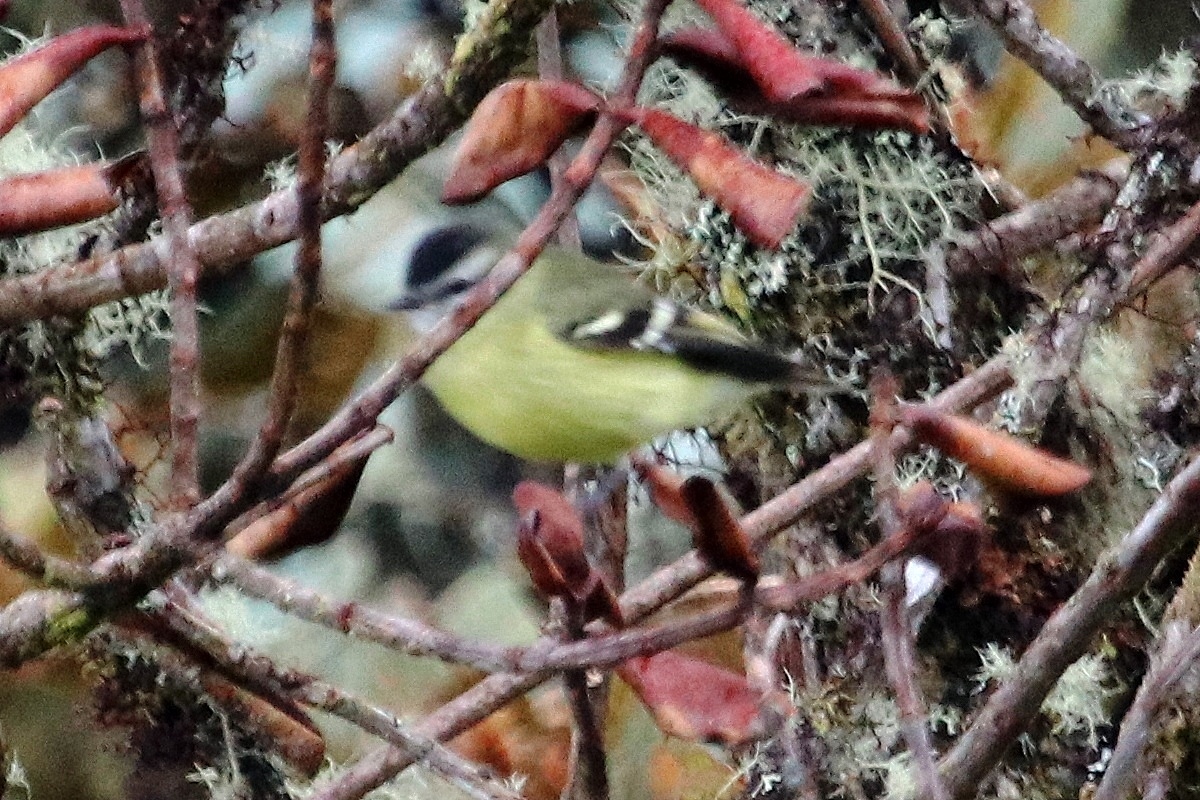
Phyllomyias is a genus of small birds in the tyrant-flycatcher family Tyrannidae. They are found in wooded habitats of Central and South America. Some species are among the most common birds in their range, while other are rare and threatened. They have a short, stubby bill, are greenish above, yellowish or whitish below, and all except the sooty-headed tyrannulet have pale wing-bars or edging. They feed on small arthropods and fruits. Most species regularly take part in mixed species flocks.
Taxonomy
The genus Phyllomyias was introduced in 1860 by the German ornithologists Jean Cabanis and Ferdinand Heine. The genus name combines the Ancient Greek φυλλον/phullon meaning "leaf" with Modern Latin myias meaning "flycatcher". The type species was subsequently designated in 1888 by Philip Sclater as Platyrhynchus brevirostris Spix, now a subspecies of the Planalto tyrannulet.
Species
The genus formerly included more species. A molecular phylogenetic study published in 2020 found that the genus was paraphyletic. In the rearrangement to create monophyletic genera three species were moved to the resurrected genus Tyranniscus and two species to the resurrected genus Acrochordopus. The genus Phyllomyias now contains 9 species:
Image
Common name
Scientific name
Distribution
Greenish tyrannulet
Phyllomyias virescens
Argentina, Brazil, and Paraguay
Reiser's tyrannulet
Phyllomyias reiseri
central Brazil and northern Paraguay
Urich's tyrannulet
Phyllomyias urichi
Venezuela
Sclater's tyrannulet
Phyllomyias sclateri
Argentina, Bolivia, and Peru
Yungas tyrannulet
Phyllomyias weedeni
north-western Bolivia and far south-eastern Peru
Planalto tyrannulet
Phyllomyias fasciatus
eastern Brazil, extreme north-eastern Bolivia, eastern Paraguay, and far north-eastern Argentina
Sooty-headed tyrannulet
Phyllomyias griseiceps
Brazil, Colombia, Ecuador, Guyana, Panama, Peru, and Venezuela
Plumbeous-crowned tyrannulet
Phyllomyias plumbeiceps
Colombia, Ecuador, and...