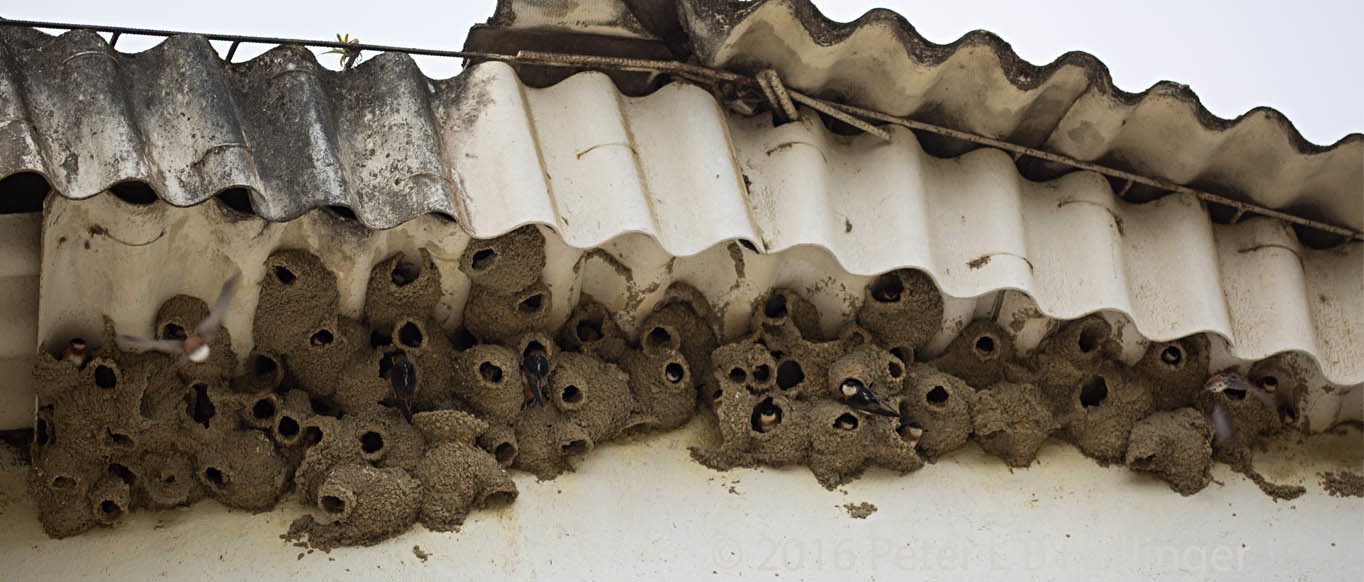
Petrochelidon is a genus of birds known as cliff-nesting swallows.
Taxonomy
The genus Petrochelidon was introduced in 1851 by the German ornithologist Jean Cabanis. He listed several species in the new genus but did not specify the type species. In 1855 the English zoologist George Gray designated the type as Hirundo melanogaster Swainson. This taxon is now treated as a subspecies of the American cliff swallow (Petrochelidon pyrrhonota melanogaster). The genus name Petrochelidon is from the Greek words petra, "rock", and khelidon, "swallow".
The genus includes all five species commonly called cliff swallow. The genus contains ten species:
Image
Common name
Scientific name
Distribution
American cliff swallow
Petrochelidon pyrrhonota
Canada and the United States of America, South American countries, such as Southern Brazil, Uruguay, and parts of Argentina.
Cave swallow
Petrochelidon fulva
south-eastern New Mexico, Texas, Florida, the Greater Antilles, portions of southern Mexico, and along the west coast of South America.
Chestnut-collared swallow
Petrochelidon rufocollaris
Ecuador and Peru.
Preuss's cliff swallow
Petrochelidon preussi
Benin, Burkina Faso, Cameroon, Central African Republic, Chad, Republic of the Congo, Ivory Coast, Equatorial Guinea, Ghana, Guinea, Guinea-Bissau, Mali, Niger, Nigeria, Sierra Leone, and Togo.
Red-throated cliff swallow
Petrochelidon rufigula
Angola, Republic of the Congo, DRC, Gabon, and Zambia.
Red Sea cliff swallow
Petrochelidon perdita
Sudan.
South African cliff swallow
Petrochelidon spilodera
Botswana, Republic of the Congo, Democratic Republic of the Congo, Gabon, Lesotho, Malawi, Namibia, South Africa, Zambia, and Zimbabwe.
Streak-throated swallow
Petrochelidon fluvicola
Afghanistan, Bangladesh, India, Nepal and Pakistan.
Fairy martin
Petrochelidon ariel
Australia, with some birds reaching New Guinea and Indonesia.
Tree martin
Petrochelidon nigricans
Australia, New Guinea,...