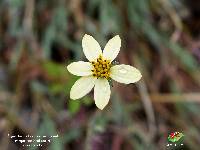
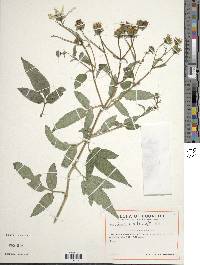
Bidens reptans is a species of scrambling perennial plant of the Neotropical realm belonging to the family Asteraceae
Description
Bidens reptans displays these main features:
It can be a herbaceous, perennial that creeps along the ground, lies atop other vegetation, and it can climb into trees as a woody liana developing branches which dangle.
Leaves arise opposite one another on stems and may be simple with no subdivisions, or have up to 7 leaflets, which are up to 14 cm (5.5 in) long and 12 cm (4.7 in) wide.
Flowering heads are all yellow, with each head producing up to 8 petal-like ray florets along the margins, and with an "eye" of up to 30 disk florets with cylindrical corollas.
The involucre from which the florets emerge consists of two dissimilar series of bracts; there are 5–8, somewhat fleshy, green, external ones and 8-10 interior ones which are thinner in texture and yellowish green.
The one-seeded, cypsela-type fruits are up to 12 mm (0.5 in) long and 1.4 mm (0.06 in) wide, topped with 2 sharp awns, with each awn bearing backward-pointing barbs.
Distribution
Bidens reptans is native to the Americas from Mexico and the Caribbean south through Central America into South America as far south as Argentina and Bolivia.
Habitat
Bidens reptans occurs in a wide variety of environments, from tropical deciduous forest, oak and pine-oak forest, mangroves, forests beside water bodies, secondary forests and pastures.
Human interactions
In Jamaica, Bidens reptans is reported as used for the common cold and flu. In Costa Rica the leaf is considered medicinal. In Mexico the plant is used to treat injuries.
In west-central Mexico, Bidens reptans is listed among the most desirable species of Asteraceae as a source of both nectar and pollen.
Traditional medicinal
In Jamaica, Bidens reptans is reported as used for the common cold and flu. In Costa Rica the leaf is considered medicinal. In Mexico the plant is used to treat injuries.