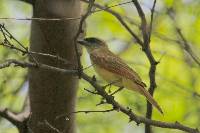
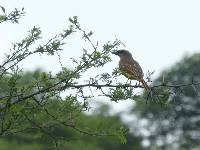
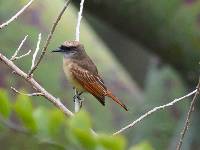
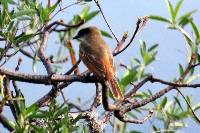
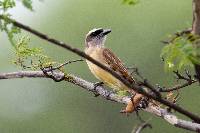
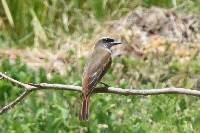
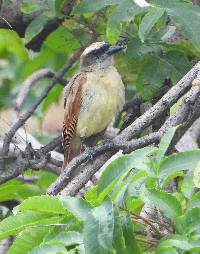
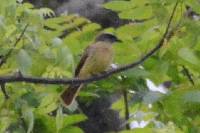
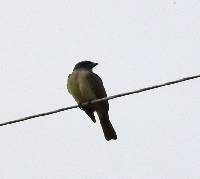
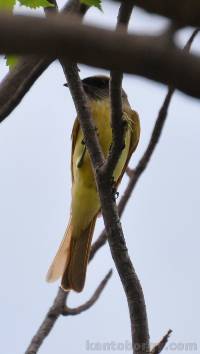
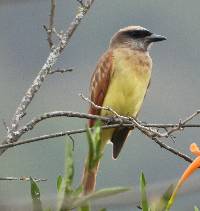
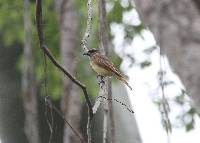
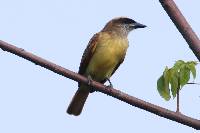
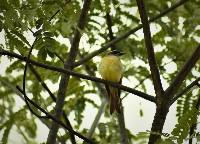
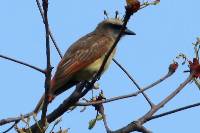
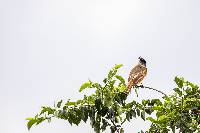
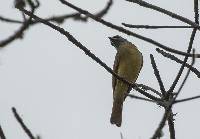
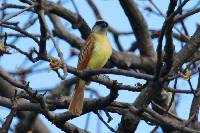
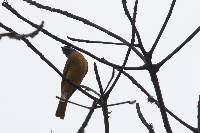
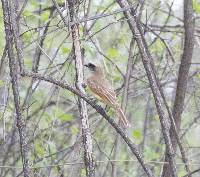
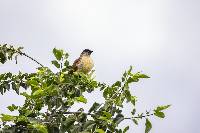
Baird's flycatcher (Myiodynastes bairdii) is a species of bird in the family Tyrannidae, the tyrant flycatchers. It is found in Ecuador and Peru.
Taxonomy and systematics
Baird's flycatcher has a complicated taxonomic history. It was originally described as Saurophagus bairdii, placing it with the great kiskadee. It was later renamed Tyrannus atrifrons, placing it with the kingbirds, then was renamed Myiodynastes atrifrons, and finally in 1883 achieved its present binomial Myiodynastes bairdii. The species' type locality was described as California, a clear error, and a correction to Guayaquil, Ecuador, was proposed in 1926.
The English name and specific epithet of Baird's flycatcher honor Spencer Fullerton Baird, a 19th-century naturalist and the first curator and later Secretary of the Smithsonian Institution.
Baird's flycatcher is monotypic.
Description
Baird's flycatcher is about 23 cm (9.1 in) long; one female weighed 45 g (1.6 oz). The sexes have the same plumage. Adults have a pale sandy brown to whitish forecrown and sandy brown crown with light gray streaks and a usually hidden yellow patch in the center. They have a wide black "mask" that extends to the dusky ear coverts. Their upperparts are mostly olive-brown with a more rufous rump. Their wings are dusky with wide cinnamon-rufous edges on the coverts and flight feathers. Their tail is mostly rufous with some dusky edges on the outermost feathers. Their throat is whitish with faint thin grayish streaks. Their breast is pale creamy yellow with an ochraceous cast and faint thin grayish streaks. Their belly is unmarked pale creamy yellow. They have a chestnut-brown to gray-brown iris, a black bill with a dusky white base to the mandible, and gray to black legs and feet.