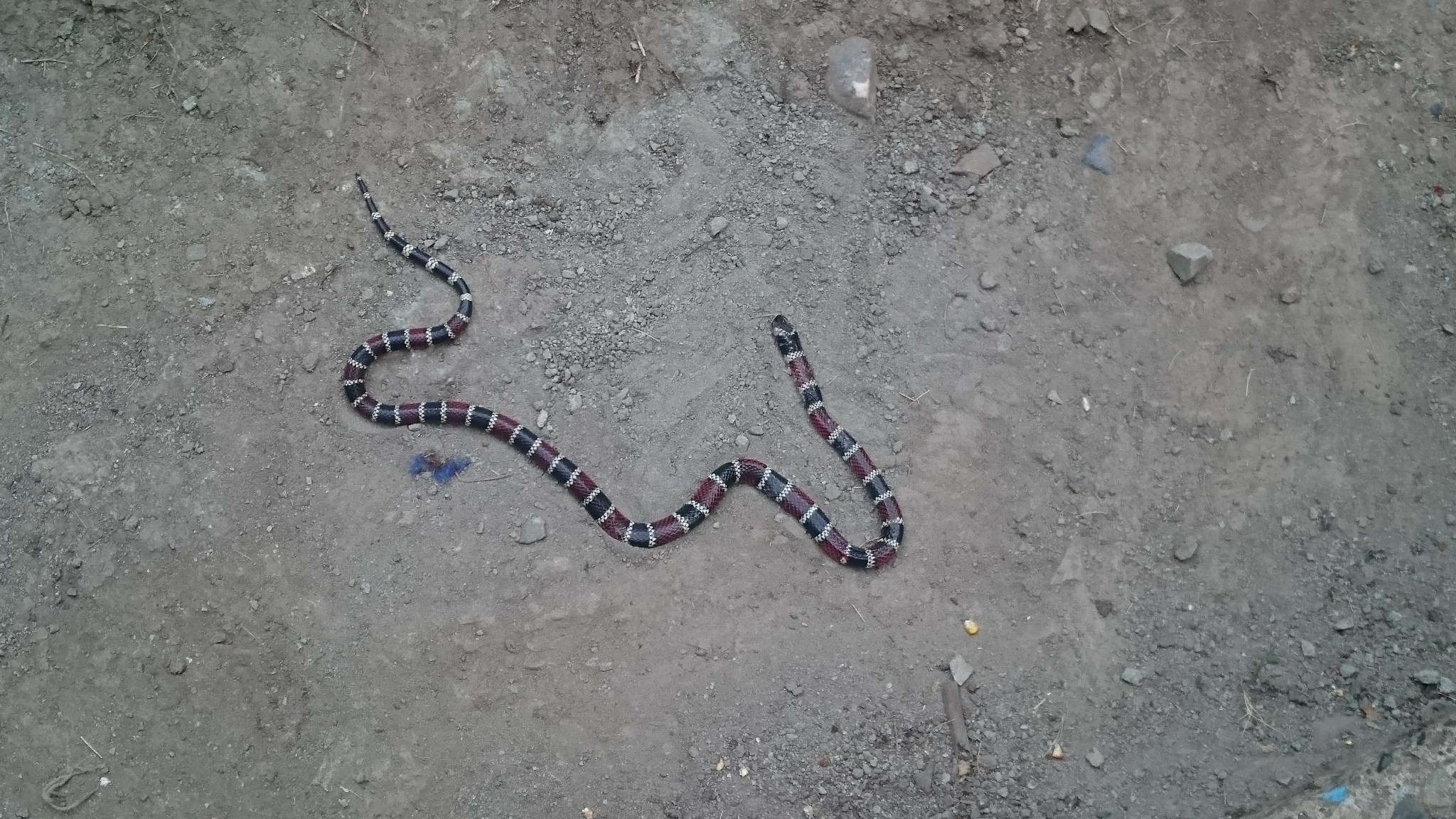
Micrurus mertensi, also known commonly as Mertens's coral snake, the Peruvian desert coral snake, and la coral peruana del desierto in South American Spanish, is a species of venomous snake in the family Elapidae. The species is native to northwestern South America.
Etymology
The specific name, mertensi, is in honor of German herpetologist Robert Mertens.
Description
Micrurus mertensi is medium to large for the genus Micrurus. Adults usually have a total length (tail included) of 50–80 cm (20–31 in), but the maximum recorded total length is 111.5 cm (43.9 in).
Like most New World coral snakes, the color pattern of M. mertensi consists of a combination of red, black, and white (or yellow) rings. The red rings are widest, and some of the included dorsal scales may have small black tips. The black rings are slightly narrower and are not arranged in triads. The white rings, which separate the red from the black, are narrowest and may not extend across the venter.
Geographic distribution
Micrurus mertensi is found in Ecuador and Peru.
Habitat
Micrurus mertensi is found in a variety of habitats, including forest, shrubland, and desert, at elevations from near sea level to 2,400 m (7,900 ft), usually near a river or stream.
Behavior
Micrurus mertensi is terrestrial.
Diet
Micrurus mertensi preys on snakes (ophiophagy), including blind snakes such as Epictia subcrotilla, and the venomous pit viper Bothrops pictus.
Reproduction
Micrurus mertensi, is oviparous.
Venom
The average venom yield obtained by scientists "milking" Micrurus mertensi was 2 mg (dry weight). The lethal dose for an adult human is unknown.