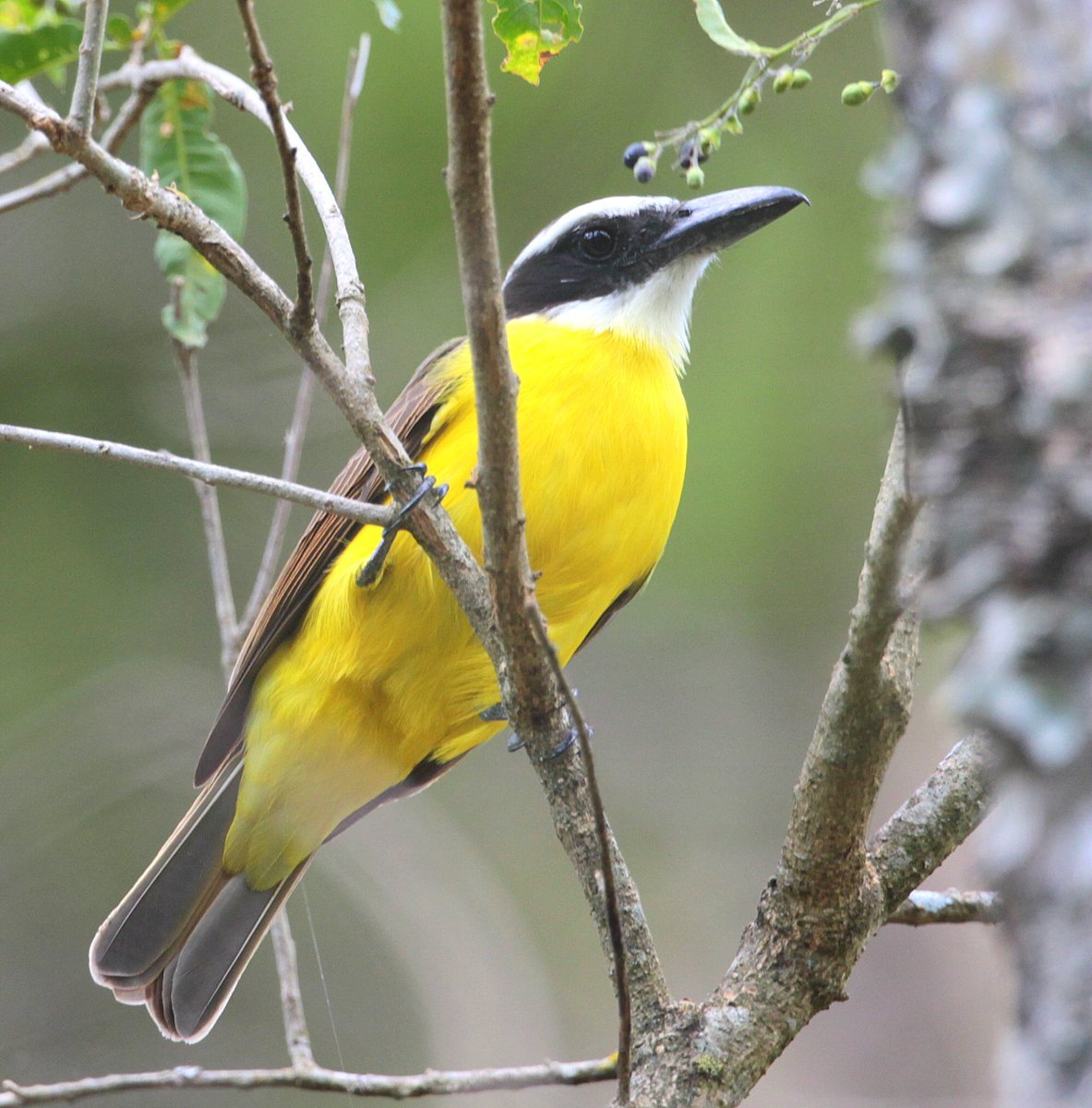
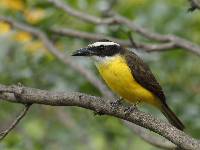
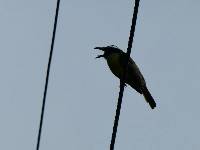
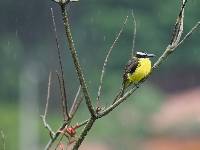
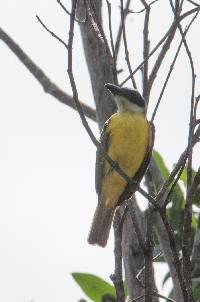
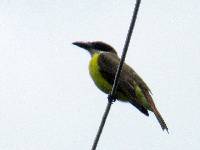
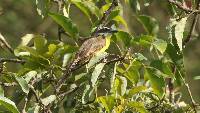
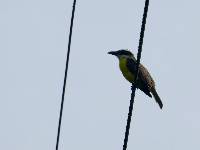
The boat-billed flycatcher (Megarynchus pitangua) is a large member of the family Tyrannidae, the tyrant flycatchers. It is found in Mexico, in every Central American country, on Trinidad, and in every mainland South American country though only as a vagrant in Chile.
Taxonomy and systematics
The boat-billed flycatcher was originally described as Lanius pitangua, mistakenly placing it in the shrike family. It was eventually moved to its present genus Megarynchus that was erected in 1824. That name is from the Greek "μεγα" (mega) meaning "much" and "ῥυγχος" (rhunkhos) meaning "bill". The specific epithet derives from the Tupi language name for the bird, "Pitanguá guacú".
The boat-billed flycatcher is the only member of its genus and has these six subspecies:
M. p. tardiusculus Moore, RT, 1941
M. p. caniceps Ridgway, 1906
M. p. mexicanus (Lafresnaye, 1851)
M. p. deserticola Griscom, 1930
M. p. pitangua (Linnaeus, 1766)
M. p. chrysogaster Sclater, PL, 1860
There are differences among the subspecies' vocalizations, leading some authors to state that "critical re-evaluation of races is needed". The Clements taxonomy recognizes some distinctions within the species by calling M. p. pitangua the "boat-billed flycatcher (South American)", M. p. chrysogaster the "boat-billed flycatcher (Tumbes)", and the other four subspecies the "boat-billed flycatcher (northern)".
Yasuni National Park, Ecuador
Description
The boat-billed flycatcher is 21.5 to 24 cm (8.5 to 9.4 in) long and weighs 53 to 70 g (1.9 to 2.5 oz). The sexes have the same plumage. Adults of the nominate subspecies M. p. pitangua have a blackish brown or sooty crown with a mostly hidden yellow to orange-rufous patch in the center. They have a wide white supercilium that begins at the forehead and wraps almost all the way around the nape, a wide black band from the lores to the ear coverts, and white cheeks. They have olive to dull brownish olive upperparts. Their wings are dusky brownish,...