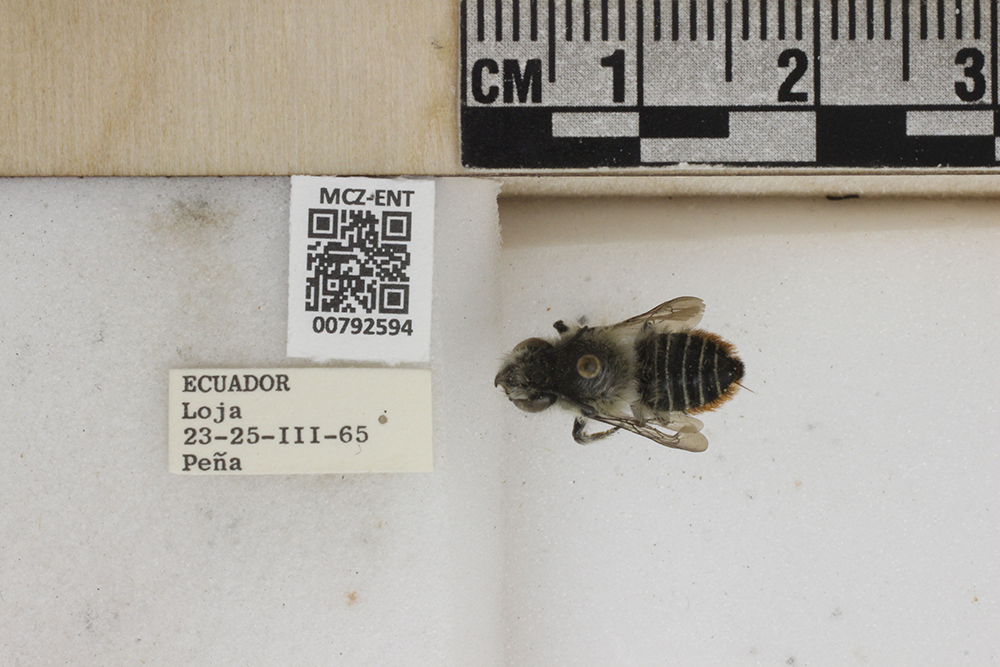
Megachilidae is a cosmopolitan family of mostly solitary bees. Characteristic traits of this family include the restriction of the pollen-carrying scopa to the entire ventral surface of the abdomen (rather than primarily on the hind legs as in most other bee families) and their typically elongated labra. Megachilid genera are most commonly known as mason bees and leafcutter bees, reflecting the materials from which they build their nest cells (soil or leaves, respectively); a few collect plant or animal hairs and fibers, and are called carder bees, while others use plant resins in nest construction and are correspondingly called resin bees. All species feed on nectar and pollen, but a few are kleptoparasites (informally called "cuckoo bees"), feeding on pollen collected by other megachilid bees. Parasitic species do not possess scopae. A megachilid bee collects pollen by rapidly tapping its abdomen against the floral reproductive structures, packing the pollen into its scope.
Lifecycle
Life cycle
Nonparasitic Megachilidae typically divide their nests into cells. Each cell receives a supply of food (pollen or a pollen/nectar mix) and an egg; after finding a suitable spot (often near where she emerged), a female starts building a first cell, stocks it, and oviposits. She builds a wall that separates the completed cell from the next one. The larva hatches from the egg and consumes the food supply. After moulting a few times, it spins a cocoon and pupates. It emerges from the nest as an adult. Males die shortly after mating, but females survive for another few weeks, during which they build new nests.
Nests are often built in natural or artificial cavities. Some embed individual cells in a mass of clay or resin attached to a wall, rock surface, or plant stem. Nest cavities are often linear, for example in hollow plant stems (snail shells are used by some Osmia, and some species readily use irregular cavities).