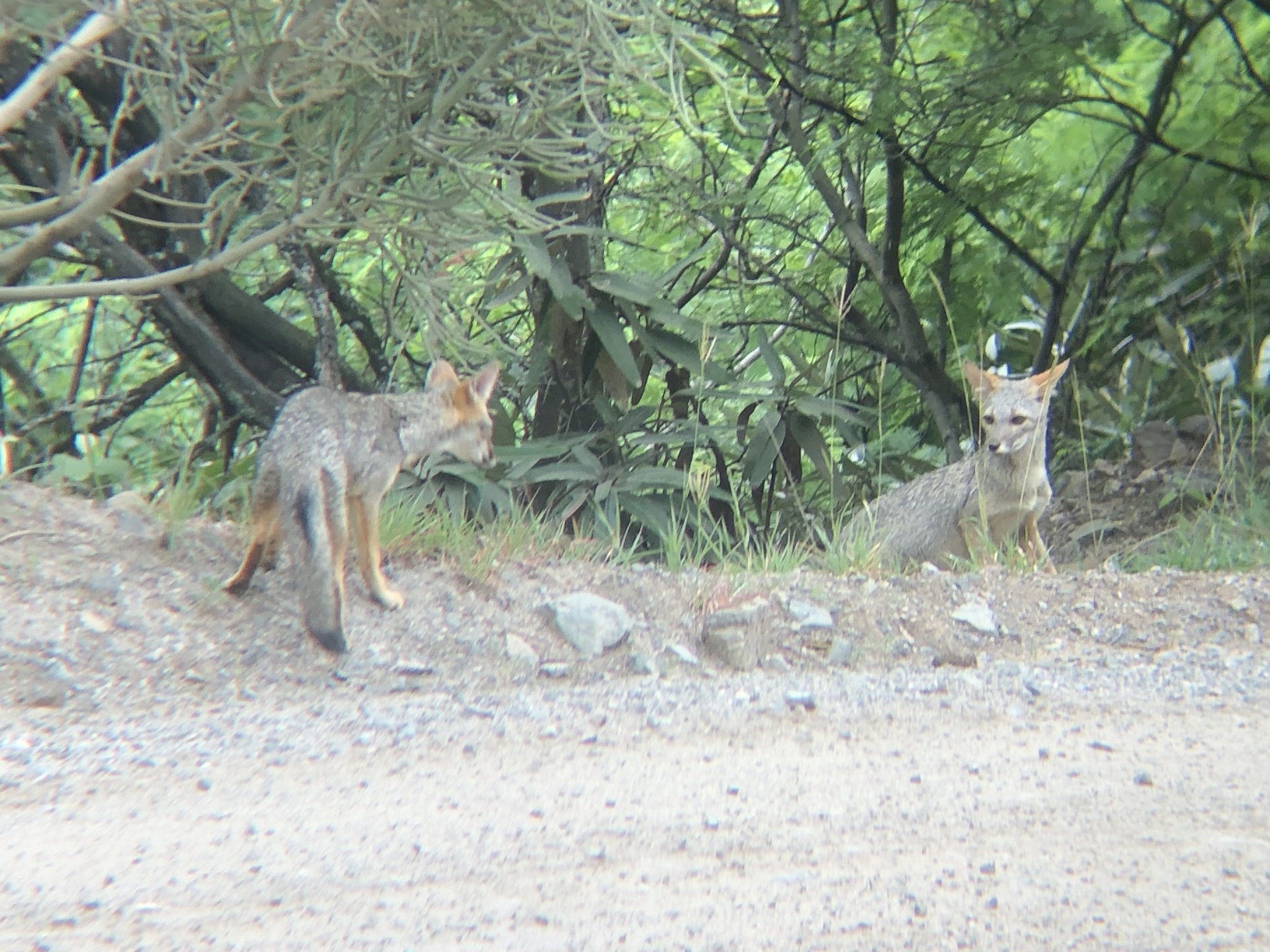
The South American foxes (Lycalopex), commonly called raposa in Portuguese, or zorro in Spanish, are a genus inhabiting South America. Despite their name, they are not true foxes, but are a unique canid genus more closely related to wolves and jackals than to true foxes; some of them resemble foxes due to convergent evolution. The South American gray fox, Lycalopex griseus, is the most common species, and is known for its large ears and a highly marketable, russet-fringed pelt.
The second-oldest known fossils belonging to the genus were discovered in Chile, and date from 2.0 to 2.5 million years ago, in the mid- to late Pliocene. The Vorohué Formation of Argentina has provided older fossils, dating to the Uquian to Ensenadan (Late Pliocene).
Names
The common English word "zorro" is a loan word from Spanish, with the word originally meaning "fox". Current usage lists Pseudalopex (literally: "false fox") as synonymous with Lycalopex ("wolf fox"), with the latter taking precedence. In 1895, Allen classified Pseudalopex as a subgenus of Canis, establishing the combination Canis (Pseudalopex), a name still used in the fossil record.
Species
Species currently included in this genus include:
Image
Name
Common name
Distribution
Lycalopex culpaeus
Culpeo or Andean fox
Ecuador and Peru to the southern regions of Patagonia and Tierra del Fuego
Lycalopex fulvipes
Darwin's fox
Nahuelbuta National Park (Araucanía Region), the Valdivian Coastal Range (Los Ríos Region) in mainland Chile and Chiloé Island
Lycalopex griseus
South American gray fox or chilla
Argentina and Chile
Lycalopex gymnocercus
Pampas fox
northern and central Argentina, Uruguay, eastern Bolivia, Paraguay, and southern Brazil
Lycalopex sechurae
Sechuran fox
west-central, northwestern Peru, including the Sechura Desert, and southwestern Ecuador
Lycalopex vetulus
Hoary fox
south-central Brazil
†Canis (Pseudalopex) australis
Vorohué Formation, Uquian-Ensenadan Argentina