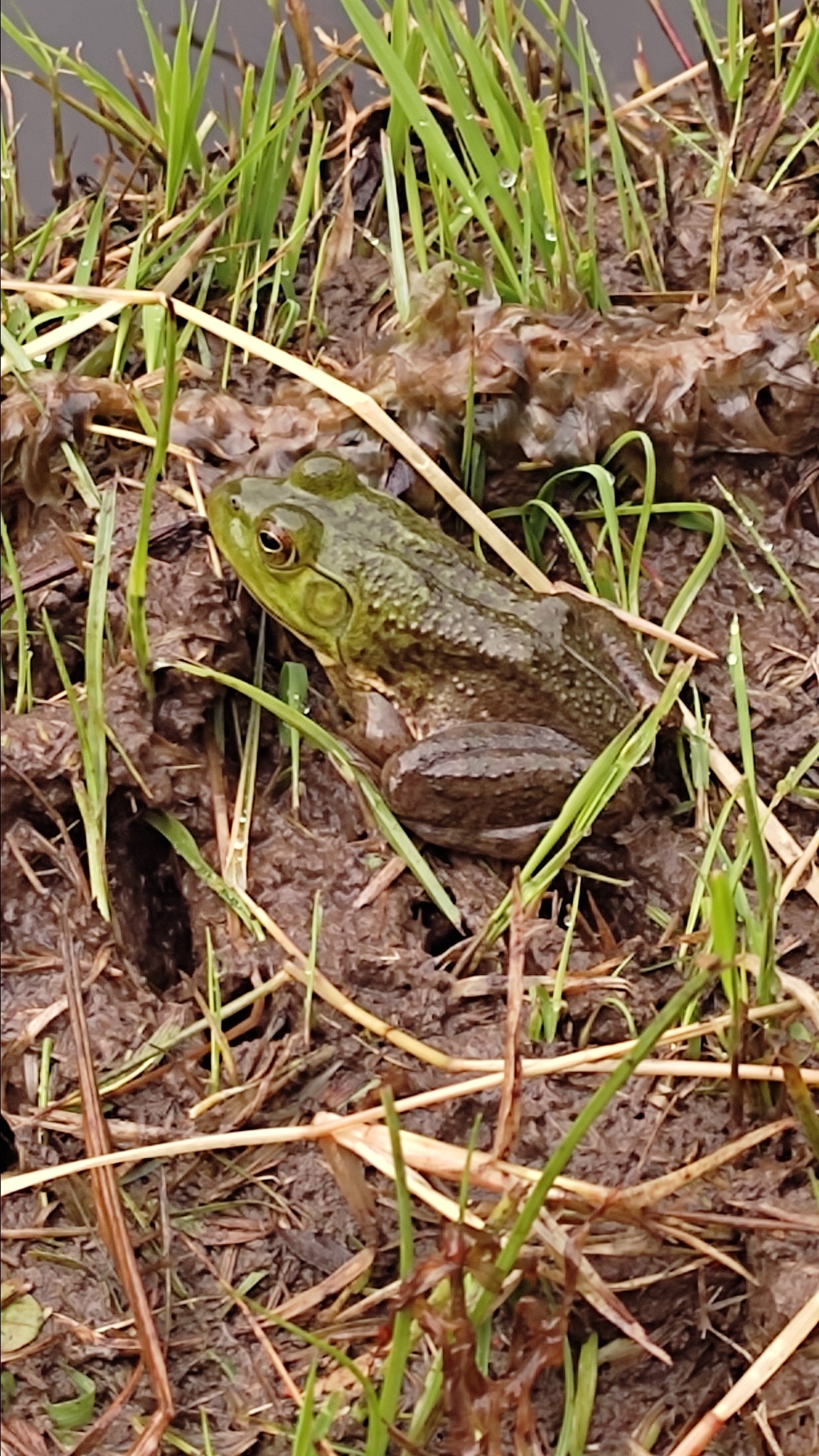
Ranidae is a family of frogs, sometimes called "true frogs". They have the widest distribution of any frog family. They are abundant throughout most of the world, occurring on all continents except Antarctica. The true frogs are present in North America, northern South America, Europe, Africa (including Madagascar), and Asia. The Asian range extends across the East Indies to New Guinea and a single species, the Australian wood frog (Papurana daemelii), has spread into the far north of Australia.
Typically, true frogs are smooth and moist-skinned, with large, powerful legs and extensively webbed feet. The true frogs vary greatly in size, ranging from small—such as the wood frog (Lithobates sylvatica)—to large.
Many of the true frogs are aquatic or live close to water. Most species lay their eggs in the water and go through a tadpole stage. However, as in most families of frogs, there is large variation of habitat within the family. There are also arboreal species of true frogs, and the family includes some of the very few amphibians that can live in brackish water.
Evolution
The Ranidae are related to several other frog families that have Eurasian and Indian origins, including Rhacophoridae, Dicroglossidae, Nyctibatrachidae, Micrixalidae, and Ranixalidae. They are thought to be most closely related to the Indian-endemic Nyctibatrachidae, from which they diverged in the early Eocene. However, other studies recover a closer relationship with the Dicroglossidae. The Ranidae began to disperse out of Asia at the end of the Eocene and by the beginning of the Miocene, colonized every continent except Antarctica. The Ranidae are known as cosmopolitan, able to be found in every continent, only excluding Antarctica.
It was previously thought that the Ranidae and their closest relatives were of Gondwanan origins, having evolved on Insular India during the Cretaceous. They were then entirely restricted to the Indian subcontinent until the late Eocene, when India collided...