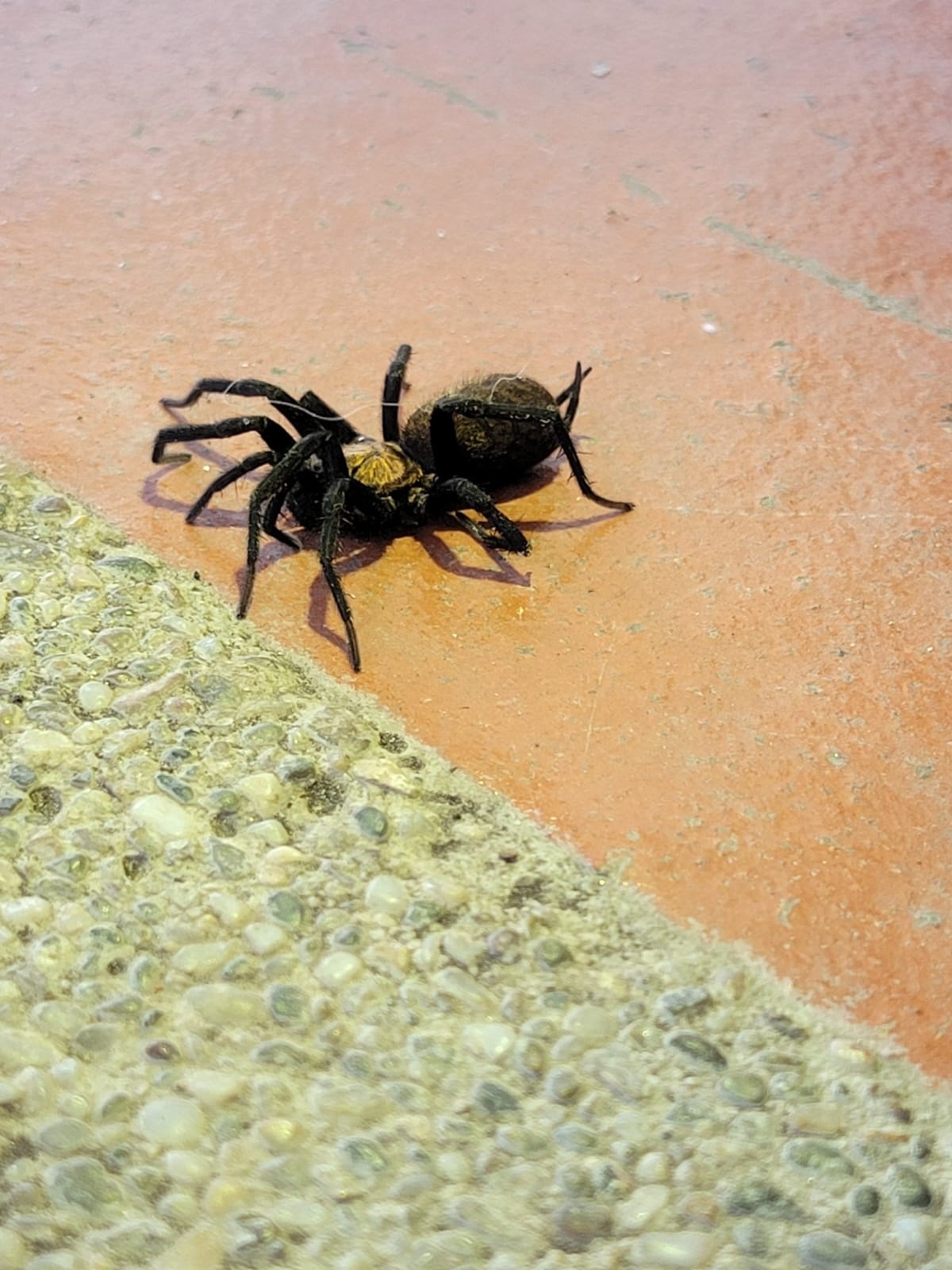
The family Dipluridae, known as curtain-web spiders (or confusingly as funnel-web tarantulas, a name shared with other distantly related families) are a group of spiders in the infraorder Mygalomorphae, that have two pairs of booklungs, and chelicerae (fangs) that move up and down in a stabbing motion. A number of genera, including that of the Sydney funnel-web spider (Atrax), used to be classified in this family but have now been moved to Atracidae.
Description
Masteria petrunkevitchi eye pattern
Dipluridae lack rastella (stout conical spines on their chelicerae). Their carapace is characterized by the head region not being higher than the thoracic region. Their posterior median spinnerets (silk-extruding organs) are much shorter than their posterior lateral spinnerets, which have three segments, and are elongated (almost as long as their opisthosoma).
Most of the species are medium to small-sized spiders; some may measure about 15 mm.
The cave species Masteria caeca is eyeless.
Biology
Members of this family often build rather messy funnel-webs. Some build silk-lined burrows instead of webs (Diplura, Trechona, Harpathele, some Linothele sp.). They generally build their retreats in crevices in earthen banks, the bark of trees, under logs or in leaf litter.
Distribution
As circumscribed as of October 2025, the family is mostly found in South America and the Caribbean, with some Masteria species found in Australia and Oceania.