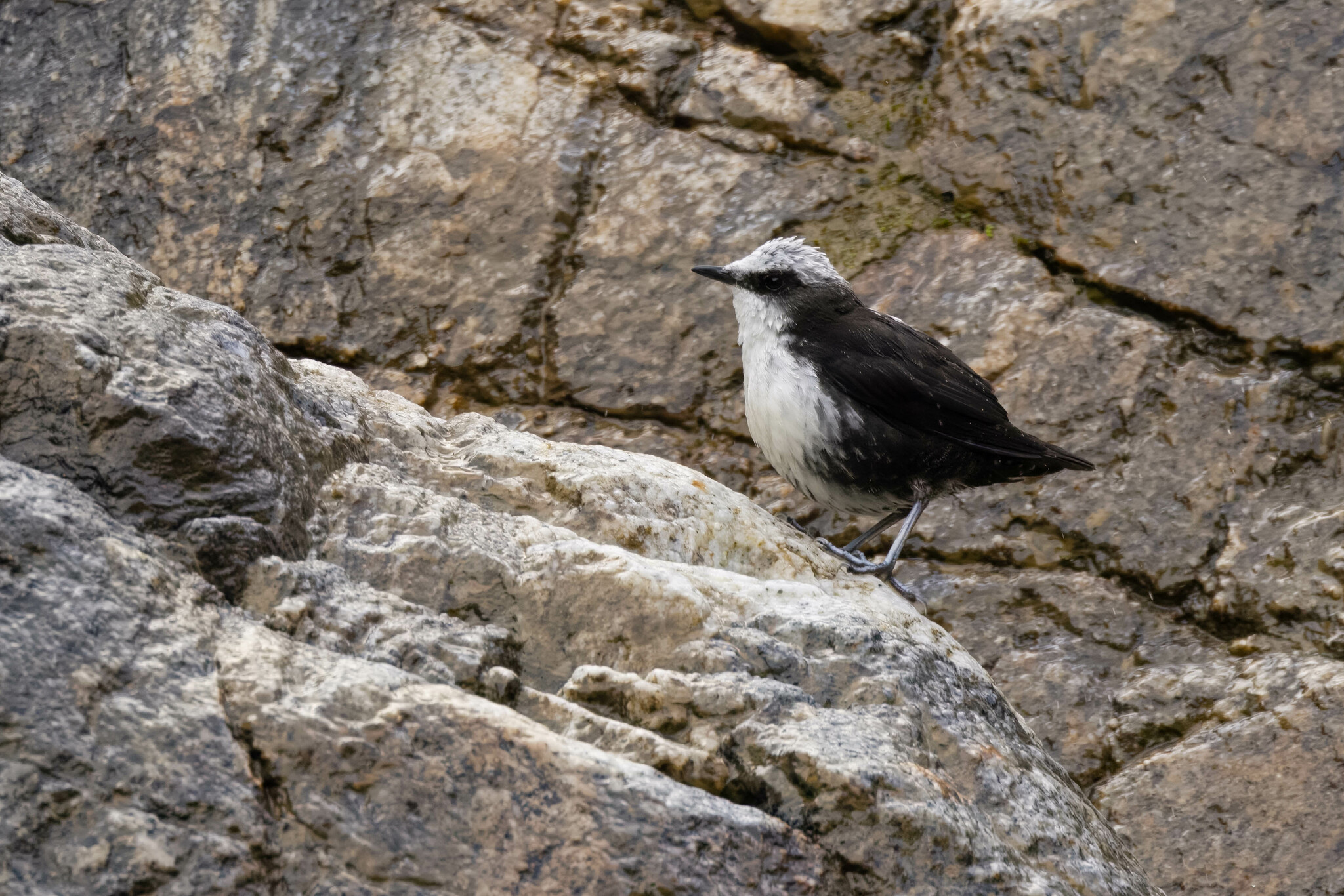
The white-capped dipper (Cinclus leucocephalus) is a semiaquatic passerine bird of South America. It is found in Bolivia, Colombia, Ecuador, Peru, and Venezuela.
Taxonomy and systematics
The white-capped dipper was described by the Swiss naturalist Johann Jakob von Tschudi in 1844 with the binomial Cinclus leucocephalus, which it has retained ever since. The type locality is the Junín Province in Peru. The specific epithet leucocephalus combines the Ancient Greek leukos "white" and -kephalos "-headed". Of the five species now placed in the genus, a molecular genetic study has shown that the white-capped dipper is most closely related to the other South American species, the rufous-throated dipper (Cinclus schulzii).
The white-capped dipper has these three subspecies:
C. l. rivularis Bangs, 1899
C. l. leuconotus Sclater, PL, 1858
C. l. leucocephalus Tschudi, 1844
Description
The white-capped dipper is 13.5 to 16.5 cm (5.3 to 6.5 in) long and weighs 38 to 59 g (1.3 to 2.1 oz). The sexes have the same plumage, but males are slightly larger than females. Adults of the nominate subspecies C. l. leucocephalus have a white crown and nape that sometimes have blackish brown streaks. The rest of their face is sooty brown with white eyelids. The sooty brown continues onto their blackish brown upperparts and tail. Their wings are mostly blackish brown with white inner webs on the secondaries. Their chin, throat, and upper breast are white and the rest of their underparts blackish brown. Subspecies C. l. leuconotus is similar to the nominate but with a large white patch on its upper back and the white of its underparts extending through the belly. C. l. rivularis is mostly paler and grayer than the nominate. Its crown and nape are like the nominate's. Its throat is white, sometimes with gray spots, and the white does not extend onto the breast. Its underparts have variable amounts of white from a few speckles to many spots. All subspecies have a brown iris, a black bill, and...