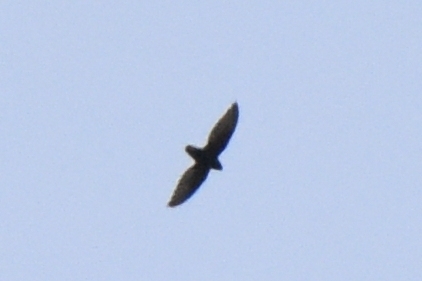
Chaetura is a genus of needletail swifts found in the Americas. Although they resemble swallows, the two are not at all closely related; this is instead a result of convergent evolution. Some members of Chaetura are long-distance migrants, while others are year-round residents.
Taxonomy
The genus Chaetura was introduced in 1826 by the English naturalist James Francis Stephens who listed several species in the genus but did not specify a type. In 1829 the English zoologist William Swainson selected the type as Chaetura pelasgia Stevens (sic). This is a junior synonym of Hirundo pelagica Linnaeus the chimney swift. The genus name combines the Ancient Greek χαιτη/khaitē meaning "long flowing hair" with ουρα/oura meaning "tail".
Species
The genus contains 11 species:
Grey-rumped swift, Chaetura cinereiventris – widespread in South America
Band-rumped swift, Chaetura spinicaudus – Panama to central Brazil
Lesser Antillean swift, Chaetura martinica – Lesser Antilles
Costa Rican swift, Chaetura fumosa – Costa Rica, Panama and north Colombia
Pale-rumped swift, Chaetura egregia – west Amazonia
Chimney swift, Chaetura pelagica – breeds in central south, southeast Canada and central, east USA; winters west South America
Vaux's swift, Chaetura vauxi – west Canada to north South America
Chapman's swift, Chaetura chapmani – Panama to northeast Brazil and west Amazonia
Ashy-tailed swift, Chaetura andrei – east Venezuela
Sick's swift, Chaetura meridionalis – breeds south Brazil to east Bolivia, Paraguay and north Argentina; winters north South America and Panama
Short-tailed swift, Chaetura brachyura – Panama through Amazonia
A fossil species, Chaetura baconica, was described from Late Miocene deposits of Hungary.