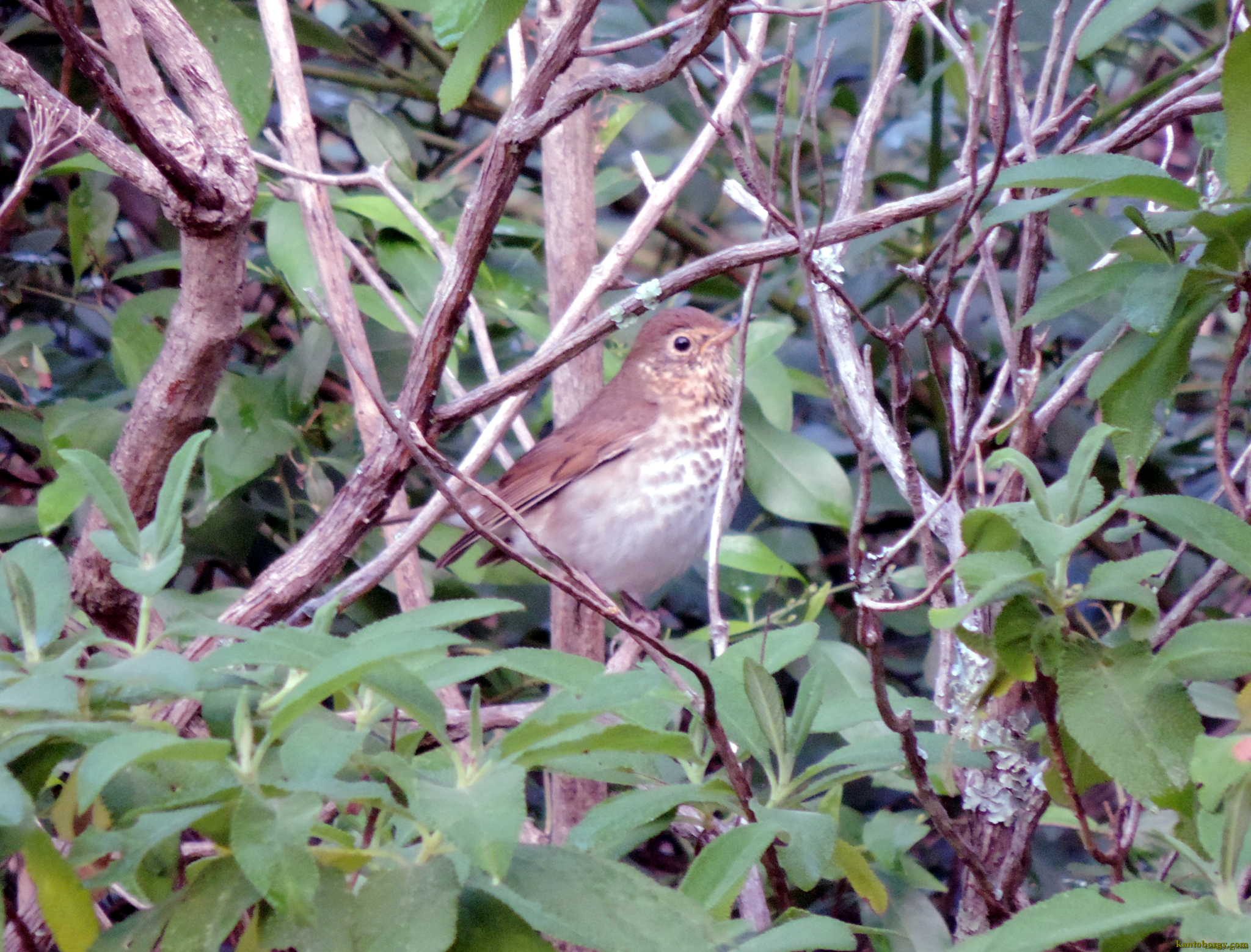
The genus Catharus is an evolutionary clade of forest-dwelling passerine birds in the family Turdidae (thrushes), commonly known as nightingale-thrushes. The extant species are widely distributed across the Americas and are descended from a common ancestor that lived 4–6 million years ago. Most of the species are shy of humans, seldom leaving the cover of dense forest vegetation, where their activities are hidden from view. Thus, many fundamental aspects of their biology and life histories are poorly known.
Nightingale-thrushes are small omnivorous songbirds that, like their sister species the wood thrush (Hylocichla mustelina), exhibit a variety of migratory and non-migratory habits. Multiple species are long-distance migrants that breed in North America and "winter" in the Neotropics. The breeding range of one migratory species, the gray-cheeked thrush (C. minimus), extends into eastern Siberia. The remainder of the migratory species are restricted to the Americas, notwithstanding occasional vagrant records in Europe and northeast Asia. The non-migratory species are residents of the Neotropical realm.
Systematics
Historically, the migratory and residents were placed in two genera: Hylocichla and Catharus, respectively. However, molecular studies indicate that hermit thrush (C. guttatus) is more closely related to three Neotropical species (C. occidentalis, C. gracilirostris, C. frantzii) than to the long-distance migrants which it superficially resembles. This pattern of homoplasy has been interpreted as evidence that seasonal migration had multiple independent origins in the genus (i.e., convergent evolution of phenotypic characters associated with migration), but a 2025 study proposed that it reflects the "budding" of daughter lineages from a long-lived "stem" lineage in evolutionary stasis (which persists today as C. guttatus).
The taxonomy of Catharus dates to the 18th century and has a confusing history resulting from multiple cryptic species, taxonomic...