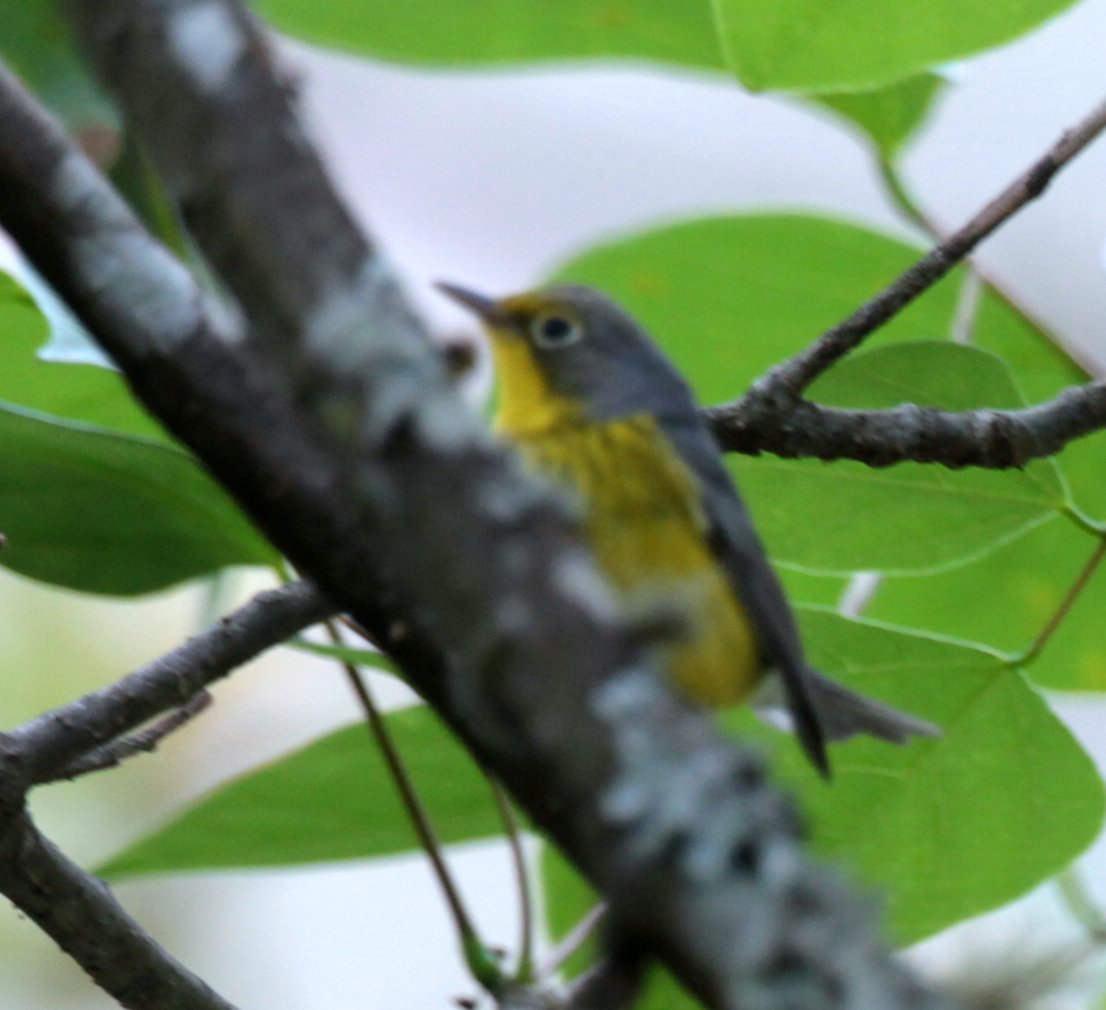
The Canada warbler (Cardellina canadensis) is a small boreal songbird of the New World warbler family (Parulidae). It summers in Canada and northeastern United States and winters in northern South America.
Taxonomy
In 1760 the French zoologist Mathurin Jacques Brisson included a description of the Canada warbler in his Ornithologie based on a specimen collected in Canada. He used the French name Le gobe-mouche cendré de Canada and the Latin name Muscicapa Canadensis Cinerea. Although Brisson coined Latin names, these do not conform to the binomial system and are not recognised by the International Commission on Zoological Nomenclature. When in 1766 the Swedish naturalist Carl Linnaeus updated his Systema Naturae for the twelfth edition, he added 240 species that had been previously described by Brisson. One of these was the Canada warbler. Linnaeus included a brief description, coined the binomial name Muscicapa canadensis, and cited Brisson's work. The species is now placed in the genus Cardellina that was introduced by the French naturalist Charles Lucien Bonaparte in 1850. The species is monotypic.
Description
The Canada warbler is sometimes called the "necklaced warbler", because of the band of dark streaks across its chest. The adults have minimal sexual dimorphism, although the male's "necklace" is darker and more conspicuous and also has a longer tail. Adults are 12–15 cm (4.7–5.9 in) long, have a wingspan of 17–22 cm (6.7–8.7 in), and weigh 9–13 g (0.32–0.46 oz).
The chest, throat, and belly of the bird are yellow, and its back is dark grey. It has no wingbars or tail spots, but the underside of the tail is white. It has a yellow line in front of its eye in the direction of the beak, but the most striking facial feature is the white eyerings or "spectacles". Immature specimens have similar coloration as adults but duller and with less pronounced facial features.