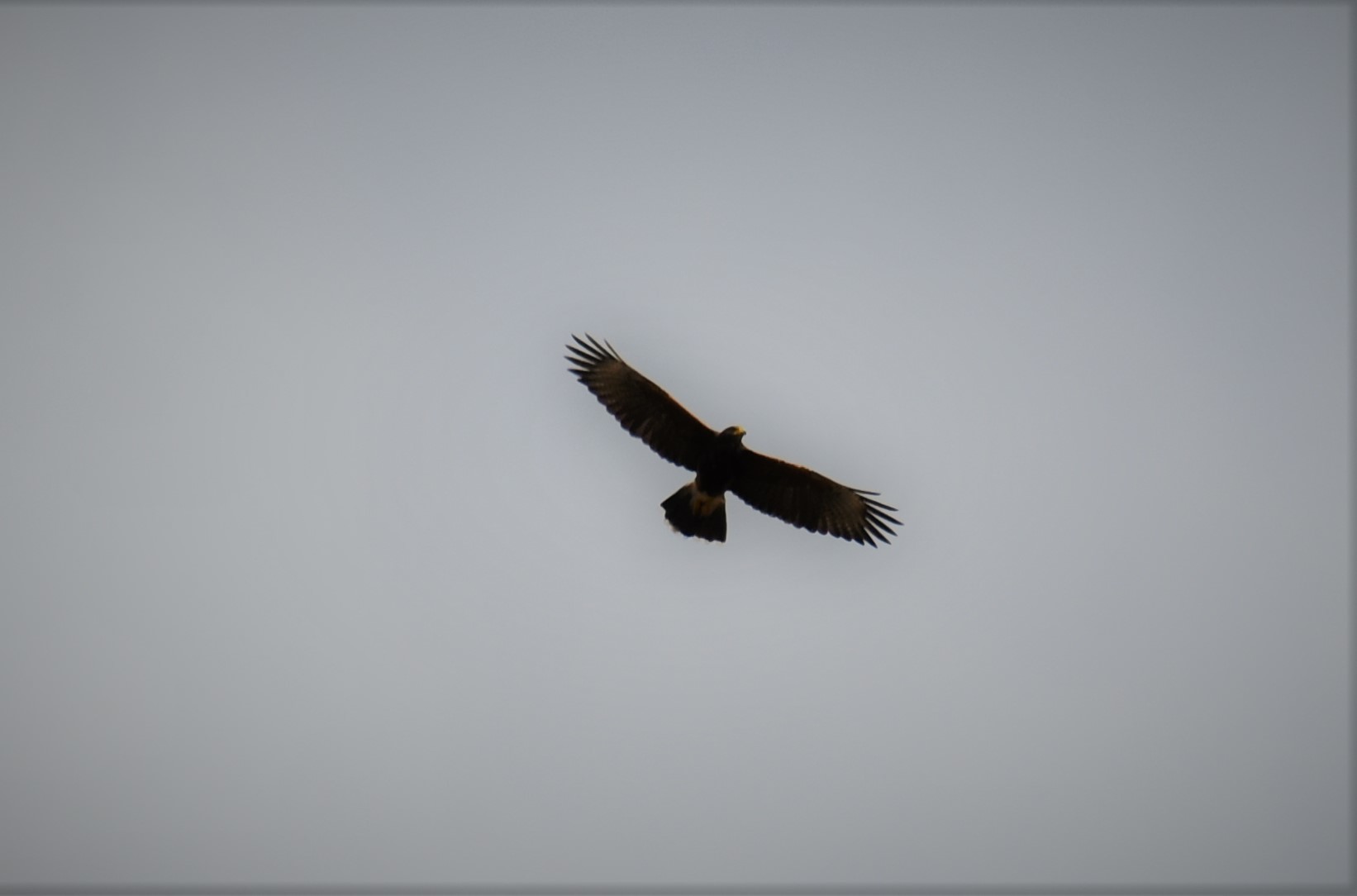
The great black hawk (Buteogallus urubitinga) is a bird of prey in the family Accipitridae, which also includes the eagles, hawks, and Old World vultures.
Taxonomy
The great black hawk was formally described in 1788 by the German naturalist Johann Friedrich Gmelin in his revised and expanded edition of Carl Linnaeus's Systema Naturae. He placed it with the eagles, hawks and relatives in the genus Falco and coined the binomial name Falco urubitinga. Gmelin's description was ultimately based on the "urubitinga" that had been described in 1648 by the German naturalist Georg Marcgrave in his Historia Naturalis Brasiliae. The great black hawk is now one of nine species placed in the genus Buteogallus was introduced in 1830 by the French naturalist René Lesson. The name genus is a portmanteau of Buteo, a genus introduced in 1779 by Bernard Germain de Lacépède for the buzzards and the genus Gallus introduced in 1760 by Mathurin Jacques Brisson for the junglefowl. The specific epithet urubitinga is from Tupi Urubú tinga meaning "big black bird" for such a raptor.
Two subspecies are recognised:
B. u. ridgwayi (Gurney, JH Sr, 1884) – Mexico to west Panama
B. u. urubitinga (Gmelin, JF, 1788) – east Panama to north Argentina
Description
The adult great black hawk is 56 to 64 centimetres (22 to 25 in) long and weighs 1.1 kilograms (2 lb 7 oz). It resembles the common black hawk, but is larger with a different call and tail pattern. It has very broad wings, and is mainly black. The short tail is white with a broad black tip. The bill is black and the legs and cere are yellow.
The sexes are similar, but immature birds are dark brown above with spotting and streaks. Their underparts are buff with dark spots, and the tail has a number of black and dusky bars. The call of the great black hawk is a distinctive piping ooo-wheeeeee.