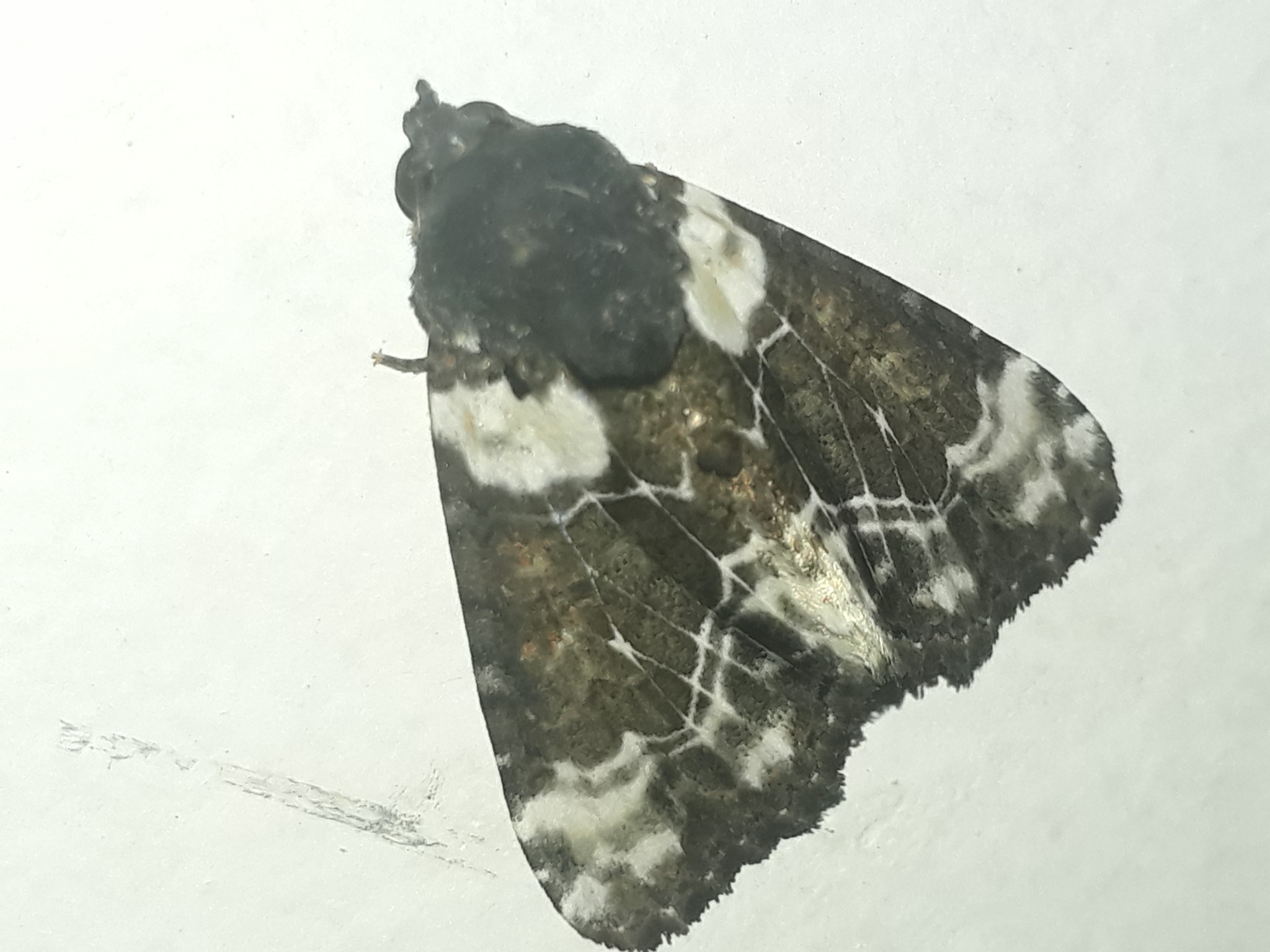
The Noctuidae, commonly known as noctuid moths or owlet moths, and their caterpillars as cutworms or armyworms, are a family of moths. Taxonomically, they are considered the most difficult family in the superfamily Noctuoidea because the classification of many of the clades is constantly changing with new research, along with that of other families of the Noctuoidea. It was considered the largest family in Lepidoptera for a long time, but after regrouping Lymantriinae, Catocalinae and Calpinae within the family Erebidae, the latter holds this title now. Currently, Noctuidae is the second largest family in Noctuoidea, with about 1,089 genera and 11,772 species. This classification is still unsettled, as more changes continue to appear between Noctuidae and Erebidae.
Description
Noctuidae wing venation (highlighting features specific to subfamily Pantheinae)
Adult: Most noctuid adults have wings with a variety of shades of brown, grey, and other varied shades and colours but some subfamilies, such as Acronictinae and Agaristinae, are very brightly coloured, especially those from tropical regions (e.g. Baorisa hieroglyphica). They are characterised by a structure in the metathorax called the nodular sclerite or epaulette, which separates the tympanum and the conjunctiva in the tympanal organ. It functions to keep parasites (Acari) out of the tympanal cavity. Another characteristic in this group is trifine hindwing venation, by reduction or absence of the second medial vein (M2).
Markings present on the wings of noctuid adults can be helpful in distinguishing species. From the basal location to the outer edge (proximal to distal) on the forewing, there is a horizontally oriented claviform (club-shaped) stigma located posterior to a discal (round) stigma. These are followed distally by a reniform (kidney-shaped) stigma, whose exact shape may vary, but is found on the distal edge of the forewing's cell. It is often not possible to discern all of the stigmata on all...