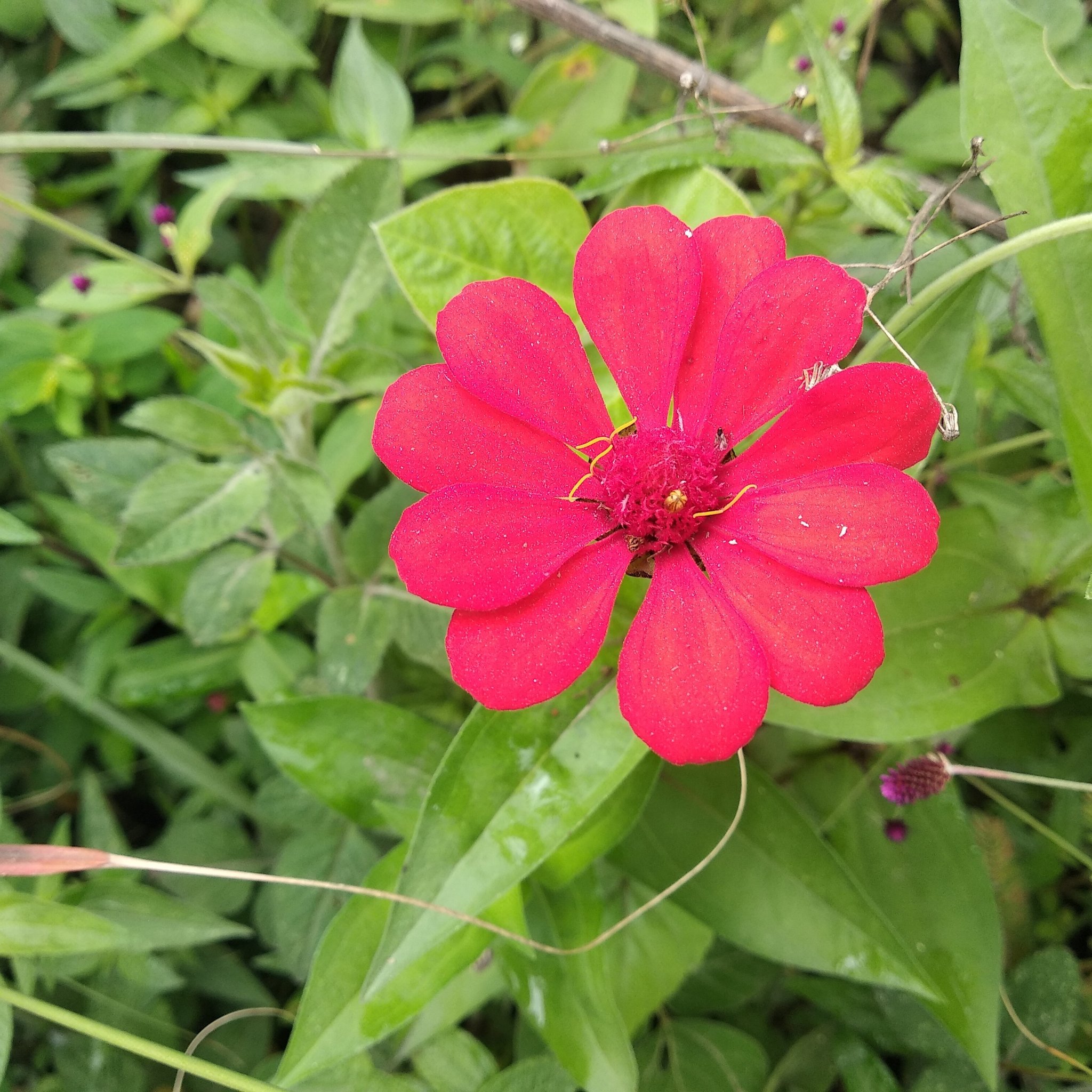
Zinnia is a genus of plants of the tribe Heliantheae within the family Asteraceae. Members of the genus are notable for their solitary long-stemmed 12-petal flowers that come in a variety of bright colors. The genus name honors 18th-century German scientist Johann Gottfried Zinn.
The genus is native to scrub and dry grassland in an area stretching from the Southwestern United States to South America, with a centre of diversity in Mexico.
Description
Zinnias are annuals, shrubs, and sub-shrubs native primarily to North America, with a few species in South America. Most species have upright stems but some have a lax habit with spreading stems that mound over the surface of the ground. They typically range in height from 10 to 100 cm tall (4" to 40"). The leaves are opposite and usually stalkless (sessile), with a shape ranging from linear to ovate, and a color ranging from pale to medium green. Zinnia's composite flowers consist of ray florets that surround disk florets, which may be a different color than the ray florets and mature from the periphery inward. The flowers have a range of appearances, from a single row of petals to a dome shape. Zinnias may be white, chartreuse, yellow, orange, red, purple, or lilac.
Each disc floret has five petals that enclose five stamens bearing anthers. When the petals open, the style elongates and pushes the pollen, produced by the anthers, upward where it becomes accessible to pollinator insects such as hoverflies that eat it. Nectar is secreted at the base of the floret, attracting long‑tongued bees and butterflies. As the style continues to grow, it divides into two branches, with the stigmatic surfaces at the tips maturing to receive pollen.
Time-lapse (200×) of Zinnia disc floret petals opening, their styles providing secondary pollen presentation. Visiting insects shown at normal speed. A thrips and two hoverflies eat the piled pollen. Two skipper butterflies reach the deep nectaries....