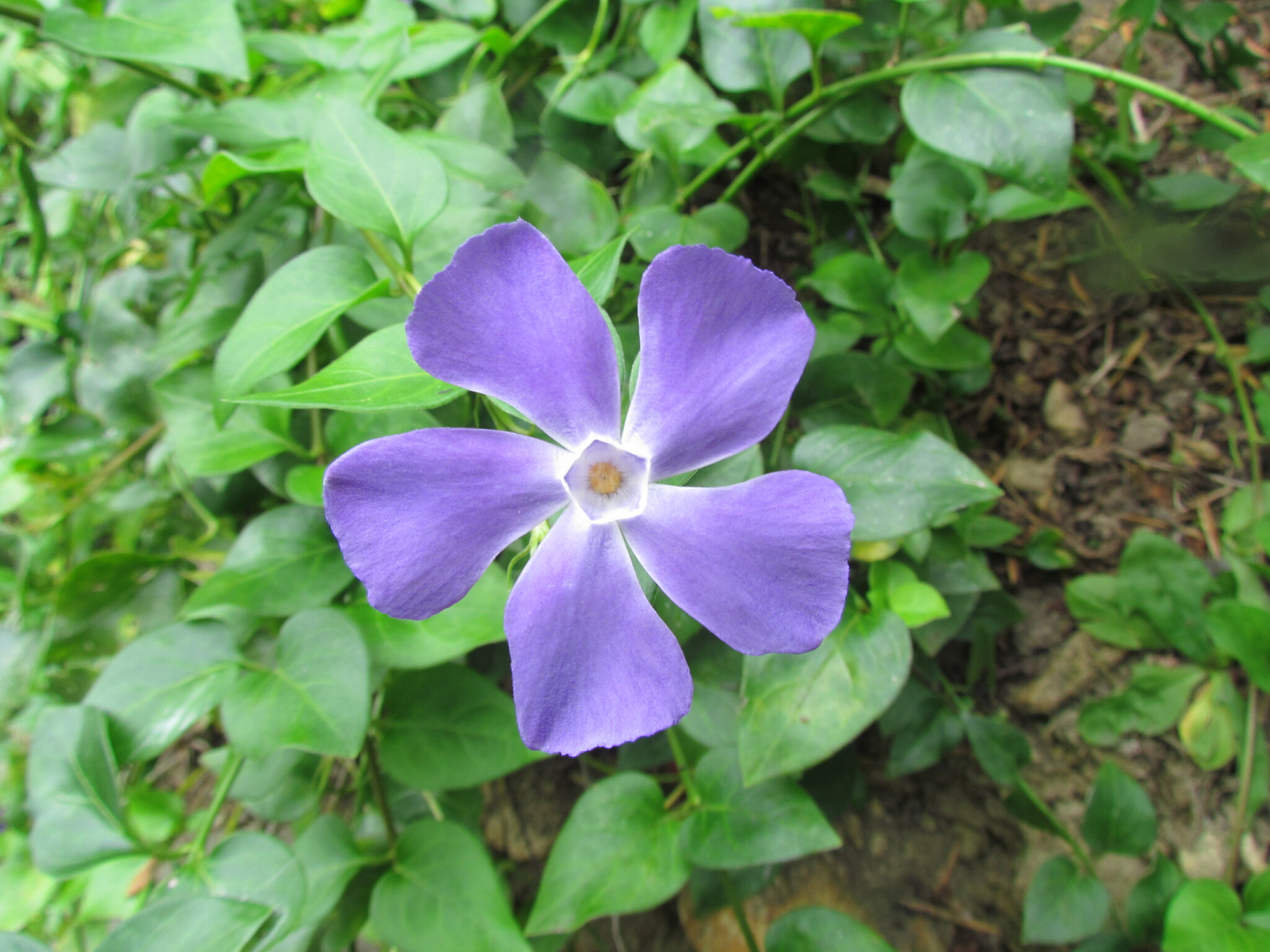
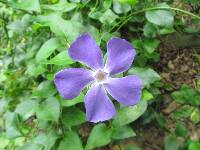
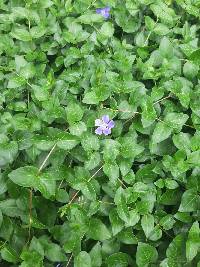
Vinca major, the greater periwinkle, also sometimes called bigleaf periwinkle, large periwinkle or blue periwinkle, is a species of flowering plant in the family Apocynaceae, native to the Mediterranean region. Growing to 25 cm (10 in) tall and spreading indefinitely, it is an evergreen perennial, frequently used in cultivation as a ground cover.
Description
Vinca major is a trailing vine, spreading along the ground and rooting along the stems to form dense masses of ground cover individually
The leaves are opposite, nearly orbicular at the base of the stems and lanceolate at the apex, 3–9 cm (1–3+1⁄2 in) long and 2–6 cm broad, glossy dark green with a leathery texture and an entire but distinctly ciliate margin, and a hairy petiole 1–2 cm long.
The flowers are hermaphrodite, axillary and solitary, violet-purple, 3–5 cm in diameter, with a five-lobed corolla. The calyx surrounding the base of the flower is 10–17 millimetres (1⁄2–3⁄4 in) long with hairy margins. The flowering period extends from early spring to autumn.
The closely related Vinca minor is similar but smaller, with narrower, hairless leaves.
Similar species
The closely related Vinca minor is similar but smaller, with narrower, hairless leaves.
Taxonomy
Three subspecies are accepted, with geographically separate ranges:
Vinca major subsp. balcanica (Pénzes) Kozuharov & A.V.Petrova (northern Balkan Peninsula)
Vinca major subsp. major - leaf petioles finely hairy, hairs short (southern Europe)
Vinca major subsp. hirsuta (Boiss.) Stearn (syn. V. pubescens d'Urv.) - leaf petioles densely hairy, hairs longer; petals much narrower (Caucasus, northern Turkey)
The genus name probably derives from the Latin word vincire, meaning snip, as the long creeping vines were used to prepare garlands. The Latin specific epithet major means 'larger', relative to the similar V. minor.
Subspecies
Three subspecies are accepted, with geographically separate...