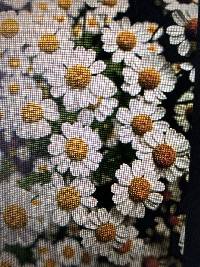
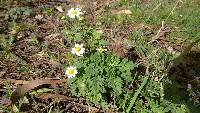
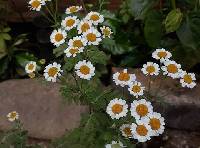
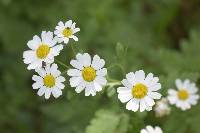
Tanacetum parthenium, known as feverfew, is a flowering plant in the daisy family, Asteraceae. It may be grown as an ornament, and may be identified by its synonyms, Chrysanthemum parthenium and Pyrethrum parthenium. Having its origin in the Balkans region, it is now distributed worldwide.
Although long used in traditional medicine, there is no clinical evidence that it has any therapeutic effects.
Description
The plant is a herbaceous perennial that grows into a small bush, up to 70 cm (28 in) high, with pungently-scented leaves. The leaves are light yellowish green, variously pinnatifid. The conspicuous daisy-like flowers are up to
Location and cultivation
Feverfew is native to Eurasia, specifically the Balkans, Anatolia, and the Caucasus, but cultivation has spread it around the world.
A perennial herb, it favors full sun 38 to 46 cm (15–18 in) apart. It grows up to 70 cm (28 in) tall. It is hardy to USDA zone 5 (−30 °C or −22 °F).
Outside of its native range, it may become an invasive weed.
Uses
Leaf of feverfew
The chemical structure of parthenolide
Phytochemicals found in feverfew include parthenolide, camphor, and the flavonoids luteolin, and apigenin. Feverfew has been used in traditional medicine, particularly in Europe, where it is mentioned in an herbal monograph as a safe compound. There is no clinical evidence for its use in treating migraines or any other clinical condition.
The parthenolide content of commercially available feverfew supplements varies substantially (by more than 40-fold) despite labeling claims of "standardization".
Long-term use of feverfew followed by abrupt discontinuation may induce a withdrawal syndrome featuring rebound headaches and muscle and joint pains. Feverfew may cause allergic reactions in those allergic to the daisy family, including contact dermatitis or swelling and numbness of the mouth. Other side effects have included gastrointestinal upset such as mild...